"Pay a 100% Tariff or Invest in the U.S."
Semiconductor Tariff Exemption Terms Disclosed in Taiwan Negotiations
Focus on Whether South Korea Will Receive Treatment No Less Favorable Than Taiwan in Future Talks
Howard Lutnick, U.S. Secretary of Commerce, warned on the 16th (local time) that major semiconductor-producing countries, including South Korea, could face a "100% semiconductor tariff" if they do not invest in the United States.
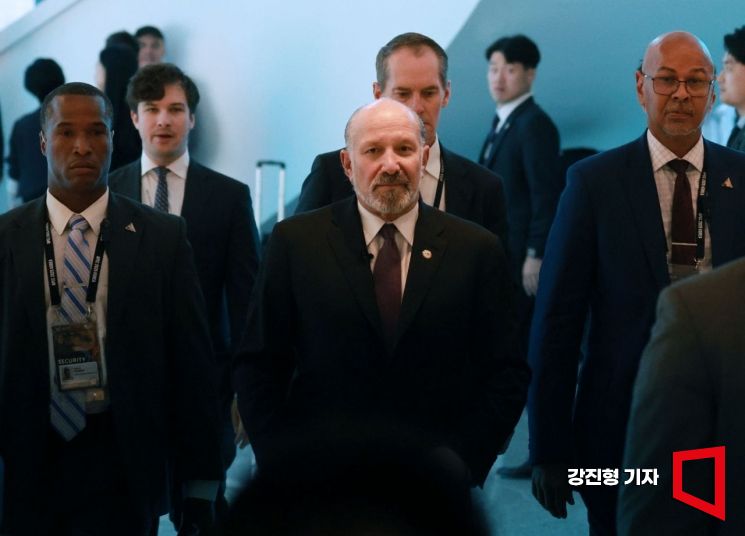 Howard Lutnick, U.S. Secretary of Commerce, is attending the Korea-U.S. Business Roundtable event at the Asia-Pacific Economic Cooperation (APEC) CEO Summit held at the Gyeongju Arts Center in Gyeongbuk on October 29, 2025. Photo by Kang Jinhyung
According to Bloomberg on this day, Secretary Lutnick told reporters at the groundbreaking ceremony for a new Micron plant near Syracuse, New York, that "everyone who wants to manufacture memory semiconductors has two choices: either pay a 100% tariff or produce in the United States."
Although Secretary Lutnick did not single out any specific companies, his remarks are interpreted as repeatedly suggesting the possibility of imposing a 100% tariff, given that South Korea is a major semiconductor-producing country.
The Donald Trump administration announced in August of last year its intention to impose a 100% tariff on all semiconductors entering the United States. However, it later decided to postpone the full implementation of tariffs and instead negotiate with exporting countries to reduce U.S. dependence on imported semiconductors.
In this context, the United States announced the results of a trade agreement with Taiwan the previous day and disclosed the conditions for "semiconductor tariff exemptions." The Trump administration decided that Taiwanese companies establishing new semiconductor production capacity in the United States would be exempt from tariffs on imports up to 2.5 times the new capacity while the facility is under construction. After completion, these companies would be able to import up to 1.5 times the new production capacity tariff-free.
These conditions for Taiwan are expected to serve as a benchmark in future Korea-U.S. semiconductor negotiations. Last year, South Korea and the United States concluded trade negotiations agreeing to apply a 15% tariff to most Korean products, but the semiconductor tariff plan was not finalized.
At that time, South Korea received a fundamental assurance that it would not be treated less favorably than its competitor, Taiwan.
This means that at least equal conditions to those offered to Taiwan, South Korea's main competitor, will be applied, and the specific implementation will be determined through negotiations with the United States.
© The Asia Business Daily(www.asiae.co.kr). All rights reserved.

















