Lee Hosts Luncheon with Ruling and Opposition Leaders on the 16th
People Power Party Leadership Absent
"Requesting Opposition Support for Diplomacy and Security"
Calls for Cooperation on Rationalizing Economic Criminal Penalties... "Concern
On January 16, President Lee Jaemyung hosted a luncheon meeting at Sangchunjae in the Blue House, inviting leaders from both the ruling and opposition parties. During the meeting, he emphasized that national unity is the highest priority in state governance. President Lee also called for bipartisan cooperation on diplomatic and security issues in the interest of the nation, requesting the opposition's support. He further discussed issues such as the Coupang personal information leak, the Homeplus corporate rehabilitation, and mass layoffs at GM Korea, agreeing that bipartisan cooperation is necessary to resolve these matters.
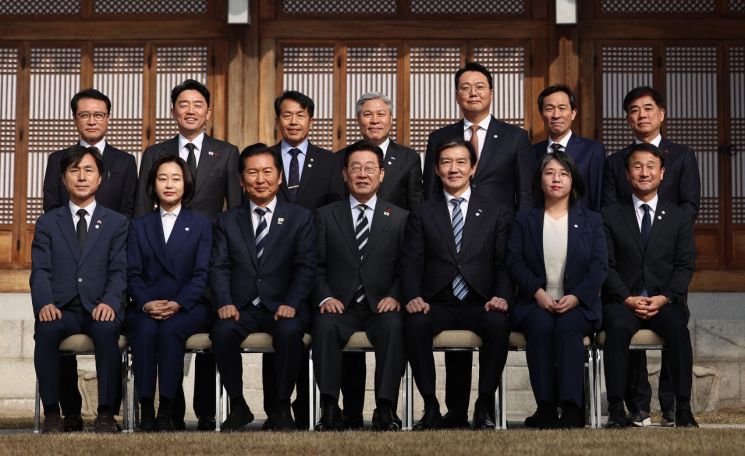
Attendees included Jeong Cheongrae, leader of the Democratic Party of Korea, and Han Byungdo, floor leader; Cho Kuk, leader of the Innovation Party, and Seo Wangjin, floor leader; Kim Jaeyeon, leader of the Progressive Party, and Yoon Jongoh, floor leader; Chun Haram, floor leader of the Reform Party; Yong Hyein, leader and floor leader of the Basic Income Party; and Han Changmin, leader and floor leader of the Social Democratic Party. From the Blue House, Kang Hoonshik, Chief of Staff; Woo Sangho, Senior Presidential Secretary for Political Affairs; Lee Guyoun, Senior Presidential Secretary for Public Relations and Communication; and Kim Byungwook, Presidential Secretary for Political Affairs, were present.
In his opening remarks, President Lee stated, "The role of the president makes national unity truly important. The people have a wide range of views and positions, and I am increasingly convinced that we need to make efforts to reflect all of them." He continued, "Since I am in a position to represent the entire nation, it would not be right to show only one side. I would appreciate it if the opposition leaders could show consideration and support as well."
Regarding foreign policy, he referenced his recent visits to China and Japan, saying, "I realized that the Republic of Korea is being evaluated very differently in terms of national stature." He added, "When considering the national interest and the international standing of all our people, we should do our best to unite our efforts in external relations. I want to emphasize once again the importance of working together on national security and diplomatic issues."
President Lee also called for cooperation on local autonomy and balanced regional development to resolve the concentration of power in the Seoul metropolitan area. He said, "Various problems are arising due to the dominance of the capital region. In particular, electricity issues have recently become an immediate constraint." He mentioned discussions regarding Gwangju-Jeonnam and Chungnam-Daejeon, noting, "The emergence of metropolitan cities could be advantageous in international competition and serve as a major catalyst for balanced regional development." He stated, "Whether it is financial aspects, the distribution of authority, or industrial allocation-especially the relocation of public institutions-we intend to guarantee the maximum possible incentives."
Jeong Cheongrae, leader of the Democratic Party of Korea, said, "Many people are applauding President Lee Jaemyung's diplomatic abilities, as he stands confidently alongside U.S. President Donald Trump and Chinese President Xi Jinping. I hope the president will continue to fully demonstrate his diplomatic skills, further elevating Korea's stature and ensuring that our national brand contributes positively to our export-driven economy."
Jeong went on to say, "The ultimate goal of diplomacy is to pursue the national interest. I hope all parties represented here will work together and cooperate across party lines." He also mentioned the resilience of 'K-democracy,' saying, "Just by normalizing the Republic of Korea, the KOSPI is now heading toward 5,000." Cho Kuk, leader of the Innovation Party, called for the swift realization of the 'Five Major Regions, Three Special Zones' strategy and proposed a single-point constitutional amendment to include local autonomy and balanced development provisions. Regarding prosecutorial reform, Cho referred to it as a 'once-in-a-lifetime opportunity' and expressed hope that it would be firmly concluded.
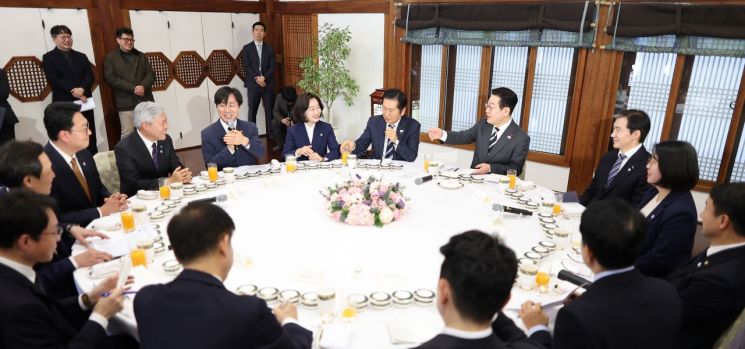
Kim Jaeyeon, leader of the Progressive Party, stated, "Now is the time for political reform," suggesting that discussions on political reform, including electoral system changes before local elections, should be initiated. She cited the upcoming implementation of the Yellow Envelope Act and the case of GM Korea, requesting the government's active role. She also emphasized the importance of democratic procedures, such as information disclosure and gathering residents' opinions, in the process of administrative integration. Chun Haram, floor leader of the Reform Party, said, "Even if there are differences of opinion in diplomacy and security, we will cooperate as much as possible for the national interest." He requested the exercise of the right to request reconsideration regarding the second comprehensive special prosecutor bill, arguing that some matters under the three major special prosecutors have been transferred to the National Investigation Headquarters, necessitating a change in investigative approach.
Yong Hyein, leader of the Basic Income Party, said, "The special prosecutor for the rebellion cannot be investigated by the police themselves, and the special prosecutor for Kim Keonhee was initiated because the prosecution did not conduct a proper investigation," stressing the need for a second comprehensive special prosecutor. She also called for the swift launch of the Basic Social Committee and highlighted the need for bold future investments during the era of artificial intelligence (AI) transformation. Han Changmin, leader of the Social Democratic Party, said that the second comprehensive special prosecutor is "not a matter of political strife, but a measure to correct history and restore democracy based on the truth." He also urged the advancement of political, tax, and prosecutorial reforms.
During the luncheon, President Lee also requested cooperation in rationalizing economic criminal penalties. Senior Secretary Lee Guyoun briefed at Chunchugwan, saying, "Our country has far more economic criminal penalties than most countries-three or four times more than typical advanced nations. There is a need to correct the practice of treating matters that could be resolved with fines or surcharges as criminal offenses." He added that rather than specifying particular systems or laws, the president's remarks were intended to share the seriousness of the issue with party leaders and seek directions for improvement.
Senior Secretary Lee further explained, "In particular, revising economic criminal penalties will require overhauling a vast number of laws, making the legislative process unavoidable. There were concerns raised during the discussion that if a filibuster is prolonged, institutional reforms could be delayed."
Meanwhile, it was reported that President Lee did not make specific comments regarding the prosecutorial reform bill, the second comprehensive special prosecutor bill, or Lee Hyehoon, the nominee for Minister of Planning and Budget. Currently, there are disagreements within the ruling party over the government’s bills to establish the Public Prosecution Office and the Serious Crimes Investigation Agency, while the People Power Party and the Reform Party strongly oppose the second special prosecutor bill. Regarding the nominee, various allegations have led to growing calls for voluntary withdrawal.
© The Asia Business Daily(www.asiae.co.kr). All rights reserved.
![Clutching a Stolen Dior Bag, Saying "I Hate Being Poor but Real"... The Grotesque Con of a "Human Knockoff" [Slate]](https://cwcontent.asiae.co.kr/asiaresize/183/2026021902243444107_1771435474.jpg)
















