Prime Minister Kim Minseok Announces Up to 5 Trillion Won in Annual Financial Support for Integrated Special City
Kang Gijung: "Entering an Era of a 25 Trillion Won Annual Budget...A Meaningful Shift"
Kim Youngrok: "A Mid- to Long-Term Financial Support System Needed for Integration Results"
Shin Junghoon: "Laying the Material Foundation for Integration Toward a Decentralized Nation"
Jung Junho: "Government Incentives Align with the Direction of the Special Act"
Min Hyungbae: "The National Assembly Must Provide Concrete Legislative Support"
As Prime Minister Kim Minseok officially announced large-scale financial support of up to 5 trillion won per year, and up to 20 trillion won over four years, for administratively integrated local governments, political circles in Gwangju and South Jeolla Province welcomed the decision in unison. As discussions on the launch of the Integrated Special City gain momentum, the government's announcement promising financial support and an elevation of status is being seen as a potential turning point for the future of the integration initiative.
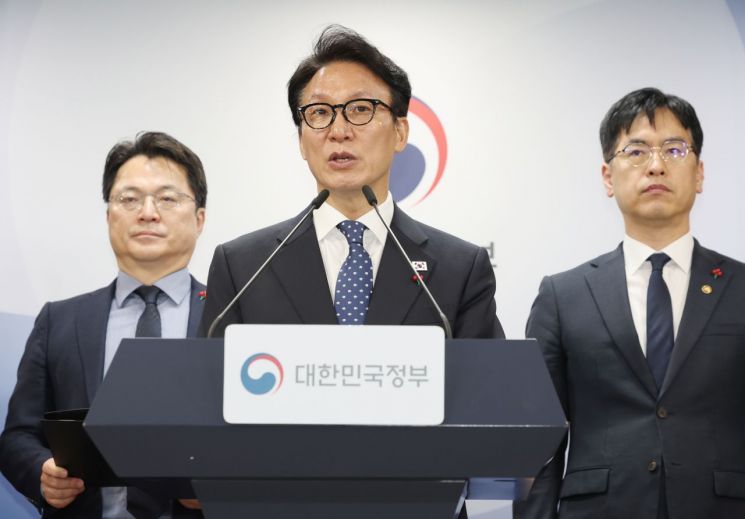 Prime Minister Kim Minseok is giving a briefing on administrative integration incentives at the Government Seoul Office in Jongno-gu, Seoul, on the 16th. Photo by Yonhap News
On the 16th, Prime Minister Kim Minseok held a briefing on "administrative integration incentives" at the Government Seoul Office, where he announced plans to provide up to 5 trillion won per year and up to 20 trillion won over four years in financial support for the Integrated Special City. The government also revealed its intention to introduce a so-called "administrative integration grant tax" and an "integration support fund" to supplement the special city's own finances, and to elevate the status of the Integrated Special City to a level comparable to that of Seoul. As a result, the special city mayor will have four vice mayors at the vice-ministerial level, and the government stated that the Integrated Special City would be given preferential treatment during the second round of public institution relocations scheduled for 2027.
Immediately following the government announcement, Gwangju Mayor Kang Gijung and South Jeolla Province Governor Kim Youngrok both expressed their welcome. Mayor Kang stated, "If we combine the annual government support of 5 trillion won with Gwangju's budget of 7.7 trillion won and South Jeolla's budget of 11.7 trillion won, we are entering an era of a 25 trillion won annual budget," adding, "This will be the third-largest budget in the country after Seoul and Gyeonggi Province." He went on to explain, "Since 2014, the Chungbuk-Cheongju integration has received 460 billion won, and since 2010, the Gyeongnam-Masan-Changwon-Jinhae integration has received about 440 billion won. While other regions have received around 400 billion won over more than a decade, Gwangju and South Jeolla will secure 5 trillion won at once."
Governor Kim stated, "We are grateful for the groundbreaking financial support of 20 trillion won over four years," but added, "To ensure this leads to tangible results that transform the region's structure, a stable financial support system must continue beyond the initial four years." He continued, "We strongly welcome the elevation of the Integrated Special City's status," and said, "We will work with the government to establish an administrative system with expertise and accountability, and to ensure that the work of special local administrative agencies is swiftly transferred."
The National Assembly also echoed the welcoming sentiment. Shin Junghoon, Chairman of the National Assembly's Public Administration and Security Committee, said, "We warmly welcome the support from the Lee Jaemyung administration," and added, "This financial support will serve as an important material foundation for the Gwangju-South Jeolla integration, the first local government to move toward a decentralized nation." However, he also stated, "While autonomy in financial management should be guaranteed to the greatest extent possible, it is desirable to clarify the purposes of the funds to prevent indiscriminate use."
Jung Junho, a lawmaker from the Democratic Party of Korea (Gwangju Buk-gu Gap), said, "The government's determination to overcome local crises, industrial base shortages, and population decline through integration at the metropolitan level has now been confirmed as a policy commitment," adding, "The direction of the incentives announced today aligns exactly with the objectives of the 'Gwangju-South Jeolla Administrative Integration Special Act' that I sponsored."
Min Hyungbae, a Democratic Party lawmaker (Gwangju Gwangsan-eul), said, "Now it is the National Assembly's turn to respond," adding, "The government has set the stage, so we must firmly support it with concrete legislation." He continued, "We will not miss out on a single practical benefit for Gwangju and South Jeolla," and stated, "I will ensure that even the bold provisions not included in the government's proposal are reflected in my special bill, and incorporated into the Democratic Party's special legislation."
© The Asia Business Daily(www.asiae.co.kr). All rights reserved.
![Clutching a Stolen Dior Bag, Saying "I Hate Being Poor but Real"... The Grotesque Con of a "Human Knockoff" [Slate]](https://cwcontent.asiae.co.kr/asiaresize/183/2026021902243444107_1771435474.jpg)
















