Jeonnam Institute of Marine and Fisheries Science Improves Seed Varieties
Rapid Growth and Increased Productivity Expected
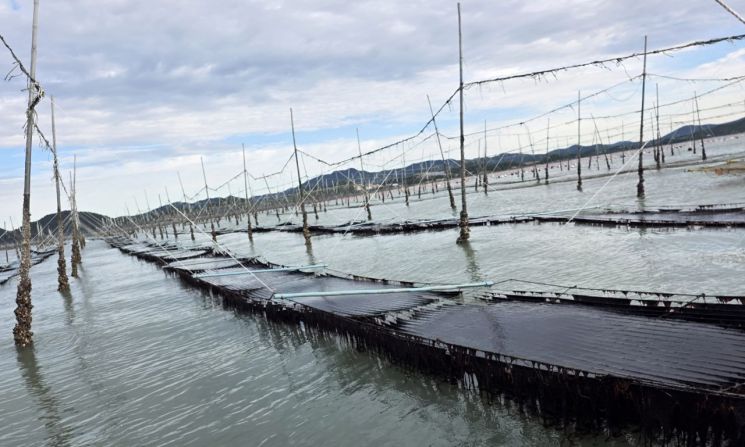
The Jeonnam Institute of Marine and Fisheries Science has completed the development of a new strain of Itbadi Dolgim (commonly known as Gopchang Gim) called "Haetbadi No. 2," which has been under development since 2021. The institute plans to apply for registration of this new variety with the National Fisheries Plant Variety Center this year.
Haetbadi No. 2 was developed over four years through the establishment of seed production technology, test cultivation, trait investigation, and selective breeding. Compared to conventional Itbadi Dolgim, this new variety is characterized by a higher rate of seed pouch (carposporangium) formation and maturity, as well as a greater release of seeds (carpospores), resulting in a higher number of seeds attaching to the nets. It also grows faster and has stronger roots adhering to the nets, which is expected to boost overall yield.
Furthermore, even when compared to "Haetbadi No. 1," another variety developed by the Jeonnam Institute of Marine and Fisheries Science that has received high praise from fishers, Haetbadi No. 2 is equally competitive in terms of quality. Its leaves grow longer and thinner, making it suitable for producing high-quality Gopchang Gim.
Itbadi Dolgim is an indigenous Korean seaweed variety known for its excellent taste and quality, making it a preferred choice among both consumers and producers. Among seaweed aquaculture varieties, it is harvested the earliest, between October and December. Its long, thin, and curly shape resembles beef intestines, hence the nickname "Gopchang Gim." It is currently the highest-priced, high value-added seaweed variety in cultivation, mainly farmed in the Jeonnam region.
Of the 925,000 nets of seaweed facilities in Jeonnam for the 2025 harvest, Itbadi Dolgim accounted for 250,000 nets, representing 26.3%. Out of the total production of 539,000 tons, 23,000 tons (4.3%) were Itbadi Dolgim, and it accounted for 103.5 billion won (12.3%) out of the total production value of 840.8 billion won, highlighting its significant economic impact.
However, Itbadi Dolgim has faced criticism for its low seed formation rate and the difficulty of attaching seeds to the nets, resulting in large fluctuations in yield. Additionally, yields vary greatly depending on ocean conditions, making cultivation challenging. Haetbadi No. 2 was developed to address these shortcomings.
The Institute plans to begin mass seed production of the new variety for distribution to fishers cultivating Itbadi Dolgim, in parallel with the application for Haetbadi No. 2's variety registration. For official registration, the Fisheries Plant Variety Center requires a two-year cultivation review to assess novelty and safety, so cultivation trials will also be conducted.
A restoration project for the endangered native "Chamgim" is also underway. After collecting seedlings in mid-October 2025, test cultivation was carried out at four locations-two in Haenam, one in Gangjin, and one in Yeosu. The leaves grew to about 10 cm, confirming the potential for aquaculture. The plan is to develop native Chamgim as a new variety and promote it as a high value-added seaweed, historically presented to royalty.
Kim Chungnam, Director of the Jeonnam Institute of Marine and Fisheries Science, stated, "We will continue to focus on developing varieties suited to local characteristics so that the seaweed aquaculture industry can continue to grow despite rapidly changing marine environments. We ask for the interest and cooperation of seaweed farmers to develop varieties that are highly practical in the field."
© The Asia Business Daily(www.asiae.co.kr). All rights reserved.
![Clutching a Stolen Dior Bag, Saying "I Hate Being Poor but Real"... The Grotesque Con of a "Human Knockoff" [Slate]](https://cwcontent.asiae.co.kr/asiaresize/183/2026021902243444107_1771435474.jpg)















