Just Two Days After Returning from the Korea-Japan Summit
Taro Aso Visits Korea for Forum, Meets President Lee at the Blue House
President Lee Expected to Broaden Dialogue Channels to Japan's Ruling Party
Aso's Role in Korea-Japan Relations Is Tw
On the afternoon of January 16, President Lee Jaemyung will meet with Taro Aso, Deputy President of Japan's ruling Liberal Democratic Party and former Prime Minister, at the Blue House. Taro Aso is regarded as the most influential politician behind the rise of Prime Minister Sanae Takaichi and holds the position of the Liberal Democratic Party's 'number two,' making him a senior figure with significant clout. He is considered someone capable of activating party and senior politician channels between Korea and Japan, separate from official government diplomacy. Given that this meeting takes place immediately after the Korea-Japan summit held in Nara Prefecture, Japan, on January 13-14, it carries a strong character of follow-up diplomacy with Japan.
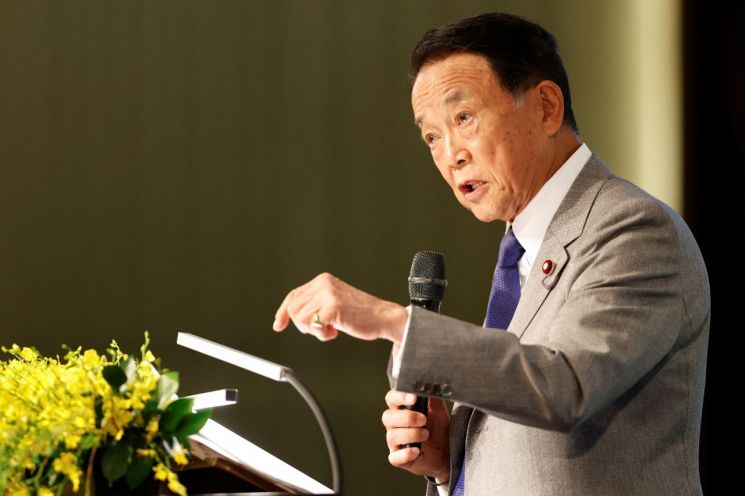
According to the Blue House, Taro Aso is visiting Korea to attend a forum hosted in Seoul by the Nakasone Peace Institute (NPI), a conservative senior group think tank in Japan. On this occasion, he will meet with President Lee. Last November, he attempted to arrange a meeting with President Lee during his visit to Jeju Island for the Korea-Japan Cooperation Committee joint general meeting, but the meeting did not take place.
The position of Deputy President of the Liberal Democratic Party is the highest-ranking post assisting the party president, typically held by a senior figure with both symbolic and practical influence in Japanese politics. In this meeting, Taro Aso plans to support the development of Korea-Japan relations by building trust in various areas, including the economy, security, culture, and historical issues, while fostering deeper, multi-layered trust between the two countries.
Taro Aso's role in Korea-Japan relations has been twofold. In 2019, when tensions over forced labor and historical issues were escalating, he made his presence felt with hardline remarks, publicly mentioning the possibility of retaliatory measures such as tariffs, suspension of remittances, and visa issuance restrictions against Korea. At the same time, he has served as a 'bridge' in private diplomatic channels. As chairman of the Korea-Japan Cooperation Committee, he has led dialogue between senior political and business figures from both countries.
Through this meeting, President Lee is expected to use the opportunity to manage issues that are difficult to resolve through summits alone by expanding the scope to include Japan's ruling party. In their recent summit, President Lee and Prime Minister Takaichi agreed to jointly pursue DNA testing to confirm the identities of remains recovered from the Josei coal mine, opening the door to addressing sensitive historical issues alongside discussions on economic security and technological cooperation.
In particular, since Taro Aso played a key role in the launch of the Takaichi administration, his support for improving Korea-Japan relations could accelerate working-level discussions on sensitive issues. Topics discussed at the summit, such as Korea's accession to the Comprehensive and Progressive Agreement for Trans-Pacific Partnership (CPTPP), regulations on imports of Japanese seafood, and cooperation on North Korea, are complex and require practical consultations and momentum. The meeting with Taro Aso is expected to provide political backing for these follow-up adjustments.
However, as a conservative 'senior power broker,' Taro Aso has previously made controversial statements with an eye on Japanese public opinion, so there is a cautious view that this meeting should be seen as separate from the summit-level discussions. In 2023, Taro Aso sparked controversy by telling Japanese lawmakers about his conversation with former President Yoon Suk-yeol, saying, "Most former Korean presidents are either killed or arrested after their five-year term."
© The Asia Business Daily(www.asiae.co.kr). All rights reserved.
![Clutching a Stolen Dior Bag, Saying "I Hate Being Poor but Real"... The Grotesque Con of a "Human Knockoff" [Slate]](https://cwcontent.asiae.co.kr/asiaresize/183/2026021902243444107_1771435474.jpg)















