Changwon Hits 19°C, Daegu 18°C: Record-High January Temperatures
KMA: "Influx of Warm Southwesterly Winds Raises Daytime Temperatures"
On January 15, some regions in the southern part of the country recorded the highest January temperatures since weather observations began, with temperatures approaching 20 degrees Celsius. The main reason cited for the rise in temperature was the influx of warm southwesterly winds.
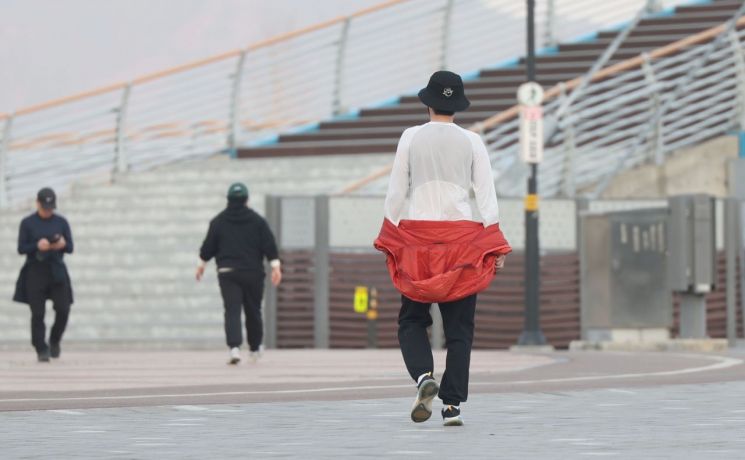 On the afternoon of the 15th, when the highest daytime temperature in Changwon, Gyeongnam, rose to 19 degrees Celsius, citizens were seen walking in light clothing. Photo by Yonhap News Agency
According to the Korea Meteorological Administration, as of 3 p.m. on this day, the temperature in Changwon, Gyeongnam, rose to 19 degrees Celsius. Despite being mid-January, this temperature, which nearly reached 20 degrees Celsius, marks the highest January temperature recorded in Changwon since weather observations began there on July 1, 1985.
In Daegu, the highest daytime temperature reached 18 degrees Celsius, breaking the previous record for the highest January temperature since weather observations began there on January 31, 1907. The previous record was 16.5 degrees Celsius, set on January 15, 2002, making this year's temperature 1.5 degrees higher.
Busan, one of the locations with the longest history of modern weather observations in Korea, dating back to April 1904, also saw temperatures rise to 18.3 degrees Celsius on this day. This became the second-highest January temperature ever recorded in Busan.
Regions that set new January temperature records on this day include: Gimhae (18.9°C), Miryang (18.9°C), Hapcheon (18.6°C), and Sancheong (18.4°C) in Gyeongnam; Pohang (17°C) and Yeongcheon (17.2°C) in Gyeongbuk; and Boseong (18.3°C) and Goheung (17.8°C) in Jeonnam.
Areas that recorded the second-highest January temperatures include: Jinju (18.3°C), Yangsan (18.3°C), and Gyeongju (18.4°C) in Gyeongnam; Suncheon (17.7°C), Gangjin (16.8°C), Jangheung (17.6°C), and Gwangyang (18.2°C) in Jeonnam; and Imsil (15.6°C) in Jeonbuk.
The significant rise in daytime temperatures across Gyeongsang, Jeolla, and Jeju in the southern regions was largely attributed to the inflow of warm southwesterly winds. The main factor was the southwesterly wind blowing along the edge of a migratory anticyclone, which brought warm air from the Shanghai area in China. Additionally, clear skies under the influence of high pressure led to abundant sunshine, further contributing to the rise in temperature.
This week, temperatures are expected to remain above average. However, on Tuesday the 20th, cold air from the north is forecast to move in, causing a sharp drop in temperatures and bringing a cold snap throughout next week.
© The Asia Business Daily(www.asiae.co.kr). All rights reserved.
![Clutching a Stolen Dior Bag, Saying "I Hate Being Poor but Real"... The Grotesque Con of a "Human Knockoff" [Slate]](https://cwcontent.asiae.co.kr/asiaresize/183/2026021902243444107_1771435474.jpg)
















