Tax Exemption on Youth Future Savings Account Interest Extended Up to Age 40
Jointly Owned Single-Home Couples Now Allowed to Choose Taxpayer
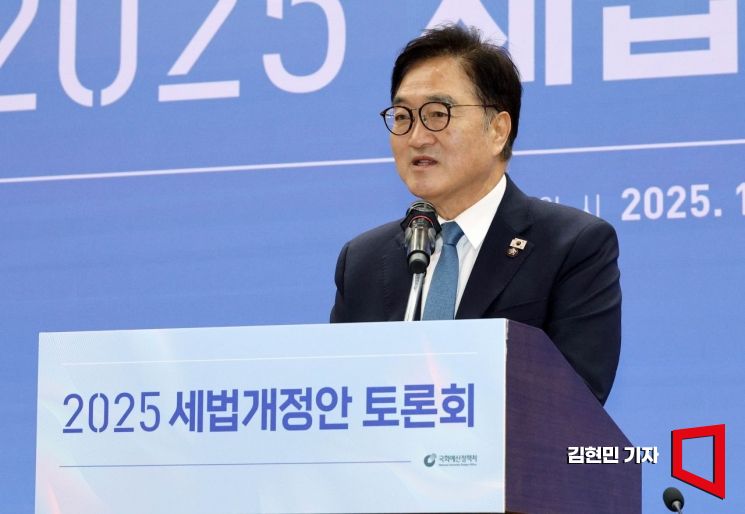 Woo Wonshik, Speaker of the National Assembly, is delivering an encouragement speech at the 2025 Tax Law Revision Bill discussion held at the National Assembly on the 10th. 2025.11.10 Photo by Kim Hyunmin
Going forward, factory workers and beauty service professionals earning an annual salary of 37 million won or less will be eligible for tax exemption on night shift allowances. The tax exemption on interest income for the new Youth Future Savings Account, which will be launched this year, will also be extended to men up to the age of 40. In addition, the tax burden on low-alcohol mixed beverages such as highballs will be significantly reduced.
On January 16, the Ministry of Economy and Finance announced the “2025 Tax Reform Follow-up Enforcement Decree Amendment” containing these measures. First, the scope of tax exemption for night shift allowances will be expanded. The current system exempts income tax on overtime and night shift allowances for factory and mine workers, fishery workers, and service industry workers in fields such as beauty and accommodation, provided their monthly salary and annual income are below certain thresholds. The new amendment will ease these thresholds, raising the annual income limit from 30 million won to 37 million won, and the monthly fixed salary limit from 2.1 million won to 2.6 million won. As a result, eligible workers will be able to receive additional income from night and overtime work without any tax burden.
The eligibility for tax exemption on interest income from the Youth Future Savings Account, which will be launched in June this year, will also be greatly expanded. Initially, only young people aged 34 or younger (with a total annual salary of 75 million won or less, or comprehensive income of 63 million won or less) were eligible for the tax exemption. However, if an individual was 34 or younger as of December 31 of last year, they will be allowed to enroll in the product even if they are over 34 at the time of its launch in June this year. Furthermore, by excluding up to six years of military service from age calculations, men will be able to benefit from tax exemption on interest income from the Youth Future Savings Account until the age of 40. The intent is to significantly expand asset-building opportunities for young people.
In the alcoholic beverage sector, which has a high impact on consumers, a new liquor tax reduction will be introduced for low-alcohol mixed drinks such as highballs. The reduction rate is 30%, and it will be applied temporarily from April 1, 2026, to December 31, 2028. The drinks eligible for this reduction, as finalized in the new enforcement decree, are those with an alcohol content of 8.5% or less and a non-volatile solids content of 2% or more. Non-volatile solids refer to ingredients that do not evaporate, excluding water and alcohol, and typically mean sugar content and similar substances.
Until now, low-alcohol mixed drinks such as highballs have been taxed at a liquor tax rate of 72% based on price, the same as distilled spirits like soju and whiskey. While beer and takju (unrefined rice wine) are taxed based on volume, mixed drinks have been taxed based on price, making it difficult for manufacturers to remain competitive. The government expects that by reducing the tax burden on low-alcohol beverages through this tax reduction, consumer prices could drop by about 15%.
In real estate taxation, the right to choose the taxpayer for a single home jointly owned by a married couple has been expanded. Previously, for jointly owned homes, the spouse with the larger share automatically became the taxpayer. For example, in a 51-to-49 share, the spouse with 51% was required to pay the tax. Under the revised rules, couples can now agree to choose the taxpayer regardless of share ratio.
Even if one spouse acquires another home through inheritance or other means, the couple can maintain the single-homeowner status by designating the spouse who owns only one home as the taxpayer. As a result, key tax benefits such as the 1.2 billion won basic deduction and the elderly and long-term holding tax credits (up to 80%) can continue to be applied. Cho Manhee, Director General of the Tax Policy Bureau, explained, “If a person holding a 51% share in their current home inherits another home, designating their spouse as the taxpayer for the comprehensive real estate tax allows the spouse to receive the single-homeowner tax benefits.”
© The Asia Business Daily(www.asiae.co.kr). All rights reserved.

















