There have been calls for a comprehensive overhaul of the corporate disclosure system. The argument is that disclosures should move beyond being a mere formality and instead enhance their substance, so that boards of directors can demonstrate how they have fulfilled their fiduciary duty to shareholders.
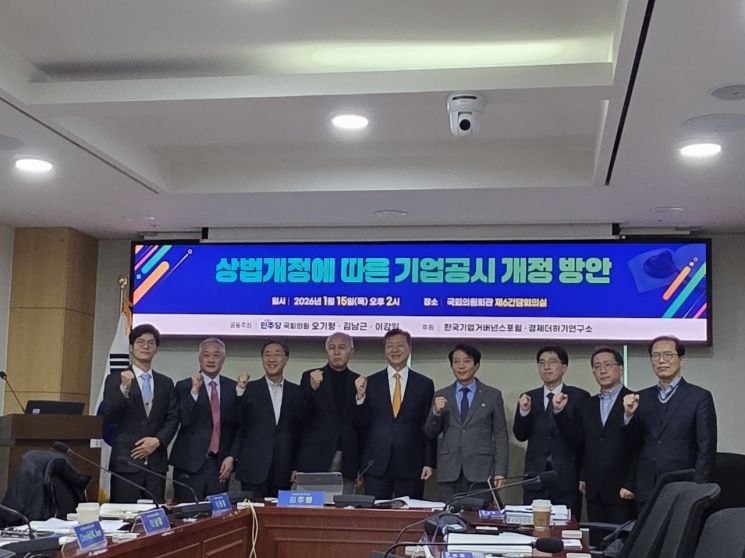
On January 15, a forum titled "Corporate Disclosure Reform Plans Following Amendments to the Commercial Act" was held at the National Assembly Members' Office Building. The forum was co-hosted by Democratic Party lawmakers Oh Ki-hyung, Kim Namgeun, and Lee Kangil, and sponsored by the Korea Corporate Governance Forum and the Economy Plus Research Institute.
Lee Yongwoo, CEO of the Economy Plus Research Institute, who presented at the event, identified several issues with Korea's corporate disclosure system: the formalistic disclosure practices, the timeliness of disclosures, lack of effectiveness in supervision and sanctions, insufficient ESG non-financial disclosures, and the dual structure of the disclosure delivery system. Lee pointed out, "The biggest challenge for foreign investors in Korea is that, even after reading the disclosed information, they cannot understand the rationale behind certain decisions," adding, "Disclosures are being made as a formality."
He emphasized, "Disclosure forms should be revised so that they provide substantial grounds for determining how the board of directors has fulfilled its fiduciary duty to shareholders and whether sufficient information has been provided to shareholders, in accordance with the Commercial Act."
Lee further stressed the need to revise disclosures in nine specific areas: corporate governance, dividends, executive compensation, transactions with major shareholders, mergers, paid-in capital increases, stock-related bonds, treasury stock, and acquisition of shares in other companies. However, he added, "Items that require amendments to legal provisions cannot be changed solely by revising disclosure form preparation standards," and emphasized, "Legal amendments must come first."
Attorney Yoon Sangnyeong, who participated as a panelist, emphasized the need to disclose Capital Cost of Equity (COE) in management analysis and opinions by directors. COE refers to the cost of capital and represents the minimum required return for shareholders. Yoon stated, "From a long-term perspective, management has a duty to achieve a return on equity (ROE) higher than the cost of equity (COE). If ROE falls below COE, capital should be returned to shareholders."
He also pointed out the lack of awareness of COE among management. "Even when shareholders demand COE awareness to enhance corporate value, most executives at listed companies in Korea lack even a basic understanding of the concept," he explained, "or they show a clear tendency to simply accumulate assets."
In addition, Yoon stated that corporate disclosures should be revised to strengthen internal control responsibilities, reinforce shareholder rights under the Commercial Act, impose sanctions on cross-shareholding, and require fair value assessment of investment properties.
However, there were also opinions that, as the burden on companies is expected to increase, it is important to prepare support measures. Kim Choon, Director of Policy Division 1 at the Korea Listed Companies Association, said, "There is a significant gap between the board system and its actual operation, as well as between large corporations and mid-sized or small companies," adding, "While disclosure is important, it is also crucial to establish a practical foundation that enables these changes to be implemented."
© The Asia Business Daily(www.asiae.co.kr). All rights reserved.
![Clutching a Stolen Dior Bag, Saying "I Hate Being Poor but Real"... The Grotesque Con of a "Human Knockoff" [Slate]](https://cwcontent.asiae.co.kr/asiaresize/183/2026021902243444107_1771435474.jpg)















