Bold Fiscal Expansion and Special Delegation of Authority
Discussing a New Model for Region-Led Growth
Future Growth Engines: AI, Energy, and Culture
Public Discussion on Medical School, National Industrial Complex, and More
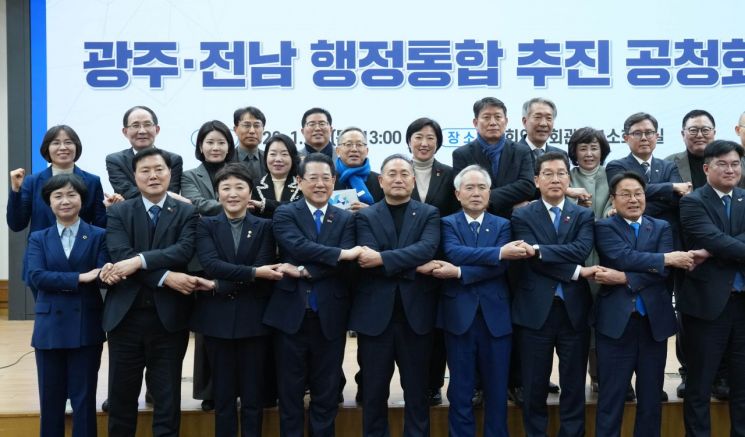 Kim Youngrok, Governor of Jeollanam-do, is taking a commemorative photo with attendees at the "Gwangju-Jeonnam Administrative Integration Promotion Public Hearing" held on the 15th at the National Assembly Members' Office Building in Seoul. Provided by Jeonnam Province
On January 15, Jeollanam-do and Gwangju Metropolitan City held a public hearing on the promotion of administrative integration between Gwangju and Jeonnam at the National Assembly Members' Office Building, providing a broad forum for public discussion on the background, justification, and future direction of the integration initiative.
This public hearing was jointly organized by the Special Committee for Gwangju-Jeonnam Integration Promotion of the Democratic Party of Korea, Jeollanam-do, and Gwangju City, with attendees including Kim Youngrok, Governor of Jeollanam-do, as well as National Assembly members Yang Bunam, Kim Woni, and An Dogeol.
The hearing was chaired by Kim Youngsun, President of the Jeonnam Research Institute, and featured panelists from the Jeonnam Research Institute, the Gwangju Research Institute, academia, and legislative support organizations of the National Assembly, who presented a variety of perspectives on administrative integration.
National Assembly member An Dogeol, who delivered the keynote presentation, pointed out that Gwangju and Jeonnam have seen their regional growth foundations continuously weakened due to population decline and increasing concentration in the Seoul metropolitan area. He emphasized the need to foster future strategic industries such as AI and energy, and to establish a region-led growth system through the integration of administrative, industrial, and living spheres on a wide-area basis.
In his opening remarks, Governor Kim stated, "With the strong commitment of President Lee Jaemyung's administration, the surge in public support for integration following the attraction of a global AI data center, and the powerful momentum from the party level, we now have the optimal environment to accelerate administrative integration." He added, "The key to the success or failure of administrative integration lies in institutionalizing bold fiscal expansion and the robust delegation of authority."
He further stressed, "A fiscal structure that returns the fruits of regional economic activities back to the region, along with real authority to foster future growth engines for Gwangju and Jeonnam, such as AI, energy, and culture, must be ensured."
He also noted, "In order to create a structure that attracts businesses and increases youth employment, we must calmly discuss necessary special provisions, the establishment of a medical school, and the creation of a national industrial complex following the relocation of the airport, which are longstanding regional challenges."
Governor Kim remarked, "As the government has declared this year as the first year of Korea's great leap forward and presented region-led growth as a core task, administrative integration must also proceed in that direction." He added, "We will continue discussions at a rapid pace, but will also listen more deeply to the voices of residents through upcoming county-level public hearings, and achieve integration based on social consensus."
During the comprehensive discussion, various issues were debated, including maintaining the identity of existing cities after integration, preventing the marginalization of rural, fishing, and agricultural communities, enhancing tangible benefits for residents, ensuring administrative stability, and the need for a phased approach. Participants agreed on the importance of pursuing integration through sufficient collection of opinions and deliberation.
Jeollanam-do and Gwangju City plan to use this National Assembly public hearing as a starting point to gather a wide range of local opinions through a series of county-level public hearings and briefing sessions, and to expand social consensus on administrative integration.
In addition, they intend to continue communicating with the National Assembly to ensure that local voices are faithfully reflected in the institutionalization process moving forward.
© The Asia Business Daily(www.asiae.co.kr). All rights reserved.
![Clutching a Stolen Dior Bag, Saying "I Hate Being Poor but Real"... The Grotesque Con of a "Human Knockoff" [Slate]](https://cwcontent.asiae.co.kr/asiaresize/183/2026021902243444107_1771435474.jpg)















