Trump Imposes 25% Tariff
Korean Semiconductor Industry: "More of a Threat Than a Real Change"
"Burden on U.S. Firms, Actual Impact Unclear"
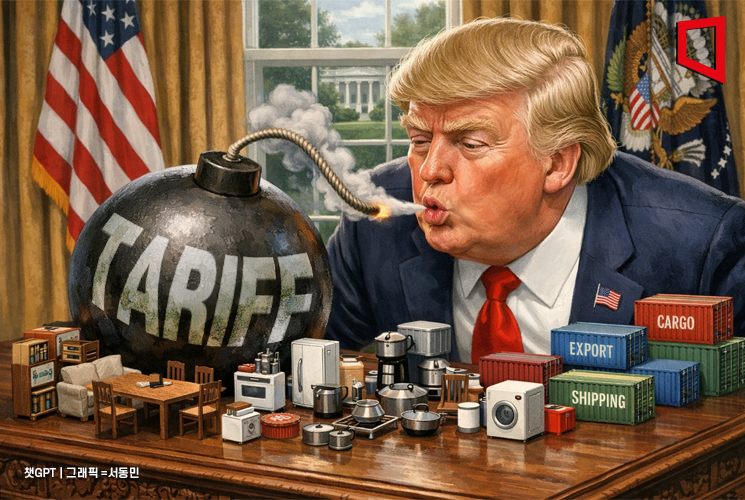
Tensions are once again rising in the semiconductor industry after U.S. President Donald Trump signed a proclamation imposing a 25% tariff on semiconductors and related derivative products. While the administration claims the move is aimed at strengthening America's semiconductor manufacturing capabilities, industry insiders have questioned both the actual scope and effectiveness of the measure, calling it unrealistic.
On January 14 (local time), President Trump announced that, under Section 232 of the Trade Expansion Act, a 25% tariff would be imposed on semiconductors, semiconductor manufacturing equipment, and their derivative imports, with the exception of products that contribute to strengthening U.S. data centers and semiconductor manufacturing capacity. The tariff will apply to goods imported or shipped for consumption starting from 12:01 a.m. Eastern Time on January 15.
Industry sources say this measure is more of a message that increases uncertainty rather than a step that will fundamentally change the market structure. One industry insider commented, "While there is no immediate impact, the industry is watching closely out of concern that the situation could escalate further."
Within the industry, the announcement is being interpreted as a move specifically targeting AI (artificial intelligence) accelerators exported to China. Given the logistics structure, where re-exports to third countries via the U.S. are under scrutiny, the only realistic items affected are AI accelerators. Another industry official explained, "Although specific items were not named, considering the logistics flow, it is natural to see this as a statement aimed at AI accelerators. Outside the U.S., China is essentially the only customer base for these products."
Considering that the U.S. government has recently shown some willingness to permit exports of AI accelerators to China, this move could be interpreted as a signal to leave a certain 'hurdle' rather than a complete ban. President Trump previously announced in December last year that exports of the H200 to China would be permitted. An industry insider noted, "It appears to be a kind of check-allowing exports while still imposing a burden. It seems like an attempt to induce AI accelerators bound for China to pass through the U.S."
However, the consensus is that the direct impact on the domestic semiconductor industry, especially the memory sector, will be limited. This is because there is virtually no logistics structure in which semiconductors produced in Korea are routed through the U.S. to China, and memory semiconductors follow the same pattern. The proportion of direct exports of Korean semiconductors to the U.S. is also low, making it unlikely that the new tariffs will be directly applied.
Nevertheless, there are lingering concerns about potential indirect effects. If the tariffs do become an actual burden for semiconductor companies, there is a possibility that cost pressures could be passed on to component suppliers. An industry insider said, "If the 25% tariff is implemented, AI accelerator companies will inevitably face increased costs, which could lead to pressure to lower component prices."
Despite this, there is widespread skepticism in the industry about the practicality of the measure itself. Imposing tariffs when supply cannot keep up with demand does not align with market logic, and major U.S. companies such as Nvidia, Google, and Broadcom would also be directly affected. One insider remarked, "Because the structure would place a burden on domestic companies, it will be difficult to actually implement."
© The Asia Business Daily(www.asiae.co.kr). All rights reserved.

















