Surpassing $70 Billion for Three Consecutive Years
Record-High Exports of Both Eco-Friendly and Used Vehicles
Domestic Sales Reach 1.68 Million Units, with Eco-Friendly Cars Accounting for 48%
Electric Vehicle Sales Up 52%
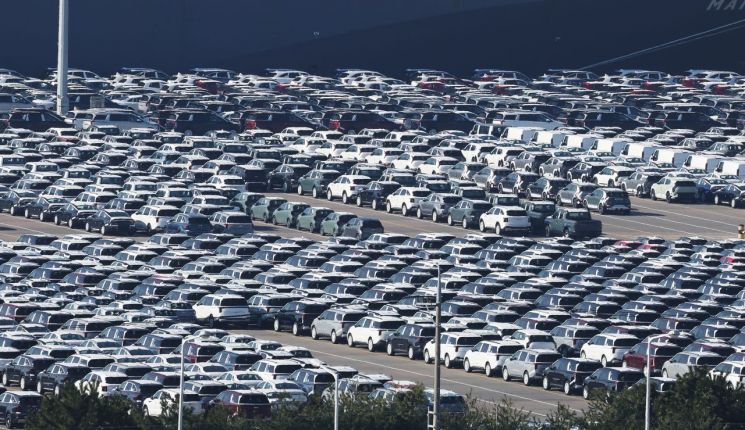
Last year, South Korea's automobile exports reached a record high of 72 billion dollars.
According to the Ministry of Trade, Industry and Energy on January 15, 2025, total automobile exports surpassed the previous record of 70.9 billion dollars set in 2023, achieving the highest figure ever and exceeding 70 billion dollars for the third consecutive year.
Exports of eco-friendly vehicles totaled 25.8 billion dollars, an 11% increase from the previous year. In particular, hybrid vehicle exports reached 14.8 billion dollars, setting a new record and driving overall growth. Used car exports also soared by 75.1% year-on-year to 8.8 billion dollars, marking an all-time high.
Domestic demand and production were also strong. In 2025, domestic automobile production reached 4.1 million units, surpassing 4 million units for the third consecutive year, with 2.74 million units (67%) exported overseas. The domestic new car sales volume was 1.68 million units, a 3.3% increase from the previous year, with eco-friendly vehicles accounting for 810,000 units (48%). Electric vehicle sales reached 216,000 units, up 52% from the previous year.
However, while annual exports increased overall, there were divergent trends by region. Due to U.S. tariffs, exports to North America fell by 13.2%, while exports to the European Union and Asia rose by 20.1% and 31.9%, respectively, compared to the previous year.
The Ministry of Trade, Industry and Energy explained that, in a situation where the industry faced a potential crisis due to U.S. automobile tariffs, measures such as the "Strategy to Strengthen Competitiveness in Eco-Friendly Vehicles and Secondary Batteries," "Emergency Response Plan to U.S. Auto Tariffs," and "Follow-up Support Measures for Tariff Negotiations" helped mitigate uncertainties and contributed to these results.
Regarding the outlook for next year, the ministry assessed that "challenges are expected due to the spread of global protectionism, expansion of local production, and intensifying competition with major countries."
Accordingly, the government plans to maintain export momentum through AI-based manufacturing innovation and the implementation of the "K-Mobility Leading Strategy." This strategy aims to: ▲ become a global leader in autonomous driving technology by 2030 ▲ achieve a 90% share of eco-friendly vehicles in new car sales by 2035 ▲ train 70,000 future mobility specialists ▲ foster 200 specialized companies.
© The Asia Business Daily(www.asiae.co.kr). All rights reserved.
![Clutching a Stolen Dior Bag, Saying "I Hate Being Poor but Real"... The Grotesque Con of a "Human Knockoff" [Slate]](https://cwcontent.asiae.co.kr/asiaresize/183/2026021902243444107_1771435474.jpg)
















