National AI Strategy Committee Holds Two-Hour Open Roundtable
Debate Between Both Sides Over Use of Copyrighted Works as Training Data
Government to Pursue Copyright Act Revision by Second Quarter and Foster Creators
On January 15, a roundtable was held to hear the perspectives of both the AI industry and copyright holders regarding the use of copyrighted works in the era of artificial intelligence (AI). The National AI Strategy Committee, the country's highest-level AI policy body, hosted the "AI Strategy Committee and Copyright-Related Association Meeting" at Seoul Square in Jung-gu, Seoul, on this day.
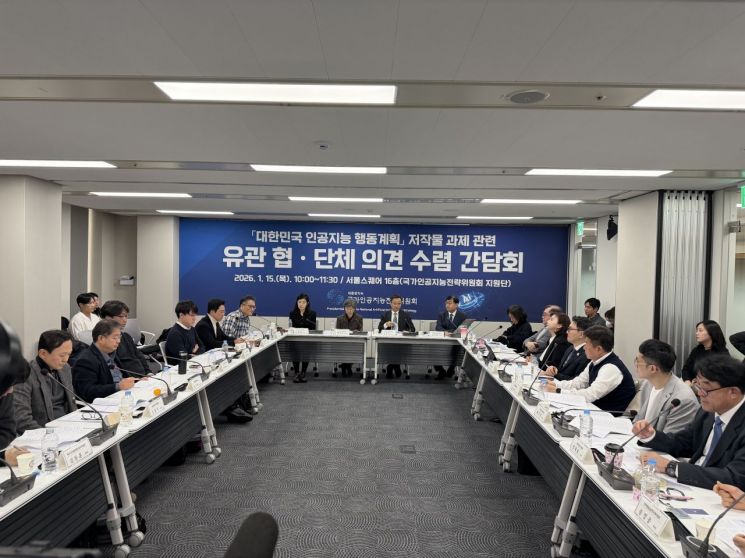 The National AI Strategy Committee held the "AI Strategy Committee and Copyright-Related Association Meeting" on the 15th at Seoul Square in Jung-gu, Seoul. Photo by Kim Bokyung
This event was organized to explain and gather feedback on copyright-related tasks outlined in the "Korea AI Action Plan," which the National AI Strategy Committee released in December of last year. Copyright issues are broadly categorized into three areas: cases where there is a transaction market, cases where there is no transaction market, and the promotion of fair use.
The committee clarified that the "use first, compensate later" principle does not apply to works with clear copyright holders and established transaction markets. This category includes works such as news, publications, newspapers, music, and videos, which are managed by trust management organizations and are traded in the market. The committee stated that it has established the principle of "government support to promote transactions based on prior consultation" for these works.
In cases where the copyright holder is unclear or there is no transaction market, the committee will pursue the following: support for the exercise of the copyright holder's right to refuse, promotion of third-party use for works where the right to refuse has not been exercised, and support for the creation of transaction markets. Baek Eunok, Head of the Data Division at the National AI Strategy Committee, explained, "The goal is to address the factors that prevent the activation of transactions in cases where the copyright holder is unclear, such as online posts or works with unknown authors, or where there is no trust management organization."
The committee also stated that when the use of copyrighted works contributes to the expansion of the AI ecosystem and the public interest, these works should be subject to fair use to promote their utilization. As an example, the "independent AI foundation model" project promoted by the Ministry of Science and ICT was mentioned.
"AI Development Should Not Be Premised on Copyright Holders' Sacrifice"... Call for Fair Use Standards
Copyright-related associations emphasized the need to clearly establish principles for protecting copyright holders to ensure sustainable growth. They also stated that prior discussions with copyright holders are necessary for the fair use system and that the proper value of copyrighted works should be recognized.
Shin Hansoo, Chairman of the Digital Council at the Korea Newspaper Association, said, "Data is the private property of copyright holders. Only by establishing clear principles and standards for the protection of copyright holders' rights can a sustainable AI ecosystem be created. The protection of copyright holders' rights should be treated and discussed as importantly as technological development."
Kim Siyul, Executive Director of the Korean Publishers Association, argued that the development of AI should not be premised on the sacrifice of copyright holders, and pointed out that the opinions of copyright holders have not been sufficiently reflected in discussions on fair use thus far. He also emphasized the need for proper compensation for data and the activation of transactions.
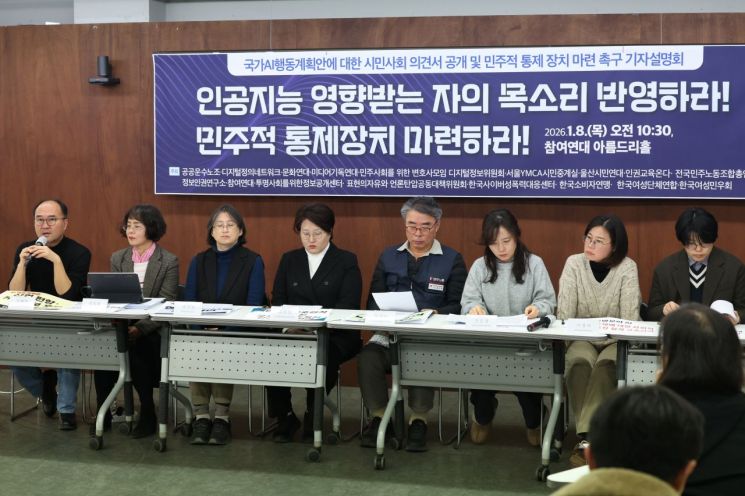
Jung Jaehong, Director of the Korea Broadcasting Writers Association, criticized, "Fair use is being used as a pretext to utilize assets stored in my own vault. If fair use is implemented without being clearly legislated, copyright holders will inevitably be sacrificed."
Song Youngwoong, Director of the Korea Broadcasting Performers' Rights Association, stated that even if the government introduces a TDM exemption clause (Text Data Mining, which conditionally allows automated analysis and learning of data that can be legally accessed), balanced legislation with copyright holders is necessary.
The Industry Stresses "AI Is a Race Against Time"... Need to Secure Technological Sovereignty
The industry, which needs to foster the AI sector and ecosystem by utilizing copyrighted works as training data, emphasized that now is the golden time to secure technological sovereignty in AI, and stressed the importance of swiftly resolving copyright disputes and fostering the industry.
Park Yeonjeong, Executive Director of the Korea Artificial Intelligence and Software Industry Association, said, "In the era of AI hegemony, this is a crucial golden time for securing technological sovereignty and determining whether we become a leading or subordinate nation in AI." She added, "It is realistically difficult for small and medium-sized enterprises to obtain permission for the use of each copyrighted work. When the AI Basic Act comes into effect on the 22nd, related legal and copyright discussions may cause confusion in the industry."
Choi Jiyoung, Executive Director of the Korea Startup Forum, noted, "Recently, the Japanese government has been rapidly advancing AI policy. If we become too focused on copyright disputes, the sovereignty of the industrial ecosystem could be lost." She added, "Since this is the golden time for the AI industry, it is essential to quickly find an appropriate compromise."
Cho Younggi, Secretary-General of the Korea Internet Corporations Association, expressed concern, saying, "Even if the government establishes a framework for calculating compensation for copyrighted works, I don't think there will be anyone who agrees to it. Small and medium-sized AI startups with limited financial resources will find it difficult to handle all these procedures."
Government to Pursue Legislation and Creator Development... Seeking Cooperation with the AI Industry
The government announced plans to provide legal improvements and support for fostering K-content businesses, including the creation of funds, to coordinate the interests of both sides.
The Ministry of Culture, Sports and Tourism plans to prepare a revision to the Copyright Act by the second quarter of this year, aiming to respect creators' rights while enabling companies to use copyrighted works without legal uncertainty. The ministry also plans to work with the Ministry of Science and ICT and other relevant agencies to announce standard contracts for the licensing and transfer of copyrights for AI training and evaluation purposes by the third quarter of this year.
The government will establish a "K-Culture Content Business Fostering Plan" by the second quarter of this year to provide funding and technology support so that content businesses can enhance their competitiveness using AI technology. This plan includes the creation of an AI content fund, support for collaborative projects between IP-owning companies and AI companies using fund resources, and the promotion of innovation in AI-based production processes and the dissemination of best practices.
© The Asia Business Daily(www.asiae.co.kr). All rights reserved.
![Clutching a Stolen Dior Bag, Saying "I Hate Being Poor but Real"... The Grotesque Con of a "Human Knockoff" [Slate]](https://cwcontent.asiae.co.kr/asiaresize/183/2026021902243444107_1771435474.jpg)

















