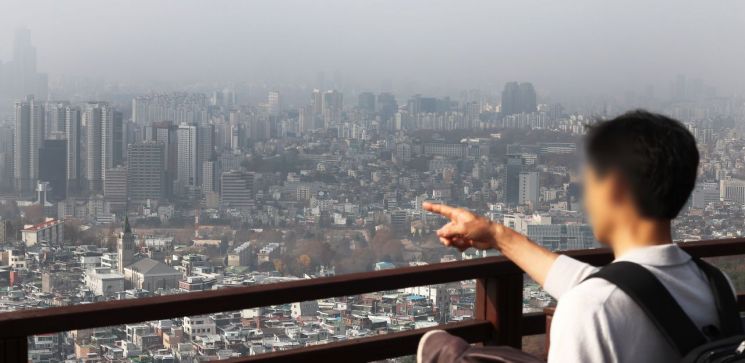
As housing prices in the Seoul metropolitan area continue to rise, housing developers’ business outlook has improved.
The Housing Industry Research Institute announced on January 15 that its survey of housing developers showed the Housing Business Sentiment Index (HBSI) for January stood at 80.5, up 5.8 points from the previous month. In the Seoul metropolitan area, the index rose 10.9 points to 95.4, while in non-metropolitan regions it increased by 4.8 points to 77.3. When the index exceeds the baseline of 100, it indicates that more companies expect the housing business climate to improve.
Within the Seoul metropolitan area, Gyeonggi Province saw a 13.1-point increase to 92.5. Seoul itself rose by 12.3 points to 107.3, and Incheon climbed 7.3 points to 86.6.
The Housing Industry Research Institute stated, "This month’s rise in the Housing Business Sentiment Index for the Seoul metropolitan area was significant, driven by the ongoing upward trend in overall housing prices." The institute added, "In Seoul, the index was buoyed by strong performance in complexes with expectations for reconstruction and in areas adjacent to Gangnam, such as Dongjak and Seongdong districts."
The institute further noted, "With the number of new apartment units set to be supplied in Seoul in 2026 expected to reach 16,412, a decrease of about 48% compared to 2025, the combination of reduced supply and rising price expectations in key areas of Seoul is keeping developers’ market outlook relatively positive. In addition, continued demand for preferred areas such as Suji in Yongin and Bundang in Seongnam, as well as growing interest in non-regulated areas like Pyeongtaek, appear to have improved developers’ sentiment across Gyeonggi Province."
For non-metropolitan regions, the institute reported a 4.8-point increase to 77.3. Among metropolitan cities, the index rose 10.5 points to 88.9, while provincial areas saw a 0.6-point increase to 68.7. By city, Busan was up 22.9 points, Daegu 13.1 points, Daejeon 8.8 points, Ulsan 7.5 points, Sejong 7.2 points, and Gwangju 2.9 points.
Among provincial areas, Gangwon saw the largest increase at 12.1 points, followed by Chungbuk at 3.6 points, Jeonbuk at 2.3 points, and Gyeongnam at 1.6 points.
The institute explained, "As regulations in the Seoul metropolitan area have tightened, market conditions are gradually improving in certain regions, including Busan, Ulsan, and Sejong, where transaction volumes are rising and sales prices are rebounding. However, given that there is still a large number of unsold homes after completion in provincial areas, it is difficult to conclude that the recovery is spreading across all non-metropolitan regions."
In January, the nationwide funding procurement index stood at 89.0, up 20.2 points from the previous month. The materials supply index was projected to rise by 2.2 points to 96.8.
© The Asia Business Daily(www.asiae.co.kr). All rights reserved.
![Clutching a Stolen Dior Bag, Saying "I Hate Being Poor but Real"... The Grotesque Con of a "Human Knockoff" [Slate]](https://cwcontent.asiae.co.kr/asiaresize/183/2026021902243444107_1771435474.jpg)















