Key Issues and Schedule Shared at January 15 National Assembly Breakfast Meeting
Bill to Be Proposed by End of January, Aiming for February Passage
Discussions on Financial Support, Transfer of Authority, and Special Provisions for Future Industries
Gwangju Mayor Kang Gijeong and Jeonnam Governor Kim Youngrok, together with all local members of the National Assembly, have begun full-scale discussions on enacting a special law for the administrative integration of Gwangju and Jeonnam.
On January 15, Gwangju City and Jeonnam Province held a "Breakfast Meeting of Local National Assembly Members to Promote Administrative Integration of Gwangju and Jeonnam" at the National Assembly Members' Office Building, where they discussed key issues and the future schedule related to the enactment of the special law.
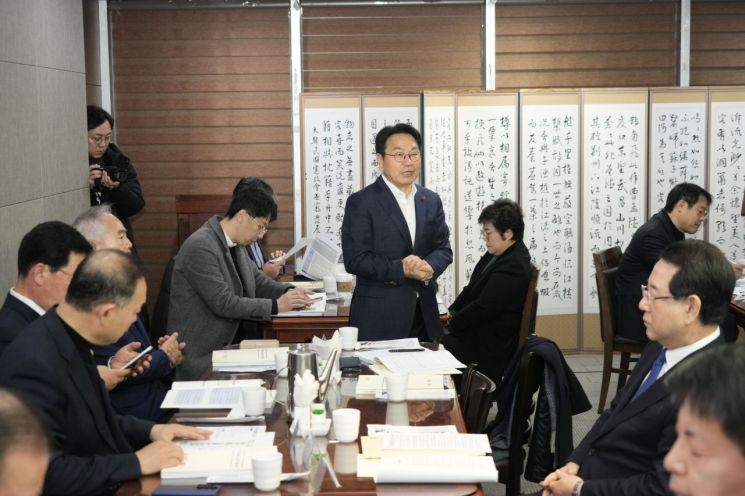 Kang Gijeong, Mayor of Gwangju, is speaking at the breakfast meeting of local members of the National Assembly to promote administrative integration of Gwangju and Jeonnam, held at the National Assembly Members' Office Building on the 15th. Provided by Gwangju City
The meeting was attended by Mayor Kang Gijeong, Governor Kim Youngrok, Yang Bunam and Kim Wonyi, co-chairs of the Democratic Party's Special Committee on Administrative Integration, Gwangju National Assembly members Min Hyungbae, Cho Incheol, Jung Jinwook, Ahn Dogeol, Park Kyuntaek, Jeon Jinsook, and Jung Junho, as well as Jeonnam National Assembly members Park Jiweon, Shin Junghoon, Lee Gaeho, Seo Samseok, Joo Cheolhyeon, Cho Gyewon, Moon Geumjoo, Kwon Hyangyeop, and Kim Moonsu. Im Taek, Mayor of Dong-gu and Chairman of the Gwangju District Mayors' Council, was also present.
The attendees exchanged opinions on the basic direction of administrative integration, key contents to be included in the special law, and supplementary matters related to local issues.
The special administrative integration bill jointly prepared by Gwangju City and Jeonnam Province consists of a total of 8 parts, 23 chapters, and 312 articles, and contains about 300 special provisions. It includes systems that citizens can directly benefit from, such as fostering core regional growth engines like artificial intelligence, mobility, culture capital, and advanced strategic industries, as well as support for youth and small business owners.
The special law covers the establishment and operation of "Gwangju-Jeonnam Special City." The name will be "Gwangju-Jeonnam Special City," but it may be changed in the future to reflect the opinions of the assembly in accordance with the Local Autonomy Act. The current city, county, and district system and the local tax structure will be maintained, and existing Gwangju and Jeonnam government office buildings will be used to minimize administrative confusion and cost burdens.
In addition, a support committee chaired by the Prime Minister will be established to support the launch and stabilization of the special city, and the plan also includes transferring the authority, organization, and budget of special local administrative agencies in areas such as small and medium-sized enterprises, environment, employment, and labor to the special city.
In the industrial sector, special provisions reflecting the future growth engines of Gwangju and Jeonnam, such as artificial intelligence, energy, and culture capital, were included. To enhance the global competitiveness of the artificial intelligence industry, special provisions were added for designating research and development hubs and infrastructure, establishing a wide-area mega-cluster linked with renewable energy, and designating demonstration districts and regulation-free mega-sandboxes.
In the cultural tourism sector, the law allows for the priority establishment or attraction of cultural facilities such as international conference halls, libraries, museums, art galleries, cultural centers, and large-scale performance venues, as well as tourism, accommodation, and sports facilities. It also includes a special provision allowing the designation or cancellation of cultural industry promotion districts without the approval of the Minister of Culture, Sports and Tourism.
This meeting was held to share the draft of the special law jointly prepared by the two cities and the education office, and to gather opinions from local National Assembly members and district governments regarding administrative integration. The participants focused their discussions on bold financial support, the transfer of government authority to local governments, and ways to reflect future growth engines such as artificial intelligence, energy, and culture capital.
Mayor Kang Gijeong stated, "The biggest challenge for the administrative integration of Gwangju and Jeonnam is the passage of the special law," adding, "We will work closely with the National Assembly and sufficiently reflect the opinions of the local political community and citizens to create an effective integration model that citizens can truly feel."
On the afternoon of the same day, Gwangju City and Jeonnam Province plan to hold a public hearing at the National Assembly to gather opinions from academic experts and others regarding the enactment of the special administrative integration law and to further enhance the completeness of the bill.
© The Asia Business Daily(www.asiae.co.kr). All rights reserved.
![Clutching a Stolen Dior Bag, Saying "I Hate Being Poor but Real"... The Grotesque Con of a "Human Knockoff" [Slate]](https://cwcontent.asiae.co.kr/asiaresize/183/2026021902243444107_1771435474.jpg)















