"Korea Future Biohealth Forum" Held on January 12
"Creating a Digital Environment for Primary Care Institutions and Vulnerable Groups"
"Realistic Reimbursement for Continuous Monitoring"
There have been growing calls for urgent improvements to digital healthcare systems in order to successfully implement the government's integrated care policy and primary care-based chronic disease management initiatives. Experts point out that establishing a reimbursement system and building infrastructure that can be effective in real-world settings are key factors.
 Byungha Cho, Head of Digital Healthcare Business Division at Daewoong Pharmaceutical, is presenting at the "Korea Future Biohealth Forum" held on the 12th at the National Assembly Members' Office Building, Room 2. Daewoong Pharmaceutical
At the "Korea Future Biohealth Forum" held at the National Assembly Members' Office Building in Yeouido, Seoul on January 12, experts urged the establishment of a system that can seamlessly manage patients' conditions outside hospitals. In particular, they agreed that in order to enhance the effectiveness of integrated care, it is essential to have both a technological foundation for real-time monitoring of vital signs and legal and economic incentives to support it.
Byungha Cho, Head of Digital Healthcare Business Division at Daewoong Pharmaceutical, who gave a presentation at the forum, diagnosed that the success or failure of integrated care depends on the quality of patient monitoring. He emphasized that the true value of patient monitoring lies not simply in increasing the frequency of observation, but in how early risk signals can be detected and how quickly responses can be made.
He stated, "A system that allows all citizens to be monitored 24 hours a day, anywhere and anytime, must be established for the integrated care policy to take root stably." He added, "Early diagnosis and continuous management may seem like costs in the short term, but they are effective investments that prevent the progression to severe diseases and, in the long run, reduce medical expenditures."
In fact, there have been a series of cases in clinical settings where digital healthcare has enabled early intervention. The Health Screening Center at Kangbuk Samsung Hospital prevented emergencies in advance through AI-based electrocardiogram analysis.
Cho presented the following tasks to expand these achievements: ▲creating an environment for digital utilization at primary care institutions ▲realizing reimbursement for continuous monitoring and long-term testing ▲expanding digital care infrastructure for vulnerable groups.
He analyzed that the chronic disease management initiative can succeed only if primary care institutions actively utilize digital platforms and diagnostic technologies. He argued that this would not only improve access to healthcare, but also promote clear role-sharing with tertiary general hospitals, thereby contributing to the establishment of an efficient healthcare system.
The need to expand the reimbursement system for continuous monitoring was also raised. Since the Centers for Disease Control and Prevention (CDC) in the United States recommends perioperative blood glucose management and 24-hour ambulatory blood pressure monitoring, there is an urgent need to create an environment in Korea where vital signs can be continuously monitored.
The importance of building a "digital integrated care" infrastructure for medically underserved areas and elderly people living alone was also mentioned. While combining digital technology with remote home monitoring and home visits enables continuous health management, the current reimbursement and institutional limitations pose significant barriers to wider adoption.
In particular, he called for alleviating the high out-of-pocket cost (80%) for long-term Holter electrocardiogram tests lasting more than three days. Cho emphasized, "Although long-term testing of more than 72 hours is effective in detecting hidden atrial fibrillation, many people miss the opportunity for early diagnosis due to the financial burden." He stressed that incorporating this into the reimbursement system would help prevent severe diseases such as stroke.
Lee Jooyoung, a member of the National Assembly Health and Welfare Committee from the Reform New Party, who hosted the forum, stated, "Digital healthcare is a core infrastructure for completing the medical system," and added, "We will actively pursue institutional improvements at the National Assembly level."
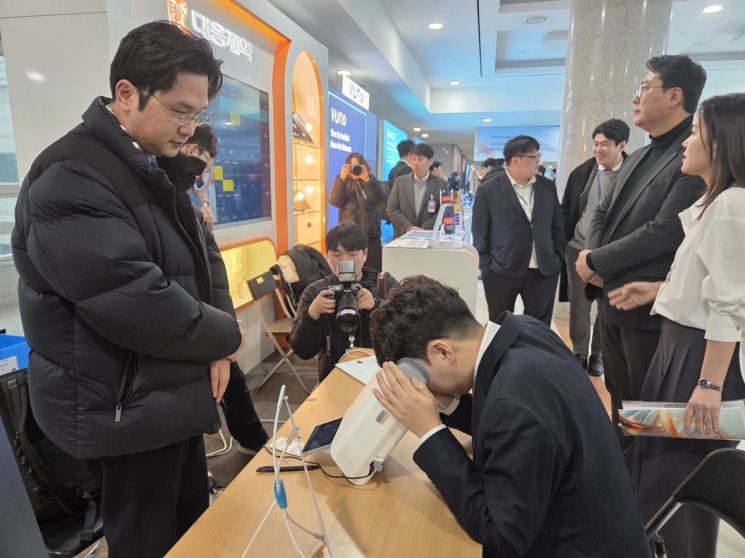 Lee Junseok, a member of the Reform New Party, is listening to an explanation at the Daewoong Pharmaceutical booth set up at the National Assembly Members' Office Building in Yeouido, Seoul on the 12th. Daewoong Pharmaceutical
Meanwhile, prior to the forum, a booth was set up in the lobby of the National Assembly Members' Office Building where participants could experience digital healthcare devices firsthand. Various visitors, including Lee Junseok, leader of the Reform New Party, visited the booth and tried out Daewoong Pharmaceutical's bedside monitoring system "Think," the wearable electrocardiogram device "Mobicare," and the fundus camera "Optina."
© The Asia Business Daily(www.asiae.co.kr). All rights reserved.
![Clutching a Stolen Dior Bag, Saying "I Hate Being Poor but Real"... The Grotesque Con of a "Human Knockoff" [Slate]](https://cwcontent.asiae.co.kr/asiaresize/183/2026021902243444107_1771435474.jpg)

















