Roadmap for "Electric" Transition Proposed in Davos Forum Contribution
"Toward a Carbon-Free Marine Ecosystem... Let's Transform Propulsion Systems"
"Secure Stable ESS and Build Battery Infrastructure"
Kim Donggwan, Vice Chairman of Hanwha Group, has proposed the establishment of an "electric propulsion ship-centered marine ecosystem" to drive the decarbonization transition of the global shipping industry. He emphasized that it is necessary to move beyond eco-friendly technologies at the individual vessel level and shift the entire marine value chain-including ports and energy sources-to an electricity-based system.
On January 15, ahead of the 56th Annual Meeting of the World Economic Forum (WEF, Davos Forum), which opens on the 19th (local time) in Davos, Switzerland, Vice Chairman Kim shared this vision in a contribution published on the forum's official website. Building on his proposal at last year's Davos Forum, where he introduced the "carbon-free propulsion gas carrier" for the first time in the global industry, this year he presented a more comprehensive roadmap for a "carbon-free marine ecosystem."
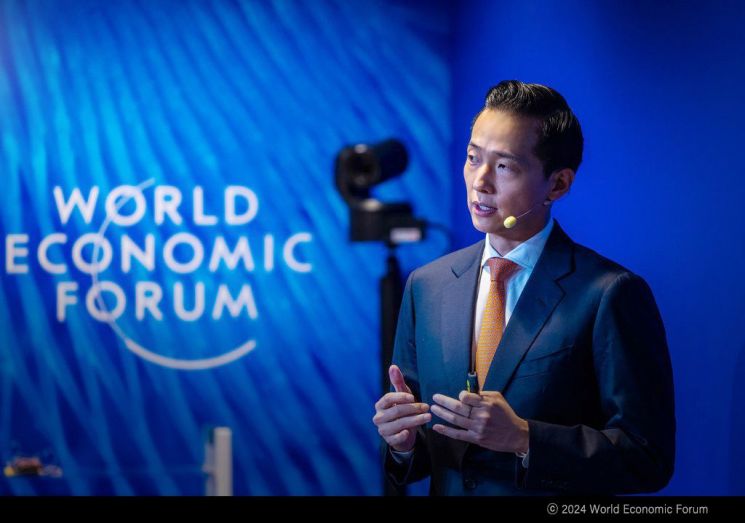 Kim Dong-kwan, Vice Chairman of Hanwha Group, is presenting the marine decarbonization vision at the 2024 Davos Forum Annual Meeting session titled 'World's First Fossil Fuel-Free Ship.' Hanwha
In his article, Vice Chairman Kim stated, "The shipping industry, which has relied on fossil fuels for over 200 years, now stands at the threshold of a full-scale transition in propulsion systems." He explained that, due to the International Maritime Organization's (IMO) 2050 net-zero target and the European Union's strengthened carbon emission regulations, shipping companies will be required to secure emission allowances for all carbon emissions after 2027.
While acknowledging that transitional solutions such as onboard carbon capture are unavoidable in the short term, Vice Chairman Kim stressed, "Fundamentally, the propulsion systems of ships themselves must be transformed." He analyzed that, to accelerate the adoption of electric propulsion ships, it is essential to secure stable energy storage systems (ESS) and develop accessible battery charging and replacement infrastructure. He also added that ports need to be equipped with power supply systems based on clean energy.
He remarked, "Shipping decarbonization cannot be achieved through a single technology or policy," and highlighted the importance of collaboration across the entire value chain, including shipyards, port operators, energy suppliers, and policymakers.
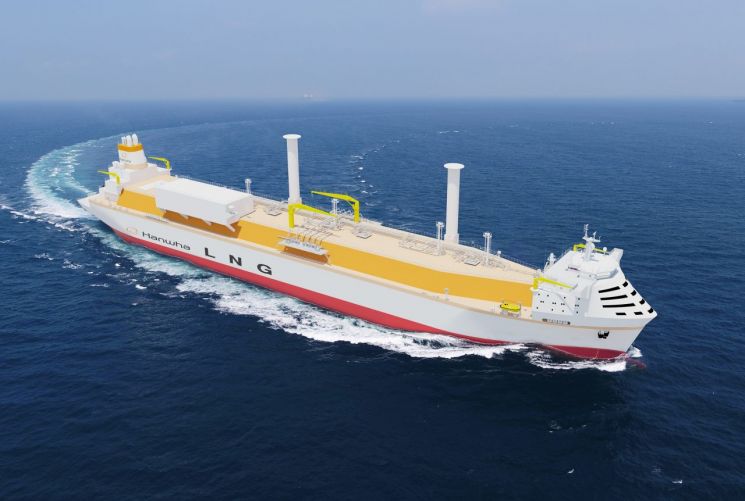 Perspective rendering of the ammonia gas turbine-powered liquefied natural gas (LNG) carrier developed by Hanwha Ocean. Hanwha Ocean
He also introduced the technological initiatives being developed by Hanwha Group. Vice Chairman Kim explained, "Hanwha Ocean is developing carbon-free ships utilizing innovative technologies such as ammonia gas turbines," and added, "By applying advanced ESS and clean energy solutions throughout marine infrastructure, we are laying the foundation for ships and ports to evolve together with the entire ecosystem."
He also mentioned collaboration with European ports. Vice Chairman Kim stated, "We are discussing pilot projects with European port authorities to provide ESS and ship charging facilities powered by clean energy," expressing his vision to establish a "new standard" for global marine clean energy systems.
Since first attending the Davos Forum in 2010, Vice Chairman Kim has continued to focus on activities centered on a sustainable future. In 2013, he was selected as a Young Global Leader (YGL) by the forum, and participated as a panelist in sessions such as "Reigniting the Economic Engine" in 2015 and "Low-Carbon Economy" in 2016. Last year, as a keynote speaker at the annual meeting, he proposed the "carbon-free propulsion gas carrier," leading the discussion on shipping decarbonization.
© The Asia Business Daily(www.asiae.co.kr). All rights reserved.
![Clutching a Stolen Dior Bag, Saying "I Hate Being Poor but Real"... The Grotesque Con of a "Human Knockoff" [Slate]](https://cwcontent.asiae.co.kr/asiaresize/183/2026021902243444107_1771435474.jpg)

















