Yeo Han-koo Meets with U.S. Congress, USTR, and OMB
Managing Both Tariff Follow-up and IEEPA Risks
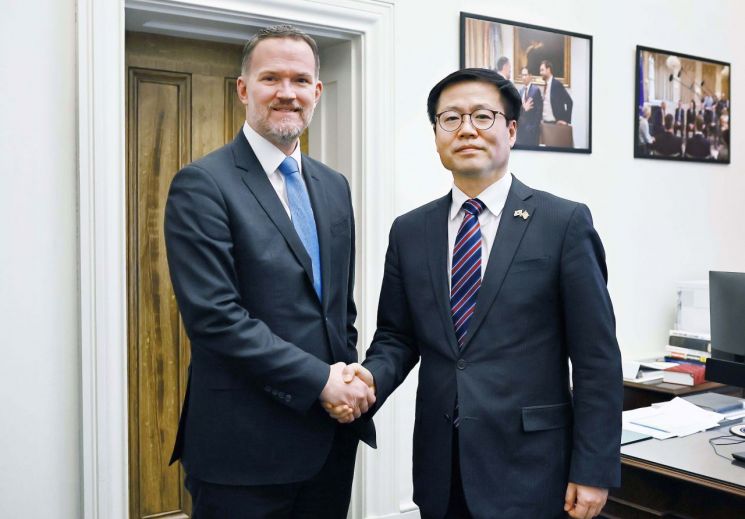
The South Korean government has launched a large-scale outreach campaign targeting the U.S. Congress, government, and industry to explain its digital legislation and follow-up measures on the Korea-U.S. tariff negotiations. This move is seen as a preemptive effort to manage trade risks and maintain the effectiveness of the tariff agreement, amid growing U.S. concerns over digital regulations.
From January 11 to 14 (local time), Yeo Han-koo, Trade Minister for Trade Negotiations at the Ministry of Trade, Industry and Energy, visited Washington, D.C., where he held a series of meetings with members of the U.S. House and Senate (Andy Kim, Bill Hagerty, Dave McCormick, Todd Young, Adrian Smith, Darrell Issa, Rudy Yakym), representatives from the service and ICT industries and associations, think tanks such as CSIS and PIIE, as well as Jamieson Greer, representative of the Office of the U.S. Trade Representative (USTR), and Russell Vought, Director of the Office of Management and Budget (OMB) at the White House.
Given that the U.S. side has expressed concerns that Korea's online platform regulations and digital service legislation could result in discrimination against American companies, Minister Yeo reportedly focused on explaining the background and procedures of the legislative process, as well as South Korea's willingness to consult with U.S. companies.
While the U.S. Congress and industry representatives expressed appreciation for the Korean government's explanations, they also emphasized that the principle of "preventing unnecessary barriers to U.S. companies," as specified in the joint statement from the Korea-U.S. summit in November last year, must be upheld. They specifically called for the collection of stakeholder opinions and transparent legislative procedures, stating that they would closely monitor developments going forward.
It was also reported that U.S. congressional officials inquired about the recent large-scale personal information leak incident in South Korea. The Korean government made it clear that the relevant agencies are conducting investigations in accordance with the law, and that it is inappropriate to interpret this issue as a matter of Korea-U.S. trade or diplomacy.
Minister Yeo also reviewed the follow-up implementation of the Korea-U.S. tariff negotiations during his meeting with Greer. Both sides shared updates on the implementation of non-tariff agreements, and Minister Yeo particularly emphasized that South Korea should not be treated unfavorably compared to other countries in light of the upcoming U.S. Supreme Court ruling on the International Emergency Economic Powers Act (IEEPA).
During his meeting with Director Vought, discussions were held on expanding investment cooperation between Korea and the U.S. in strategic industries such as shipbuilding. As U.S. industrial policy and increased local investment by Korean companies converge, there are expectations that future cooperation will be strengthened across trade, industry, and security sectors.
Concluding his visit to the U.S., Minister Yeo stated, "Since the tariff negotiations, expectations for Korea-U.S. trade and investment cooperation have risen in the U.S., but it is necessary to carefully manage risk factors such as digital trade issues and the U.S. Supreme Court ruling." He added, "It is important to accurately explain the policy intentions and background, and we will continue our outreach efforts to the U.S. going forward."
© The Asia Business Daily(www.asiae.co.kr). All rights reserved.
![Clutching a Stolen Dior Bag, Saying "I Hate Being Poor but Real"... The Grotesque Con of a "Human Knockoff" [Slate]](https://cwcontent.asiae.co.kr/asiaresize/183/2026021902243444107_1771435474.jpg)
















