Improvement of "Single Port" Business Restrictions for Marine Fuel Supply Vehicles
Ombudsman Proposed Changes in 2022... Conclusion Reached After Prolonged Review
Regulatory Rationalization Plan Finalized at National Policy Coordination Meeting
Company A, a supplier of marine fuel, has been shackled for years by restrictions on its business operation zones. Although the company invested in tanker trucks costing between 300 million and 400 million won each, it was only allowed to operate at a single registered port, resulting in actual work being available for less than a week each month. For the remaining three weeks, the trucks were essentially idle, making it difficult to sustain the business when considering the investment costs.
This regulation, which limits the business operation zones of marine fuel supply vehicles, will be abolished in the second half of this year. Tanker trucks will no longer be restricted to a specific port and will be able to supply fuel at other ports as well.
On January 15, the Office of the Ombudsman for Small and Medium Enterprises announced at the National Policy Coordination Meeting, presided over by the Prime Minister, that a plan to rationalize on-site regulatory difficulties for small and medium-sized enterprises had been finalized. This plan is a package aimed at addressing chronic regulations that small businesses and self-employed individuals experience in the field. It was developed by selecting regulatory issues that have not been improved for several years and coordinating with relevant ministries and agencies.
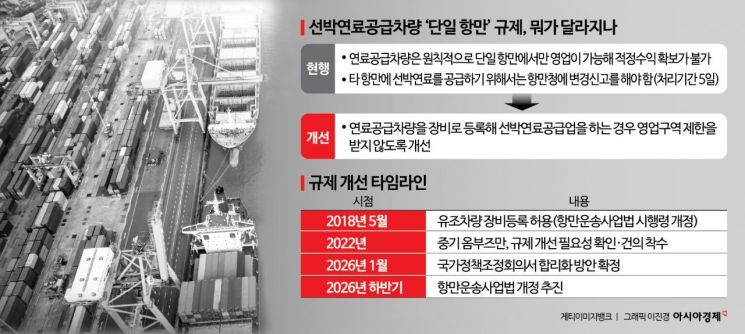
In the field of marine fuel supply, it is common practice to use tanker trucks to refuel ships. However, under the existing system, if a vehicle was registered as equipment, its business operation zone was limited to a "single port," meaning it could only operate when a ship entered that specific port. Although it was possible to operate at other ports by filing a change report, the process took five days, rendering it practically useless. Since shipping companies usually request fuel supply one to three days in advance, it has been difficult to respond in a timely manner.
This improvement addresses on-site difficulties that have persisted for about eight years since the revision of the Port Transport Business Act Enforcement Decree in 2018. Although the Office of the Ombudsman for Small and Medium Enterprises has been raising the need for improvement with relevant agencies since 2022, the review process was prolonged, and there had been no significant progress. Jeong Byeonggyu, Director of the Ombudsman Support Group, explained, "Over the past year, we have identified unreasonable regulations through research institute projects and have proposed improvements to a total of more than 700 regulations, including those that had not previously been addressed, to relevant agencies."
This plan includes not only the deregulation of business operation zones for tanker trucks, but also 21 measures to ease startup and new industry regulatory inconveniences, 28 measures to rationalize chronic regulations for small businesses and the self-employed, and 30 measures to revise hidden business regulations in administrative rules, totaling 79 regulatory improvements.
© The Asia Business Daily(www.asiae.co.kr). All rights reserved.
![Clutching a Stolen Dior Bag, Saying "I Hate Being Poor but Real"... The Grotesque Con of a "Human Knockoff" [Slate]](https://cwcontent.asiae.co.kr/asiaresize/183/2026021902243444107_1771435474.jpg)















