"National AI Strategy Committee Must Scrap 'Action Plan No. 32'"
EU Mandates 'Transparency,' US Offers Large Compensation
Only Korean Government Distorts the 'Global Trend'
 On the 15th of last month, at Seoul Square in Jung-gu, Seoul, Vice Chairman Moonyoung Lim and attendees are cutting a rice cake commemorating the 100-day anniversary during the press conference marking 100 days since the launch of the National Artificial Intelligence Strategy Committee. Photo by Yonhap News
The government's "copyright immunity" policy, which is being pushed under the banner of advancing to the "AI G3"-the top three global powers in artificial intelligence-has encountered fierce resistance from the cultural and arts sectors. On January 13, sixteen domestic organizations representing creators and rights holders, including the Korea Music Copyright Association, issued a joint statement calling for the complete withdrawal of the "Korea Artificial Intelligence Action Plan" announced by the National Artificial Intelligence Strategy Committee.
The core of the conflict is "Action Plan No. 32." This provision states that AI companies will not be held legally liable for training their models on data without the copyright holder's permission. The creative community has condemned this as legalized looting of copyrighted works and has drawn a firm line in opposition.
"Effectively Uncompensated Seizure"... Creators Outraged by 'Machine-Readable Opt-Out'
While the government insists that "eliminating legal uncertainty is necessary for industry growth" and is pushing for rapid implementation, those on the ground remain deeply skeptical. Organizations representing creators and rights holders have defined the action plan as "the state forcibly expropriating individual property rights for the benefit of corporations." In their statement, they emphasized, "The purpose of copyright law is to grant creators exclusive rights so they receive fair compensation," and criticized the plan, saying, "Allowing private companies to use others' intellectual property comprehensively and for free for commercial purposes undermines constitutional values." They argue that, under the pretext of "innovation," the government is using creators' livelihoods as collateral.
Particularly controversial is the government's proposed "machine-readable opt-out" as an alternative. Critics argue that, for the vast majority of individual creators who lack the means for sophisticated technical measures, this is an administrative convenience that essentially tells those without technical knowledge to simply accept the consequences.
 On the 15th of last month, Lim Munyoung, Vice Chairman, is briefing at the 100-day press conference for the launch of the National Artificial Intelligence Strategy Committee held at Seoul Square in Jung-gu, Seoul. Photo by Yonhap News
Global Standards Are 'Compensation' and 'Transparency'... Only Korea Is Moving Backward
An even more serious issue is the government's misleading claim that "advanced countries are also adopting immunity." In reality, the global AI market is moving in the exact opposite direction of the government's assertions.
The European Union has already cracked down on "opaque data." Under the "EU AI Act," which came into effect in 2024, developers of general-purpose AI models have been required since August last year to disclose detailed sources of their training data. AI lacking such transparency is completely barred from entering the European market. This stands in stark contrast to the Korean government's proposal, which centers on non-disclosure and immunity.
In the United States-the "AI powerhouse"-the market has established order through "payment" rather than legal disputes. Over the past two years, major tech companies such as OpenAI and Google have signed a series of large-scale licensing agreements with organizations like News Corporation (Wall Street Journal), Dotdash Meredith, Reddit, and Time. To avoid litigation risks, paying fair compensation has become a standard business practice. The early argument that "fair use means no payment is necessary" effectively lost its place in the market as of last year.
Even Japan, which the government once cited as a benchmark, has changed course. Once dubbed a "machine learning paradise," Japan revised its Agency for Cultural Affairs guidelines in 2024, making it clear that "learning that unfairly harms the interests of creators is not permitted." In effect, Japan has shifted toward tighter regulation to prevent the collapse of the creative ecosystem that unlimited immunity could cause.
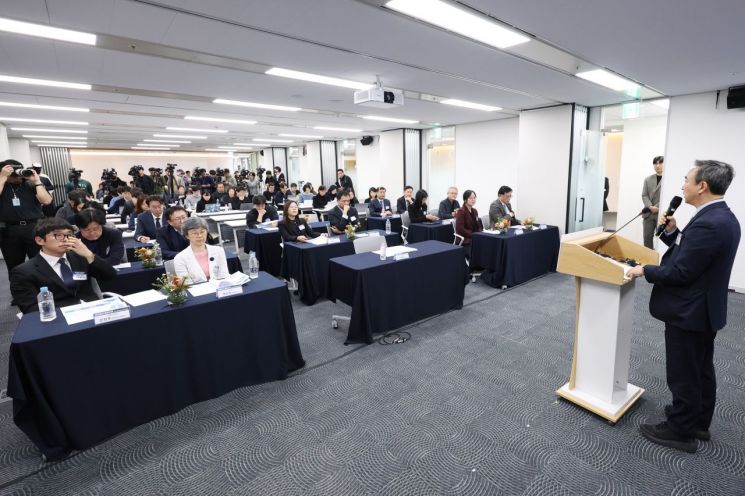 On the 15th of last month, Lim Munyoung, Vice Chairman, is briefing at the 100-day press conference for the launch of the National Artificial Intelligence Strategy Committee held at Seoul Square in Jung-gu, Seoul. Photo by Yonhap News
With the global standard now moving toward "coexistence" and "compensation," organizations representing creators and rights holders conclude that only the Korean government is heading in the opposite direction. They warn that if the government creates an environment of free use under the pretext of "fair use," it will undermine companies' willingness to negotiate and paralyze market functions.
The national goal of becoming a "Global AI G3" is undoubtedly important. However, if the government sacrifices creators' rights for immediate results, it will be akin to "killing the cow to straighten its horns." Ultimately, the solution to this controversy depends on how the government incorporates the global principle of "prior permission, followed by fair compensation" into its policy.
© The Asia Business Daily(www.asiae.co.kr). All rights reserved.



















