Annual Survey of Korean Companies in China by KIET
Southeast Asia Chosen as Relocation Destination by 59%
"Proportion Expecting Annual Sales Decline" Rises from 36% to 41.3%
It has been found that 32.4% of Korean companies operating in China are considering withdrawing, relocating, or downsizing their businesses over the next five years.
On January 14, the Beijing office of the Korea Institute for Industrial Economics and Trade (KIET) announced the main findings of its "2025 Survey on the Business Environment of Korean Companies in China." This annual survey was conducted jointly by the KIET Beijing office, the Beijing office of the Korea Chamber of Commerce and Industry, and the Korean Chamber of Commerce in China. It targeted 455 Korean companies operating in China from August to November last year.
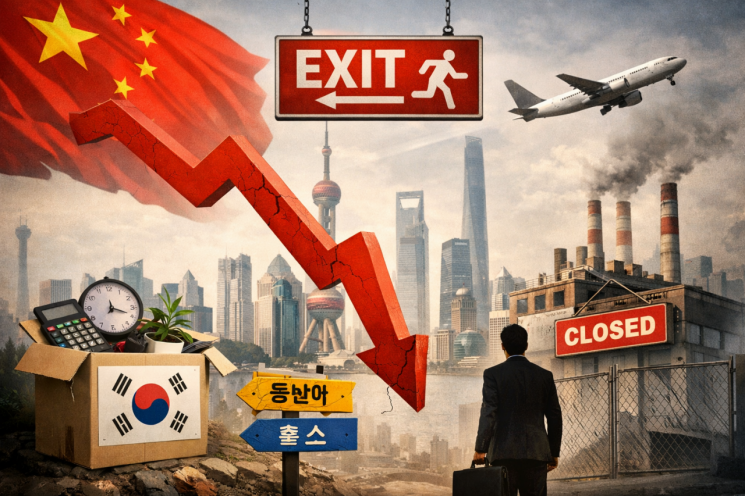
According to the survey, 9.7% of companies expect to withdraw within the next five years, 1.8% anticipate relocating, and 20.9% foresee downsizing. In the 2024 survey, the figures were 8.8% for withdrawal, 3.6% for relocation, and 24.6% for downsizing, totaling 37%. The proportion of respondents expecting to maintain their business over the next five years was 48.6%, similar to 49.2% in 2024. However, the proportion expecting to expand their business increased from 13.8% to 19.1%.
The main reasons cited by Korean companies in China for considering withdrawal or relocation were intensified competition, rising production costs within China, and difficulties in business succession. Among companies considering relocation, Southeast Asia was the most preferred destination at 59%, followed by Korea at 17%.
The proportion of respondents expecting sales to increase compared to the previous year dropped from 35% in the 2024 survey to 25.7% for 2025, while the proportion expecting a decrease in sales rose markedly from 36% to 41.3%, according to the institute.
As reasons for last year’s sales declines, companies cited intensified local competition in China, sluggish local demand, and supply chain disruptions caused by US-China tensions. On the other hand, factors contributing to sales growth included product quality, business diversification, and increased local demand.
The operating rate of businesses improved slightly over the past year. In this survey, 48.8% of companies reported an operating rate of "over 60%," up from 44.8% in 2024. The proportion reporting an operating rate of "over 80%" also increased from 18.4% to 23.1%.
The Korea Institute for Industrial Economics and Trade explained, "Since the survey began in 2020, operating rates have not shown significant improvement, but in 2025, they have improved compared to 2024. This indicates that Korean companies in China have not yet experienced a full-fledged recovery in business sentiment."
© The Asia Business Daily(www.asiae.co.kr). All rights reserved.
![Clutching a Stolen Dior Bag, Saying "I Hate Being Poor but Real"... The Grotesque Con of a "Human Knockoff" [Slate]](https://cwcontent.asiae.co.kr/asiaresize/183/2026021902243444107_1771435474.jpg)















