Closer to the European Model Than the American One
Concerns Over Excessive Litigation
If Compensation Is Granted to All Victims
Improving the Current Group Litigation System
Paving the Way for Collective Monetary Damage Claims
The government is moving forward with the design of a Korean-style class action system. The core of this approach is that consumer organizations or public interest groups can file lawsuits on behalf of victims, and only those victims who explicitly express their intention to participate in the lawsuit will receive compensation. The government has determined that the American-style class action system (opt-out), in which all victims are subject to the court's ruling unless they explicitly declare their intention to be excluded from the lawsuit, carries a high risk of excessive litigation. As a result, the government is leaning toward a more restrained collective redress model, closer to the European-style class action system.

According to relevant ministries on January 15, the Korea Fair Trade Commission and the Personal Information Protection Commission are reviewing ways to improve the current group litigation system to facilitate collective damage claims by consumers. The plan is to allow only entities with representative status, such as consumer organizations, to file lawsuits, while enabling monetary damage claims so that the system can function as an effective means of redress for actual damages.
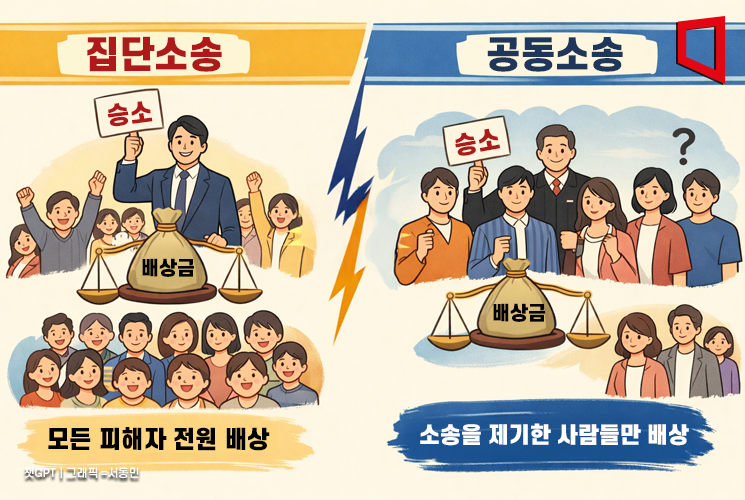
The current group litigation system has been criticized for its limitations as an effective means of redress. Under the Framework Act on Consumers and the Personal Information Protection Act, only consumer or public interest organizations can file lawsuits, but these are limited to seeking injunctions or cessation of rights violations, and monetary damage claims are not permitted. As a result, even in cases involving multiple victims, the system rarely leads to monetary compensation, resulting in low utilization. It is understood that fewer than 10 group lawsuits have been filed in the past decade. Courts have also conducted strict preliminary reviews of public interest at the stage of filing group lawsuits, which has been cited as a reason for the system's limited practical use.
Current law only allows for group litigation without monetary compensation, joint litigation in which only plaintiffs who directly file suit are subject to the court's ruling, and securities-related class actions, which are limited to cases such as stock price manipulation or false disclosures.

To enhance the effectiveness of the group litigation system, the government is considering allowing claims for monetary damages, but limiting compensation to those victims who participate in the lawsuit. This is intended to reduce concerns about excessive litigation under the American-style class action system, where all victims are compensated unless they opt out. While the American system is positively evaluated in terms of consumer rights protection, it has also been criticized in the United States for encouraging excessive lawsuits by certain law firms. The government also plans to lower the threshold for group litigation by abolishing the requirement for prior court approval before filing a lawsuit.
Meanwhile, the Ministry of Justice attempted to introduce the American-style class action system in 2020, during the Moon Jae-in administration, but failed due to opposition over concerns about excessive litigation. The Ministry of Justice is still reviewing the American-style system, but given industry opposition and legislative uncertainty, it is expected to take time before it is institutionalized. Accordingly, there is a strong expectation within and outside the government that, for the time being, the amendment to the group litigation system being promoted by the Korea Fair Trade Commission and the Personal Information Protection Commission will be at the center of policy.
Currently, eight bills have been submitted to the National Assembly, sponsored by Assembly members Baek Hyeryeon, Park Jumin, Cha Kyugeun, Jeon Yonggi, Lee Hakyoung, Han Changmin, Kim Namgeun, and Oh Gihyeong (in order of submission). The bills by Baek Hyeryeon, Park Jumin, Jeon Yonggi, and Oh Gihyeong are classified as American-style, while those by Lee Hakyoung and Kim Namgeun are considered European-style.
© The Asia Business Daily(www.asiae.co.kr). All rights reserved.



















