Startup Education Experience Increases Actual Startup Potential
High Interest in Knowledge Services and IT-Based Businesses
AI Education and Entrepreneurial Culture Also Have an Impact
It has been found that experience in startup education and activities not only increases the entrepreneurial intentions of unemployed youth, but also changes the quality and direction of their startups.
The Korea Economic Association’s Center for Entrepreneurship Development announced these findings on January 14, based on a follow-up analysis and in-depth interviews related to the "Survey on the Startup Status and Promotion Factors of Unemployed Youth," which was released on December 2 last year.
The analysis showed that among unemployed youth with experience in startup education, 35.2% responded that their intention to start a business in the future was "high," which is about 1.6 times higher than those without such experience (22.6%). Including those who answered "moderate," three out of four (76.5%) unemployed youth with startup education experience did not rule out the possibility of starting a business, whereas only 58.2% of those without such experience did so.
Mr. A, who double-majored in Startup Convergence Studies while in college, said, "The biggest driving force that enabled me to go beyond simply coming up with ideas and actually start a business was the technical and psychological advice I learned from listening to startup CEOs' lectures." He added, "I was able to learn in detail how to write a business plan and which government support programs I could utilize, so I overcame my fears and took on the challenge." He further stated, "Startup education does not just deliver knowledge, but also plays a role in lowering the psychological barriers to taking on challenges."
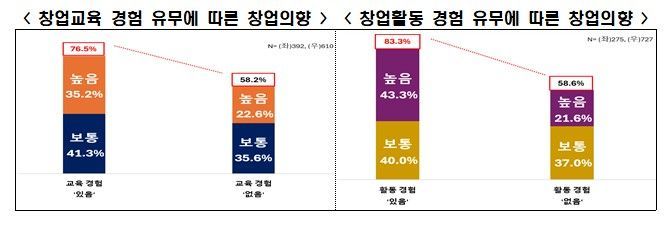 Entrepreneurial Intentions Based on Experience in Startup Education and Activities. Korea Economic Association.
The effect of startup activity experience was even more pronounced. Among unemployed youth with experience in startup activities, 43.3% responded that their intention to start a business in the future was "high," which is twice the rate of those without such experience (21.6%). Including those who answered "moderate," four out of five (83.3%) unemployed youth with startup activity experience left the possibility of starting a business open.
Ji Sangcheol, Head of the Sejong Startup Support Center at Korea University, said, "Startup activity experience is an important turning point that allows young people to recognize that they can verify their ideas and try again, rather than excessively fearing the possibility of failure." He added, "The accumulation of such experiences is ultimately a key factor in making entrepreneurship a realistic career path rather than a vague choice."
The analysis suggests that while startup education experience helps lower the psychological entry barriers and deepen understanding of entrepreneurship, startup activity experience significantly increases the likelihood that this awareness will translate into actual action.
Experience in startup education and activities also influenced the direction of youth entrepreneurship. The survey found that youth with such experience showed a higher interest in idea-driven knowledge service industries and IT (information technology)-based sectors. This analysis was conducted on 276 respondents who answered "high" to entrepreneurial intention.
The proportion of respondents who selected knowledge service industries as their top area of interest was 26.8% among those with startup education experience, higher than those without such experience (17.4%). Based on startup activity experience, those with experience (26.9%) also showed higher interest than those without (18.5%).
For IT-based industries such as artificial intelligence and software, 14.5% of respondents with startup education experience and 15.1% of those with startup activity experience chose it as their top area of interest, compared to only 3.6% and 4.5%, respectively, among those without such experience.
Mr. B, who is currently active in a university startup club, said, "By interacting with students from various majors in the club, I became interested in tech startups beyond my own major in languages and literature," adding, "If startup clubs and project-based activities become more active, it will have a positive impact on youth entrepreneurship."
It was also found that expanding AI education and spreading an entrepreneurial culture generally boost the entrepreneurial intentions of unemployed youth. The effect was particularly strong among those with experience in startup education and activities. When asked whether their entrepreneurial intention would increase with expanded AI education, 59.4% of those with startup education experience said yes, compared to 44.6% of those without. Based on startup activity experience, there was also a difference between those with experience (64.4%) and those without (45.1%).
Sakar Biswajit, Professor of Industrial Engineering at Yonsei University, explained, "AI education is most effective when it functions not just as a means of acquiring technology, but as a tool for defining and solving problems." He added, "The effect of increasing entrepreneurial intention can be greater for young people who have already considered or attempted entrepreneurship, as they are more likely to understand how to connect AI with the process of idea realization and commercialization."
The spread of an entrepreneurial culture showed a similar trend. Among unemployed youth with startup education experience, 57.4% said their entrepreneurial intention would increase, higher than those without such experience (42.5%). Similarly, 60.0% of those with startup activity experience responded positively, compared to 43.9% of those without.
Jung Chul, Chief Research Officer and Head of the Center for Entrepreneurship Development at the Korea Economic Association, said, "This analysis shows that the spread of an entrepreneurial culture not only significantly enhances young people's entrepreneurial intentions but that experience in startup education and activities is a key factor in amplifying this effect." He added, "We will continue to expand opportunities for education, hands-on experience, and networking so that young people can move from learning to challenge and execution."
© The Asia Business Daily(www.asiae.co.kr). All rights reserved.
![Clutching a Stolen Dior Bag, Saying "I Hate Being Poor but Real"... The Grotesque Con of a "Human Knockoff" [Slate]](https://cwcontent.asiae.co.kr/asiaresize/183/2026021902243444107_1771435474.jpg)















