Vice Prime Minister of Science and ICT:
"Organizational Restructuring Discussed Amid Information Security Issues"
The government will select two elite teams for its independent artificial intelligence (AI) foundation model support project by the end of the year.
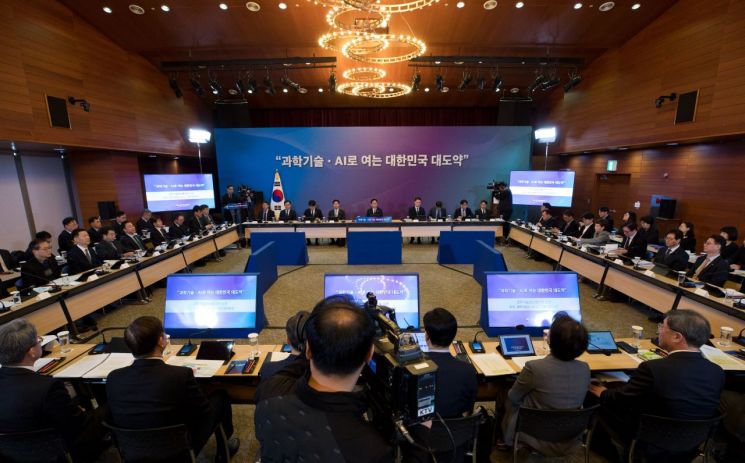 On the 14th, a briefing on the work of subordinate institutions in the Information and Communication Technology (ICT) sector of the Ministry of Science and ICT was held at the Central Post Office in Jung-gu, Seoul. Provided by the Ministry of Science and ICT
The National IT Industry Promotion Agency (NIPA) announced this on January 14 at a briefing on the work of subordinate institutions in the Information and Communication Technology (ICT) sector, held at the Central Post Office in Jung-gu, Seoul. More than 15,000 advanced graphics processing units (GPUs) will be secured this year to support independent AI elite teams and related initiatives.
In addition, regarding the plan to secure an additional 15,000 GPUs for the National AI Computing Center, which is scheduled to open in 2028, NIPA aims to establish a special purpose company (SPC) with the Samsung SDS consortium by June. The agency also plans to invest 1 trillion won each in North Jeolla Province and South Gyeongsang Province to build a leading model of a Korean-style AI factory based on physical AI by 2030.
Vice Prime Minister and Minister of Science and ICT Bae Kyunghoon emphasized, "Since there is a lack of AI training infrastructure, we need to use imported GPUs to create high-quality AI models and services, and at the same time, foster an ecosystem that expands the domestic neural processing unit (NPU) market through the service process."
At the briefing, the Central Radio Management Office announced that it would establish a dedicated system within the year to monitor whether low-Earth orbit communication satellites, such as those operated by SpaceX in the United States, are causing radio interference with domestic geostationary satellites.
The Korea Internet & Security Agency (KISA), which has been responding to cyber incidents, presented its goals for this year: building an AI-based automated response system, applying generative AI throughout the entire cyber incident response cycle, and establishing an AI-based voice phishing response platform. To respond quickly to large-scale cyber incidents, KISA will establish an intelligent forensics lab and secure dedicated personnel for incident investigations.
Vice Prime Minister Bae stated, "As information security issues continue to arise in this era of AI transformation, it is becoming almost overwhelming," adding, "It appears that we need to consider fundamental organizational restructuring at the government level, and discussions are currently underway."
© The Asia Business Daily(www.asiae.co.kr). All rights reserved.

















