Local Governments Join Efforts to Guarantee Civil Servants' Right to Rest
Challenges Remain for Citizens Who Rely on Lunchtime Services
The so-called "lunch break shutdown," in which civil servants suspend civil service work during lunch hours, is rapidly spreading among local governments nationwide. While the intent is to institutionally guarantee rest time for public officials and thereby improve work efficiency and service quality, complaints are growing among citizens who have used the lunch hour to handle administrative matters.
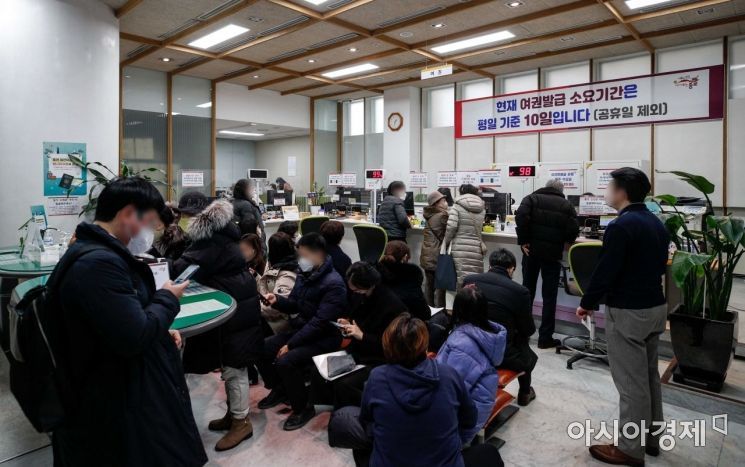 A district office passport service center in Seoul is bustling with citizens hoping to obtain passports. This photo is provided to aid understanding of the article and is not directly related to the content. Photo by Kang Jin-hyung
'Lunch Break Shutdown' Spreads Nationwide
The lunch break shutdown policy has been expanding with the aim of guaranteeing public officials' right to rest. Since Goseong County in South Gyeongsang Province first introduced the system in 2017, more than 100 local governments across the country are now implementing it. The expansion of online civil service platforms and the increased installation of unmanned civil document issuance machines are also cited as factors behind the spread of the policy.
Daegu also introduced the system this year. According to Daegu City and other sources on January 14, district offices in Daegu began enforcing the lunch break shutdown in administrative welfare centers starting from January 2, with lunch hours set from 12:00 to 1:00 p.m. However, the operation method varied by district. Districts such as Suseong-gu, Dong-gu, Nam-gu, Seo-gu, Buk-gu, and Gunwi-gun continued to operate civil service offices in the main government buildings as usual, applying the lunch break shutdown only to administrative welfare centers. In contrast, Jung-gu, Dalseo-gu, and Dalseong-gun implemented the lunch break shutdown in both the main government building civil service offices and the administrative welfare centers.
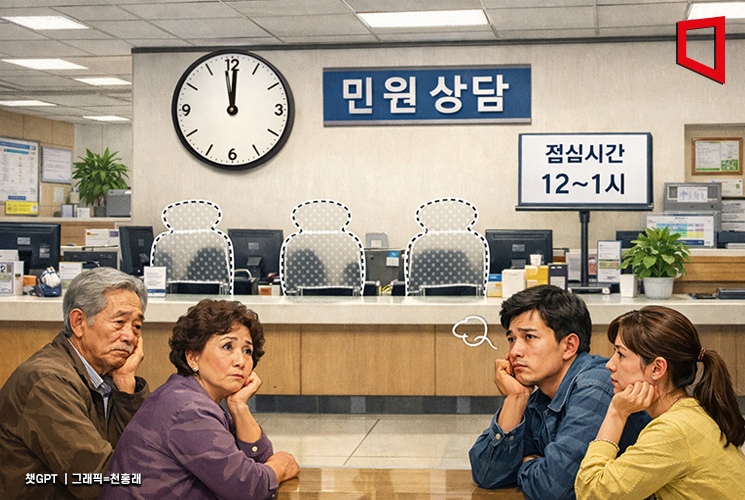
"Guaranteeing Rest Improves Administrative Service Quality"
The lunch break shutdown has long been a demand of the public officials' union. This is because, due to the nature of civil service work, there is a steady flow of citizens even during lunch hours, leading to a fixed practice of skipping meals or taking turns to eat quickly.
 Citizens having lunch with kimbap in front of a community center in Gangnam-gu, Seoul. This photo is for illustrative purposes and is not directly related to the article. Photo by Yonhap News Agency
The public officials' union emphasized, "It is structurally impossible to expect friendly and stable civil service in an environment where even lunch breaks are not guaranteed," adding, "Improving the basic working conditions of public officials ultimately leads to better administrative service quality." In fact, field officials report that the policy helps alleviate the burden of emotional labor and enhances focus on their work.
Citizen Inconvenience Remains an Issue
However, concerns about inconvenience to citizens are also significant. For some services, such as passport issuance and seal certificate verification, visiting the office in person is still essential. The inconvenience is particularly acute for office workers and dual-income households who have relied on the lunch hour to handle administrative matters. Although it has been nearly eight years since the system was introduced, public awareness remains low, leading to repeated instances of citizens visiting offices during lunch only to find them closed.
Local governments plan to minimize inconvenience by expanding unmanned civil document issuance machines, promoting online services such as Government24, and strengthening advance notifications. However, there are concerns that elderly citizens with low digital accessibility may still be left behind. Experts point out that, in order to achieve both administrative efficiency and the protection of labor rights, more sophisticated supplementary measures are needed, such as diversifying operating hours and expanding reservation-based services.
© The Asia Business Daily(www.asiae.co.kr). All rights reserved.
![Clutching a Stolen Dior Bag, Saying "I Hate Being Poor but Real"... The Grotesque Con of a "Human Knockoff" [Slate]](https://cwcontent.asiae.co.kr/asiaresize/183/2026021902243444107_1771435474.jpg)

















