Company-wide Technology System Overhaul... Integration of Unmanned Solutions
Establishment of "Robotics & Hydrogen Business Division" and Organizational Consolidation
Integration of Robotics and Autonomous Driving into Defense, Railways, and Pla
Hyundai Rotem is redrawing its business landscape with a 'Physical AI' system centered on robotics and hydrogen. The company plans to integrate unmanned systems, artificial intelligence (AI), hydrogen energy, and aerospace technologies into its existing business structure, which has been divided into defense, railways, and plant sectors.
On January 14, Hyundai Rotem announced an organizational restructuring that elevates the robotics and hydrogen businesses to company-wide strategic pillars, aiming to secure leadership in new business areas. As competition in physical AI-which goes beyond generative AI by enabling spatial recognition, judgment, and physical actions in the real world-intensifies, Hyundai Rotem intends to redesign its portfolio, which spans weapon systems, trains, logistics equipment, and energy facilities, with a focus on AI and robotics.
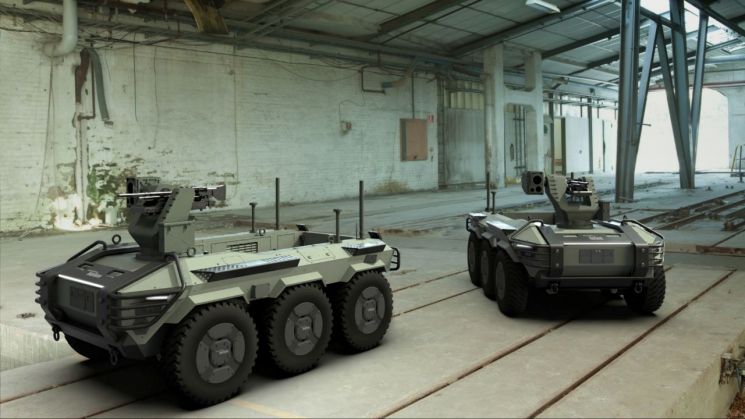 Perspective view of Hyundai Rotem's 4th generation multipurpose unmanned vehicle 'HR (Hyundai Rotem)-Sherpa'. Hyundai Rotem
In his New Year's address, Hyundai Rotem CEO Lee Yongbae stated, "The industrial competitive landscape is rapidly transforming around hydrogen, unmanned systems and AI, and aerospace," emphasizing that "securing technological sovereignty and quickly commercializing it are essential." This reflects the recognition that the company must move toward a new industrial model that combines autonomous driving, robotics, and energy technologies, rather than relying solely on simple automation.
The Defense Solutions division, responsible for defense, will focus on hybrid manned-unmanned ground weapon systems and aerospace business as its core. Next-generation tanks and armored vehicles, as well as the multipurpose unmanned vehicle 'HR (Hyundai Rotem)-Sherpa,' will be equipped with AI-based autonomous driving and swarm control functions, while research and development of legged walking robots will also be expanded. The strategy is to lead the trend of shifting dangerous tasks previously performed by humans to robots and unmanned systems.
The company is also expanding its activities in the space sector. Hyundai Rotem has begun development of South Korea's first 35-ton-class methane engine. Methane engines produce less soot during combustion, making them advantageous for reusable launch vehicles, and are considered a core technology for next-generation space transportation systems that utilize data and AI for repeated flights.
The railway division is being restructured around AI-based maintenance and autonomous operation systems. The company is developing a condition-based maintenance (CBM) system that analyzes operational, failure, and equipment data collected via sensors and the Internet of Things (IoT) to predict failures. Hyundai Rotem is also independently developing AI control systems, autonomous driving technology, and intelligent CCTV. The goal is to transform trains from 'machines that operate' into 'AI platforms capable of self-assessment.'
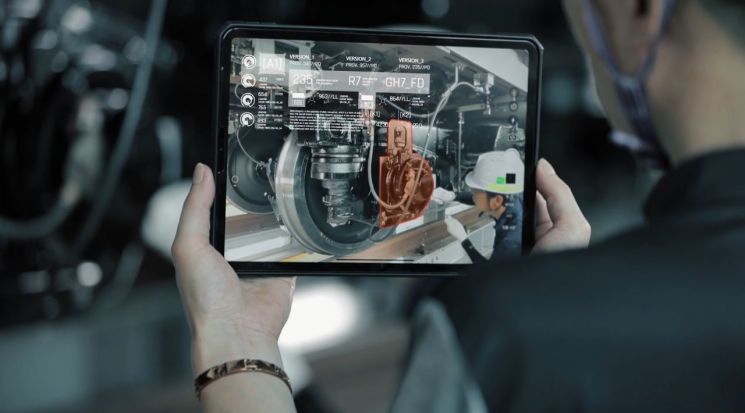 A Hyundai Rotem official is inspecting railway vehicles through a condition-based maintenance system. Hyundai Rotem
The Eco-Plant division is also moving toward a focus on robotics and AI. The company is expanding research, development, and commercialization of smart logistics equipment, such as unmanned port automated guided vehicles (AGVs), integrated with AI, while intensively developing its robotics and hydrogen business capabilities.
To implement this strategy, Hyundai Rotem has established a new 'Robotics & Hydrogen Business Division.' The company has also created new robotics sales and robotics research teams. The existing New Growth Promotion Team and Hydrogen Energy PM organization have been reorganized into the R&H (Robotics & Hydrogen) Business Planning Team and the PM Team, respectively. The Hybrid Manned-Unmanned Systems Center and Robotics Team have been renamed as the AX (AI Transformation) Promotion Center and AI Robotics Team. Within the Aerospace Development Center, a new Aerospace Systems Team has been established.
The organizational structure has also been refined, with the new system taking effect this month. The company has shifted from a function-based to a business-centric structure to accelerate decision-making, reducing the number of departments from 37 to 35, centers from 15 to 14, and teams from 186 to 176.
A Hyundai Rotem official stated, "The evolution toward Physical AI is changing the industrial competitive structure and the way we work. We will enhance our technological competitiveness centered on robotics and hydrogen, and strengthen execution with a fast and flexible organizational structure to further advance our core businesses."
© The Asia Business Daily(www.asiae.co.kr). All rights reserved.
![Clutching a Stolen Dior Bag, Saying "I Hate Being Poor but Real"... The Grotesque Con of a "Human Knockoff" [Slate]](https://cwcontent.asiae.co.kr/asiaresize/183/2026021902243444107_1771435474.jpg)

















