Industry-Academia-Research Meeting on Autonomous Driving Held on the 13th
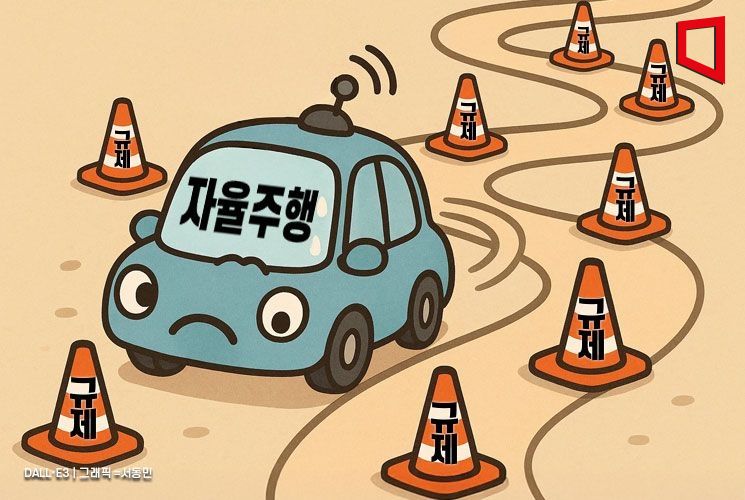
Proactive Regulatory Easing Needed for Technology Demonstration
Roadmap for Commercialization of Autonomous Driving Essential
At CES 2026, the world’s largest electronics and IT exhibition, the United States and China showcased their state-of-the-art autonomous driving technologies. In response, it has been suggested that for domestic companies to close the gap, the pace of regulatory reform centered on real-world demonstrations must be accelerated. Furthermore, it was emphasized that not only large corporations but also small and medium-sized enterprises and startups need to speed up their research and development (R&D), and that the government should establish a roadmap for technology commercialization.
Professor Sung-Ho Hwang of the Department of Mechanical Engineering at Sungkyunkwan University stated at the “Industry-Academia-Research Meeting on Autonomous Driving Technology” held on the 13th at the National Assembly Members’ Office Building in Yeouido, Seoul, “A system that connects technology demonstration and verification projects with legislation is necessary.”
Professor Hwang emphasized, “So far, there have been numerous demonstrations related to robotaxis and autonomous buses, but they have not been directly linked to laws or regulations. If a technology has been demonstrated, we need a cyclical system that grants approval proactively.”
The slow pace of regulatory easing for autonomous driving technology in Korea is an issue that the government is also keenly aware of. Ryu Jemyung, the Second Vice Minister of Science and ICT, who returned from a business trip to CES 2026, wrote on his social media on the same day, “San Francisco citizens were routinely comparing prices and using Uber and Waymo. Hearing that Hyundai Motor is conducting test drives in the United States due to Korean regulations left me with a sense of regret, and I felt an urgent concern that if we continue like this, Korea might fall behind or be eliminated in the era of autonomous vehicles.”
At CES 2026, global big tech companies such as Google’s Waymo and Amazon’s Zoox exhibited their autonomous vehicles and showcased their technologies. Among Chinese companies, Great Wall Motor (GWM) placed its ‘Tank 500’ equipped with autonomous driving features at the center of its booth, while Geely Automobile unveiled its next-generation intelligent driving system ‘G-ASD,’ which ensures safety even in complex traffic environments.
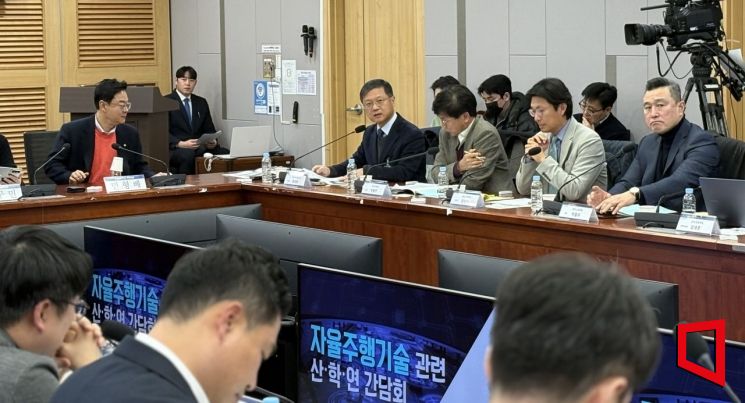 Professor Sung-Ho Hwang of the Department of Mechanical Engineering at Sungkyunkwan University is speaking at the "Industry-Academia-Research Meeting on Autonomous Driving Technology" held on the 13th at the National Assembly Members' Office Building in Yeouido, Seoul. Photo by Young-Joo Jeon
There were also calls for the government to present business models to accelerate R&D among domestic autonomous driving technology companies. Lee Seokjoo, Executive Director at Hyundai Mobis, stated, “From a corporate perspective, the goal is to make money when developing technology. If the question of how to generate profit from autonomous driving technology remains unanswered, no company or research institute will pursue related research.”
Park Dongjoo, President of the Korea ITS Society, also pointed out, “Startups related to autonomous driving are struggling because their technology does not directly translate into revenue.” He added, “R&D should be promoted from a commercialization perspective, and ministries such as the Ministry of Land, Infrastructure and Transport need to clearly present a roadmap for the commercialization of autonomous driving. This will enable companies to embark on long-term technology development.”
© The Asia Business Daily(www.asiae.co.kr). All rights reserved.
![Clutching a Stolen Dior Bag, Saying "I Hate Being Poor but Real"... The Grotesque Con of a "Human Knockoff" [Slate]](https://cwcontent.asiae.co.kr/asiaresize/183/2026021902243444107_1771435474.jpg)
















