Ministry of Agriculture Announces Measures to Improve Livestock Product Distribution Structure
New Wholesale Markets for Pork to Be Established
Expansion of Online Auctions and Promotion of Price Competition
The government has decided to improve the distribution and breeding methods of Korean beef (Hanwoo) by increasing the proportion of direct processing of Hanwoo beef at Nonghyup wholesale markets and shortening the Hanwoo breeding period.
On January 13, the Ministry of Agriculture, Food and Rural Affairs announced these measures in its "Plan to Improve the Distribution Structure of Livestock Products."
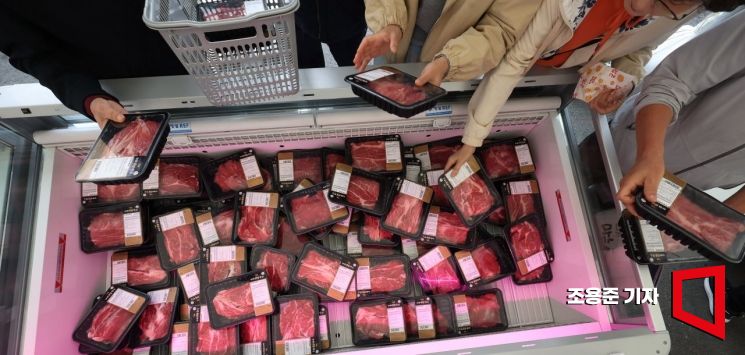
An official from the Ministry of Agriculture, Food and Rural Affairs stated, "The distribution of livestock products has been improved to an advanced level through the integration of slaughtering, processing, and sales, restructuring of slaughterhouses, and modernization of facilities. However, there are still criticisms that some inefficient distribution structures and breeding and trading practices prevent declines in producer prices from being fully reflected in consumer prices." The official added, "In response, a task force (TF) composed of the 'K-Agricultural Policy Council,' producer organizations for each item, and experts held in-depth discussions on improving the distribution structure of livestock products, which led to the development of these improvement measures."
First, the proportion of direct processing of Hanwoo beef at Nonghyup wholesale markets (Bucheon, Eumseong, Goryeong, Naju) will be increased from the current 32% to over 40% by 2030. In addition, with the construction of the Nonghyup Bucheon Integrated Logistics Center (scheduled for the second half of 2028), the currently dispersed distribution functions of Nonghyup (such as online sales and military supply) will be integrated, aiming to reduce distribution costs by up to 10%.
Breeding methods will also be improved. The current high-cost, long-term Hanwoo breeding practices will be changed to reduce the breeding period and thereby lower production costs. If the current breeding period of 32 months is shortened to 28 months, production costs such as feed expenses can be reduced by 10%. To support this, farms that shorten the breeding period will be given priority allocation of high-quality semen, support for genomic analysis, distribution of optimal feeding management programs, and customized consulting.
Measures will also be taken to enhance transparency in pig trading prices and strengthen pork belly standards. To secure the representativeness of wholesale pig prices, new wholesale markets will be established (from the current 10 to at least 12, including online markets, by 2030). Additionally, feed funds will be provided to farms that ship pigs for auction, and raw material purchase funds will be given to processors that purchase auctioned volumes, aiming to increase the auction ratio from the current 4.5% to over 10% by 2030.
In particular, to minimize the issue of excessively fatty pork belly, the fat content range for grade 1+ pork belly will be adjusted (from 22-42% to 25-40%) to encourage farms to improve their breeding methods. Furthermore, pork belly will be categorized and distributed as "front belly" (appropriate fat), "donchadol" (excess fat), and "back belly" (low fat).
For chicken, in response to changing consumption patterns, the consumer price survey will be changed from the price of a whole raw chicken to the prices of cut parts such as chicken pieces and breast meat. For eggs, to prevent market price distortions caused by seasonal changes in production ratios, the prices of extra-large and large eggs will be calculated as a weighted average based on volume. After adjusting the sample size and verifying the data, the method for calculating the Consumer Price Index (CPI) will also be changed in consultation with the National Data Office.
Along with promoting online transactions, the government will also encourage price competition. Online auctions for cattle and pigs will be expanded through remote listings (from 7 in 2025 to over 20 by 2030) and partial cuts auctions (from 2 in 2025 to 10 by 2030) to reduce distribution costs such as logistics expenses. For eggs, online wholesale transactions centered on wholesale markets will be expanded (from 4 in 2025 to over 10 by 2030).
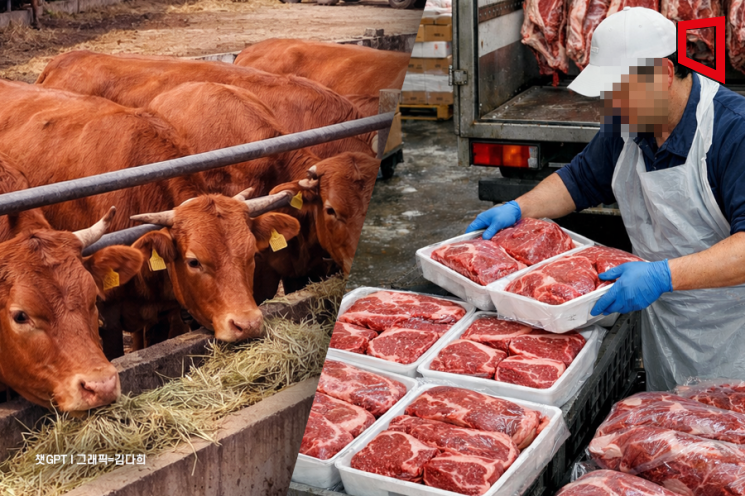
Price competition will also be promoted through price comparisons. The government will activate the "Yeogigogi" app, a livestock product price comparison service, to encourage price competition. The app will provide price information in conjunction with discount events such as check-off programs, expand participation from Nonghyup, producer organizations, and butcher shops, and develop a separate app to enhance user convenience.
© The Asia Business Daily(www.asiae.co.kr). All rights reserved.
![Clutching a Stolen Dior Bag, Saying "I Hate Being Poor but Real"... The Grotesque Con of a "Human Knockoff" [Slate]](https://cwcontent.asiae.co.kr/asiaresize/183/2026021902243444107_1771435474.jpg)
















