Seoul City Bus Union Launches Strike from First Service on the 13th
Final Mediation Fails the Previous Day; Labor and Management Remain at Odds
Only 6.8% of Buses Operating as of 9 a.m.
Seoul city buses began a general strike starting with the first buses of the day on January 13. As approximately 6,500 buses came to a halt during the morning commute, confusion among citizens intensified. The Seoul Metropolitan Government activated emergency transportation measures, allocating around 1 billion won per day to deploy chartered buses in each of the 25 districts.
According to the Seoul Metropolitan Government on January 13, due to the bus union strike, 6,540 city buses-93.2% of the total-had stopped operating as of 9 a.m. Of the total fleet, 478 buses, or 6.8%, continued to run for the convenience of citizens. These were either operated by non-union drivers or by union members who chose not to participate in the strike. The Seoul City Bus Transport Business Association, representing management, has established an "emergency response team" to ensure these drivers can work safely without interference.
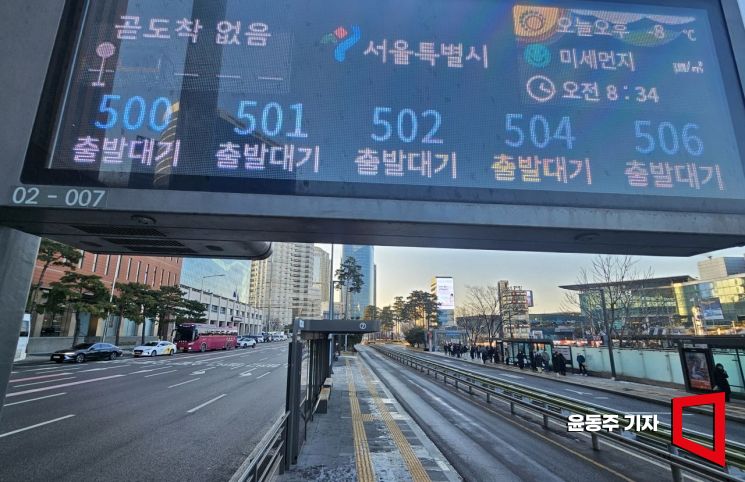 Most Seoul city buses have ceased operation as the Seoul City Bus Labor Union launched an indefinite full strike on the 13th. The electronic display board at a bus stop near Seoul Station shows the location of Seoul city bus routes as "Departing Wait." 2026.01.13 Photo by Yoon Dongju
Buses currently in operation are not charging fares. Notices inside the buses state, "No fare due to bus strike." A city official explained, "During the strike, intervals between buses are longer and citizens inevitably face more inconvenience compared to usual, so buses are operating free of charge during this period." The city plans to resume normal fare collection once the operation rate rises above 30%.
With most buses out of service, subway ridership increased. Yeo Jangkwon, Director of Transportation at the Seoul Metropolitan Government, stated, "Looking at subway usage patterns this morning, the number of passengers between 5 and 7 a.m. increased by 18% compared to the same time yesterday," adding, "This means many citizens anticipated the strike, left home earlier than usual, and opted for the subway."
To prepare for the bus strike, the city implemented emergency transportation measures from the first bus of the day. Subway rush hour periods were extended by one hour, and the last trains were scheduled to run until 2 a.m. Free shuttle buses were deployed in all 25 districts to connect with subway stations. It is reported that about 1 billion won per day is being spent on these chartered bus operations.
"I Didn't Know"... Commuters Stranded on Their Way to Work
The bus strike caused chaos for commuters. As crowds flocked to the subway, stations became packed, and citizens who had not heard about the strike were left stranded at empty bus stops. Park Sunghyun (26), whom we met at Seoul Station, said, "Normally, I take the bus right in front of my house, but today I had to walk a kilometer to the subway. I hope the bus strike ends soon." Yoon Junghyun (44) also commented, "Perhaps because of the bus strike, the subway was much more crowded than usual, which was confusing."
Many people left home earlier than usual, fearing a morning commute crisis. Office worker Jang Junwoo (31) said, "I came out a bit earlier, thinking the subway would be crowded, but it was still very uncomfortable because there were so many people." Kim (38) shared, "When I found out in the morning that the buses weren't running, I rushed to the subway. I left at least 30 minutes earlier than usual. When things stop so suddenly, it's only the citizens who suffer."
There were also many instances of citizens who were unaware of the strike waiting in vain at bus stops. At various Seoul bus stops, only messages such as "At Garage" or "Service Ended" were displayed. Except for those waiting for Gyeonggi buses or village buses, most bus stops were empty. At a bus stop near Sindorim Station, Ahn (31) said with a perplexed expression, "I didn't know about the bus strike." Sim Suhyeon (27) also said, "I woke up and heard about the strike, so I had to quickly head to the subway."
With demand shifting to taxis, catching a cab became nearly impossible. At Exit 1 of Gangnam Station, Hong (27) said, "I have to be at work by 8, but I'm already late. I only found out about the strike just now and am waiting for a taxi." Park (29) added, "Because of the sudden bus strike, I'm just going to take a taxi."
Seoul Bus Labor and Management Remain at an Impasse Over Base Pay and Wage Structure
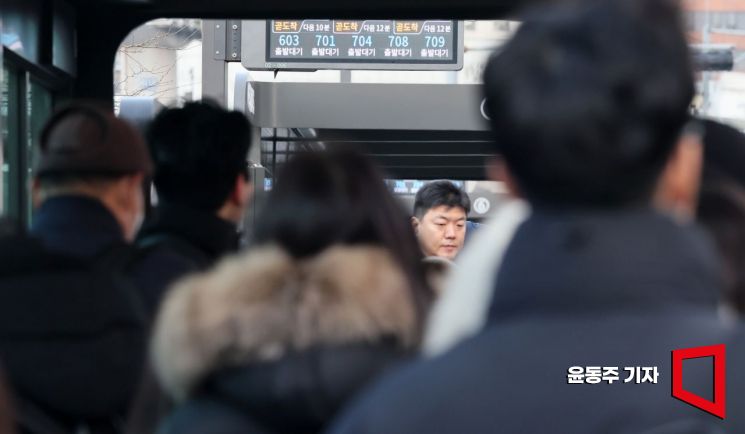 Most Seoul city buses have ceased operation as the Seoul City Bus Labor Union launched an indefinite full-scale strike on the 13th. The electronic display at a bus stop near Seoul Station shows the location of Seoul city bus routes as "Departing Wait." 2026.01.13 Photo by Yoon Dongju
The labor and management sides held a special mediation follow-up meeting at the Seoul Regional Labor Relations Commission from 3 p.m. the previous day but ultimately failed to reach an agreement. The two sides have been deadlocked over the issue of base pay since April of last year. Management insists that, in line with a Supreme Court ruling that broadens the scope of base pay, the wage structure should be revised to include bonuses in the base salary to offset a sharp increase in labor costs. They proposed a total wage increase of 10.3%. The union, on the other hand, argued that additional pay related to base wage recognition should be excluded from this negotiation and instead demanded a 3% wage increase without restructuring the wage system, an extension of the retirement age to 65, and the elimination of wage discrimination.
During the final mediation, management proposed setting the base pay calculation standard at 209 hours, immediately increasing wages by 10.3%, and, if the Supreme Court later rules in favor of the union's claim for 176 hours, retroactively settling the additional amount. Other cities such as Busan, Daegu, and Incheon have also agreed to wage increases based on the 209-hour standard for base pay calculation.
However, the union did not accept this proposal, and management also expressed willingness to accept a mediation plan that included a "base pay increase" as requested by the union. When mediators suggested to management a 0.5% base pay increase separate from the base wage and a one-year extension of the retirement age to 64, management agreed. However, the union suddenly spread the word that this was management's proposal and declared the mediation had broken down. Kim Junghwan, Chairman of the Seoul City Bus Transport Business Association, explained, "It was difficult for us because it meant giving up on restructuring the wage system, but we accepted the plan to avoid a strike. We are perplexed by the rejection of even such a proposal and the escalation to a strike."
The union, however, claims that management and the Seoul Metropolitan Government are responsible for ignoring the payment of overdue wages. In a statement, the union emphasized, "The responsibility for this strike lies with the Seoul Metropolitan Government, which refused the bus workers' demand for a 3% wage increase and distorted the facts by making it seem as if the legally mandated overdue wage payment was a wage increase demanded by the union."
Since the final mediation broke down, no further negotiation schedule has been set between the bus labor and management. It is considered unusual for collective bargaining negotiations for Seoul city bus workers to carry over into the new year. During the 2024 bus strike, the dispute was dramatically resolved around 3 p.m. on the same day, ending the strike after about 11 hours.
© The Asia Business Daily(www.asiae.co.kr). All rights reserved.
![Clutching a Stolen Dior Bag, Saying "I Hate Being Poor but Real"... The Grotesque Con of a "Human Knockoff" [Slate]](https://cwcontent.asiae.co.kr/asiaresize/183/2026021902243444107_1771435474.jpg)

















