Bank of Korea Disposes of 364.01 Million Damaged Notes and Coins Last Year
"Clean Usage of Currency Helps Reduce Production Costs"
If the damaged currency discarded last year were stacked up, it would reach 17 times the height of Mount Everest (8,849 meters).
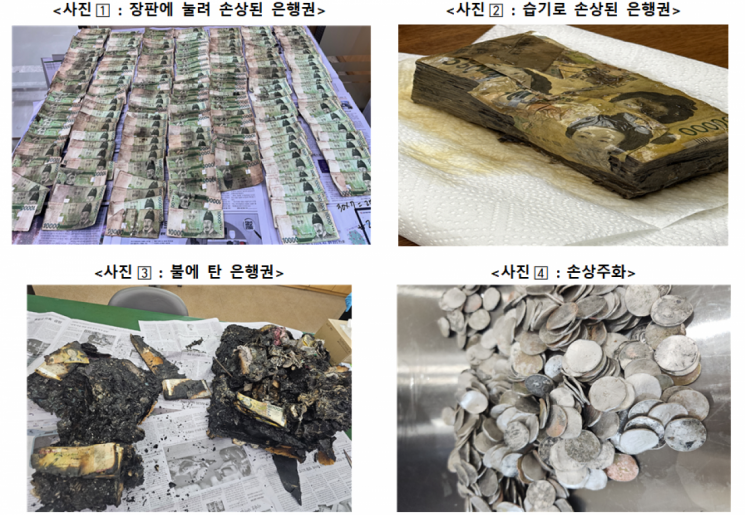
On January 13, the Bank of Korea announced that it had disposed of 364.01 million damaged banknotes and coins in 2025, amounting to 2.8404 trillion won. This represents a decrease of 110.88 million notes and coins, or 23.3%, compared to the 474.89 million (3.3761 trillion won) disposed of in 2024. A Bank of Korea official explained, "The decrease in the amount collected is the result of increased demand for currency due to falling market interest rates." Damaged currency refers to banknotes and coins that have been returned to the Bank of Korea from circulation and deemed unfit for use due to damage or contamination.
The number of damaged banknotes disposed of was 295.18 million (2.8286 trillion won). By denomination, 10,000-won notes accounted for 145.49 million, or 49.3% of the total. This was followed by 1,000-won notes at 103.99 million (35.2%), 50,000-won notes at 23.14 million (7.8%), and 5,000-won notes at 22.57 million (7.6%). The number of damaged coins disposed of was 68.82 million (11.8 billion won). By denomination, 100-won coins accounted for 30.19 million (43.9%), 500-won coins for 16.64 million (24.2%), 10-won coins for 16.36 million (23.8%), and 50-won coins for 5.63 million (8.2%).
A Bank of Korea official stated, "If the discarded currency were laid out end to end, it would stretch 44,043 kilometers, enough to circle the Earth (about 40,000 kilometers) and then some. If stacked, the total height would reach 147,017 meters, which is 17 times the height of Mount Everest and 265 times the height of Lotte World Tower (555 meters)." The official added, "Using currency cleanly can reduce the annual cost of currency production, so the Bank of Korea will continue to actively promote its 'Use Money Cleanly' campaign."
Meanwhile, the standards for exchanging damaged currency vary depending on the extent of the damage. If a banknote is damaged by fire or other causes and can no longer be used, the full face value will be paid if more than three-quarters of the original area remains, and half the face value will be paid if more than two-fifths but less than three-quarters remains. If less than two-fifths of the original area remains, the note is deemed invalid. Likewise, coins that are damaged or otherwise unfit for circulation can be exchanged at face value, but coins that are unrecognizable or whose authenticity cannot be determined cannot be exchanged.
© The Asia Business Daily(www.asiae.co.kr). All rights reserved.

















