Powell: "The Question Is Whether Monetary Policy Will Be Dictated by Political Pressure"
Concerns Over Fed Independence Chill Investor Sentiment
Market Anxiety Spreads, Driving Gold Prices Higher as a Safe Haven
All three major U.S. stock indices on the New York Stock Exchange declined on January 12 (local time). Concerns over the independence of the central bank have intensified after the Donald Trump administration launched a congressional perjury investigation against Jerome Powell, Chairman of the U.S. Federal Reserve (Fed), which is weighing on investor sentiment. A broad "sell America" trend is emerging across financial markets, with both the dollar and Treasury prices also falling.
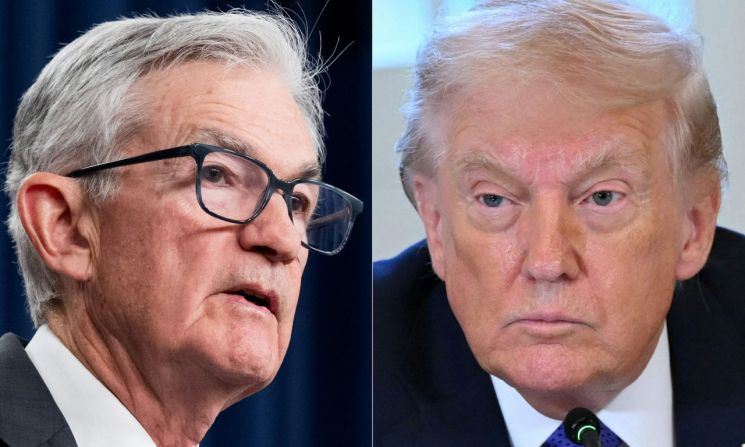 U.S. President Donald Trump (right) and Jerome Powell, Chairman of the U.S. Federal Reserve (Fed). Photo by AFP Yonhap News
As of 10:06 a.m. on the same day at the New York Stock Exchange, the Dow Jones Industrial Average, which focuses on blue-chip stocks, was down 205.86 points (0.42%) from the previous trading day at 49,298.21. The S&P 500 Index, which tracks large-cap stocks, fell 9.18 points (0.13%) to 6,957.1, while the tech-heavy Nasdaq Index dropped 29.813 points (0.13%) to 23,641.534.
Chairman Powell stated the previous day that the Fed received a subpoena from the U.S. Department of Justice on January 9 and was notified of potential criminal charges related to his testimony before the Senate Banking Committee in June of last year regarding the Fed headquarters remodeling. President Trump has publicly criticized Chairman Powell over what he claims are excessive remodeling costs at the Fed headquarters, and this has ultimately led to the launch of the investigation. Both political and financial circles interpret this as pressure from the Trump administration on Chairman Powell, who has refused to comply with demands for interest rate cuts.
In his statement, Chairman Powell directly addressed the issue, saying, "This is a matter of whether the Fed can continue to set interest rates based on evidence and economic conditions, or whether monetary policy will be dictated by political pressure or intimidation."
As the controversy over central bank independence reignites, market anxiety is rising. If monetary policy is swayed by political pressure, it could make responding to inflation more difficult, and in the long term, could result in high inflation and rising Treasury yields, sending shockwaves throughout the financial markets.
The Fed has lowered its benchmark interest rate by a total of 0.75 percentage points over three consecutive cuts since September of last year in response to signs of a slowdown in the labor market, but a rate freeze is expected this month. In contrast, President Trump continues to demand further rate cuts, insisting that rates should be brought down to around 1% per year.
Jay Woods, Chief Market Strategist at Freedom Capital Markets, said, "The market has experienced situations like this in the past and does not like them," emphasizing, "At this point, this is not just a personal issue for Chairman Powell, but an issue of the Fed's independence." He added, "Whenever news like this breaks, there is a reflexive wave of selling."
The dollar is weakening. The dollar index, which measures the value of the dollar against the currencies of six major countries, is down 0.3% from the previous trading day at 98.59.
In the Treasury market, long-term bond prices are falling, pushing yields higher. The yield on the 10-year U.S. Treasury, the global benchmark, is up 2 basis points (1bp = 0.01 percentage point) from the previous day at 4.19%. The yield on the 2-year U.S. Treasury, which is sensitive to monetary policy, is hovering around 3.54%, unchanged from the previous day.
As anxiety over dollar assets grows, gold prices are rising. Gold futures are trading at $4,610.91 per ounce, up 2.44% from the previous day.
Ben Lam, a macroeconomic strategist at Bloomberg, said, "The risk premium embedded in the dollar could rise further in the coming weeks if investors revive last year's 'sell America' sentiment," adding, "If this week's economic data show that inflation remains entrenched and the White House nominates a new dovish (monetary easing-oriented) Fed chair, the risk premium could increase even more."
Investors are also closely watching the release of major economic indicators this week. On January 13, the Consumer Price Index (CPI) for December will be released, followed by retail sales and the Producer Price Index (PPI) on January 14. In addition, the earnings season will officially kick off, starting with financial stocks. This week, major banks such as JPMorgan Chase, Bank of America, Morgan Stanley, and Goldman Sachs are scheduled to announce their quarterly results.
By sector, financial stocks such as Citigroup, JPMorgan, Bank of America, and Capital One are generally weak. President Trump's proposal to cap credit card interest rates at 10% per year for one year is putting pressure on banks and financial services companies with a high proportion of credit card sales.
© The Asia Business Daily(www.asiae.co.kr). All rights reserved.
![Clutching a Stolen Dior Bag, Saying "I Hate Being Poor but Real"... The Grotesque Con of a "Human Knockoff" [Slate]](https://cwcontent.asiae.co.kr/asiaresize/183/2026021902243444107_1771435474.jpg)















