Second Special Prosecution Bill Passed Under Ruling Party's Leadership
The National Assembly's Legislation and Judiciary Committee processed the second comprehensive special prosecution bill, led by the ruling party, at a full committee meeting on the 12th. The People Power Party criticized this move, stating, "They intend to continue stirring up insurrection charges until the local elections."
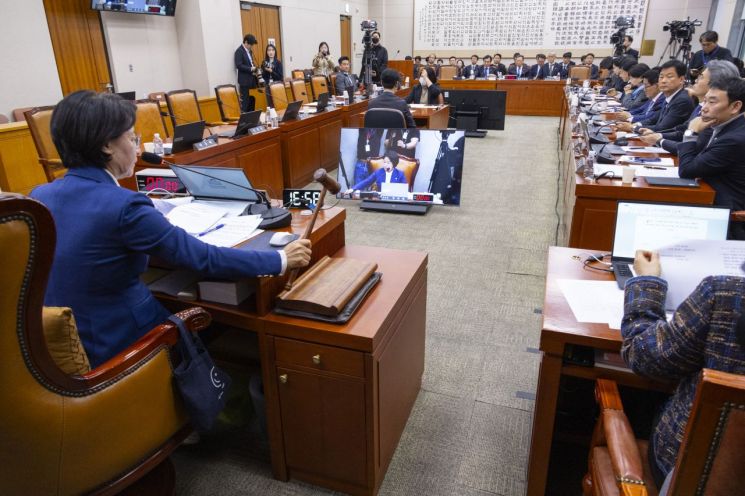 Choo Mi-ae, Chairperson of the National Assembly's Legislation and Judiciary Committee, is leading the ruling party in processing the second comprehensive special prosecution bill at the full committee meeting held at the National Assembly on the 12th. Photo by Yonhap News
The special prosecution bill includes crimes related to all acts of planning and preparing insurrection, such as the dissolution of the National Assembly and the establishment of emergency legislative bodies, as new targets for special prosecution investigations. It also covers allegations that former President Yoon Suk-yeol and others drew up response plans and conspired for additional martial law following the 12·3 Emergency Martial Law.
Allegations related to the Unification Church were excluded, as a separate special prosecution bill addressing political collusion and bribery involving the Unification Church had already been proposed, which could have led to overlap. Additionally, the mandatory provision requiring the dispatch of at least two prosecutors from the Corruption Investigation Office for High-ranking Officials (CIO) to support the special prosecutor was removed.
A new provision was added granting the special prosecutor the authority to maintain prosecution in cases that have already been indicted and are under trial. The bill also establishes a legal basis for dispatched prosecutors, who are under the direction and supervision of the special prosecutor, to maintain prosecution in court even if the special prosecutor or assistant special prosecutors are not present.
The selection of the special prosecutor will be conducted by drawing lots, with one candidate each from the Democratic Party of Korea and the largest non-negotiating parliamentary group. The investigation period is a total of 170 days, including a 20-day preparation period. The investigation team will consist of five assistant special prosecutors and 100 special investigators. The number of dispatched prosecutors will be reduced from 30 to 15, while the number of dispatched government officials will increase from 70 to 130.
The People Power Party expressed strong opposition to the passage of this second comprehensive special prosecution bill. Assemblywoman Na Kyungwon of the People Power Party stated at the full committee meeting, "They are targeting local government heads for investigation," adding, "In short, they intend to continue stirring up insurrection charges until the local elections and disgrace sitting officials."
In contrast, the Democratic Party of Korea maintains that further investigation is necessary to address shortcomings in the three major special prosecutions (involving Kim Keonhee, insurrection, and the death of Marine Chae). Assemblyman Park Ji-won of the Democratic Party said, "Through the second special prosecution, we must find the reservoir where Kim Keonhee and Choi Eunsun have hidden cash," adding, "These two are people who would do anything for money."
© The Asia Business Daily(www.asiae.co.kr). All rights reserved.
![Clutching a Stolen Dior Bag, Saying "I Hate Being Poor but Real"... The Grotesque Con of a "Human Knockoff" [Slate]](https://cwcontent.asiae.co.kr/asiaresize/183/2026021902243444107_1771435474.jpg)
















