"Need to Consider Strengthening Support for Obstetrics and Gynecology Departments at Hub Hospitals"
The Ministry of Health and Welfare’s “Support Project for Obstetrics and Gynecology in Areas Vulnerable to Childbirth” is facing criticism over its policy effectiveness, as its performance has been lackluster compared to the budget allocated. Despite tens of billions of won in taxpayer money being spent on each region, nearly 20% of the supported institutions report fewer than ten deliveries per year.

According to data submitted by the Ministry of Health and Welfare to Assemblywoman Seo Myungok of the National Assembly Health and Welfare Committee on January 13, 2026, as of 2024, seven out of thirty-six supported institutions nationwide recorded fewer than ten deliveries annually.
The support project for areas vulnerable to childbirth was introduced in 2011 to improve medical accessibility in rural and fishing communities. Its core is to assist local medical institutions without obstetric departments in establishing and operating delivery rooms. Newly selected institutions receive 1 billion won in facility and equipment costs for setting up delivery and operating rooms. Subsequently, 500 million won in annual operating expenses is provided to cover personnel and maintenance costs. By the end of 2025, a total of thirty-six obstetrics and gynecology institutions will have been selected and are receiving support.
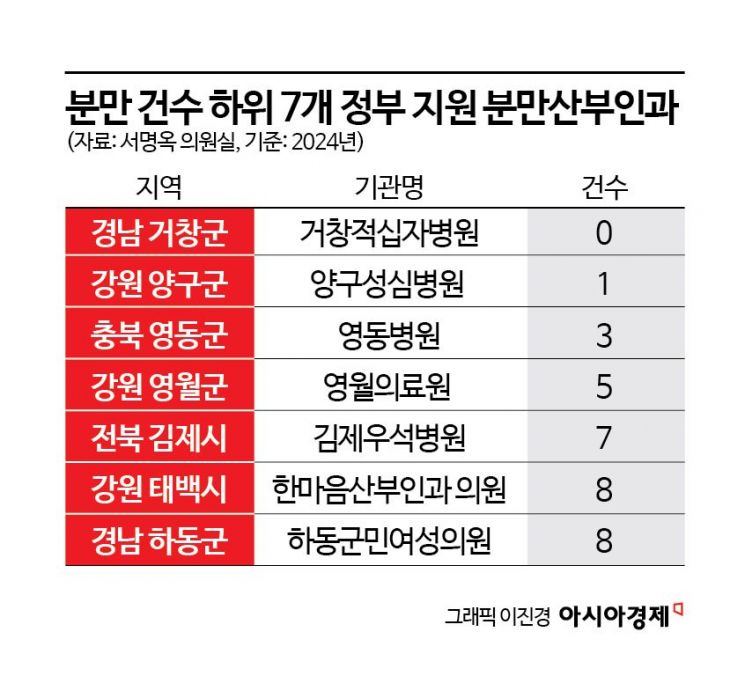
Despite the tens of billions of won in support, the number of deliveries remains low. For example, at Yanggu Seongsim Hospital in Yanggu County, Gangwon Province, the number of deliveries over the past three years (2022-2024) was just 0, 0, and 1, respectively. In 2024, Geochang Red Cross Hospital in Geochang County, South Gyeongsang Province, and Yeongdong Hospital in Yeongdong County, North Chungcheong Province, recorded only 0 and 3 deliveries, respectively. Utilization rates are also low. According to data from the Ministry of Health and Welfare, in Yanggu County in 2024, 116 children were born in the region, but only 0.8% were born at the government-supported Yanggu Seongsim Hospital. Similarly, in Yeongdong County, only 3.4% of the 88 newborns were delivered at Yeongdong Hospital.
Childbirth typically involves regular checkups and scheduled hospitalizations. Expectant mothers tend to prefer major urban hospitals that can handle high-risk situations over small local hospitals near their residences. The distance to these major urban hospitals is not significant. At many supported institutions, it takes about an hour by car to reach a regional tertiary general hospital. Analysts point out that this background is a major reason why support for obstetrics and gynecology in vulnerable areas has not been effective.
As a result, there are calls to improve the system by enhancing support for obstetrics and gynecology departments at nearby regional hospitals, rather than forcibly maintaining small hospitals in vulnerable areas, in order to increase effectiveness. Assemblywoman Seo Myungok stated, “It is time to review whether the current project is truly helping local expectant mothers and whether the budget is being used efficiently,” adding, “Beyond simply improving numerical accessibility, we must consider shifting to a more efficient support system centered on regional hospitals.”
© The Asia Business Daily(www.asiae.co.kr). All rights reserved.
![Clutching a Stolen Dior Bag, Saying "I Hate Being Poor but Real"... The Grotesque Con of a "Human Knockoff" [Slate]](https://cwcontent.asiae.co.kr/asiaresize/183/2026021902243444107_1771435474.jpg)
















