Audi Jumps to Third Place
Mercedes-Benz Falls Behind Expectations
Last year, one out of every three imported cars sold in Korea was an electric vehicle. Electric vehicles, driven by strong demand for eco-friendly cars and led by Tesla and BYD, have emerged as the main contributors to ushering in the era of "300,000 imported cars" in the country.
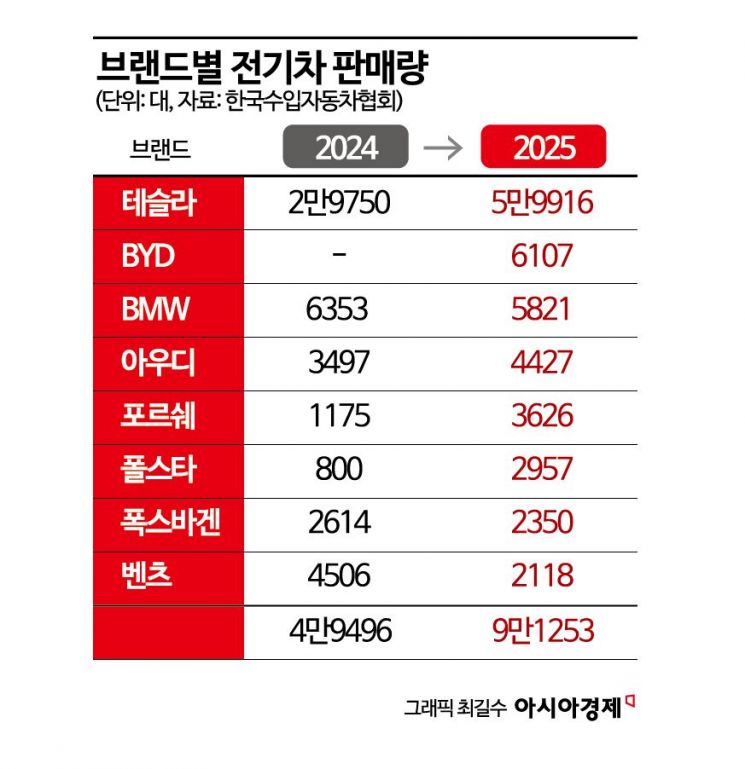
According to data on passenger car registrations by fuel type for 2025 released by the Korea Automobile Importers & Distributors Association on the 12th, newly registered electric vehicles totaled 91,253 units, a sharp increase of 84% compared to the previous year. Electric vehicles accounted for 30% of the total 307,377 imported cars sold. The market share of electric vehicles among imported cars, which was below 10% in 2023, rose to 18% in 2024 and jumped by 12 percentage points last year.
During the same period, hybrid vehicles (including plug-in hybrids) reached 174,218 units, commanding a market share of 56%. However, this represented only a 5 percentage point increase compared to the previous year's 51%.
Sales of internal combustion engine vehicles shrank significantly as they lost ground to the eco-friendly trend. Gasoline cars dropped to 38,512 units, a 62% decrease from the previous year's 62,671 units, accounting for only 12% of the market. Diesel vehicles sold just 3,394 units, barely surpassing a 1% market share.
The dominance of electric vehicles was led by brands like Tesla and BYD. Tesla sold a total of 59,916 units, spearheaded by the Model Y (including long-range models), which alone sold over 50,000 units. This figure nearly doubled compared to the previous year's 29,750 units.
BYD, which entered the Korean market last year, quickly rose to second place in electric vehicle sales by selling 6,107 units. After the successful market entry of the cost-effective Atto 3 (3,076 units), the company introduced the Seal (369 units), followed by the mid-size SUV Sealion 7, which sold 2,662 units within just four months of its launch, driving further growth. Volvo's electric vehicle brand Polestar also ranked sixth in sales, recording 2,957 units sold.
BMW and Mercedes-Benz, which ranked first and second in total imported car sales, struggled in the electric vehicle market. BMW sold only 5,821 units, an 8% decrease from the previous year's 6,353 units, while Mercedes-Benz sold 2,118 units, about half of the previous year's 4,506 units.
In contrast, Audi and Porsche both made it into the top five in electric vehicle sales, with Audi selling 4,427 units (up 27% year-on-year) and Porsche selling 3,626 units (up 208% year-on-year).
This year, a large number of new electric vehicles are expected to debut in the imported car market. BYD is expected to launch the small electric hatchback "Dolphin," which completed domestic certification procedures in October last year. However, the company plans to strategically determine the timing of the launch, as the domestic small hatchback market has not grown as much as anticipated.
BMW Korea will release the "iX3 50 xDrive," the first model under its "Neue Klasse" strategy, in the second half of the year. Mercedes-Benz also plans to introduce the mid-size electric SUV "GLC EQ Technology" and the new CLA.
© The Asia Business Daily(www.asiae.co.kr). All rights reserved.
![Clutching a Stolen Dior Bag, Saying "I Hate Being Poor but Real"... The Grotesque Con of a "Human Knockoff" [Slate]](https://cwcontent.asiae.co.kr/asiaresize/183/2026021902243444107_1771435474.jpg)
















