KCCI Releases Q1 RBSI Survey for Retailers
Slight Decline from Previous Quarter: 87 to 79
High Inflation, Strong Exchange Rate, and Seasonal Factors Cited
Only Department Stores Exceed Benchmark; Hypermarkets Hit Lowest Point
"Bold Investments Needed for Retail Innovation"
The Retail Business Survey Index (RBSI) for the first quarter of this year declined for the second consecutive quarter, affected by high inflation, a strong exchange rate, and seasonal factors.
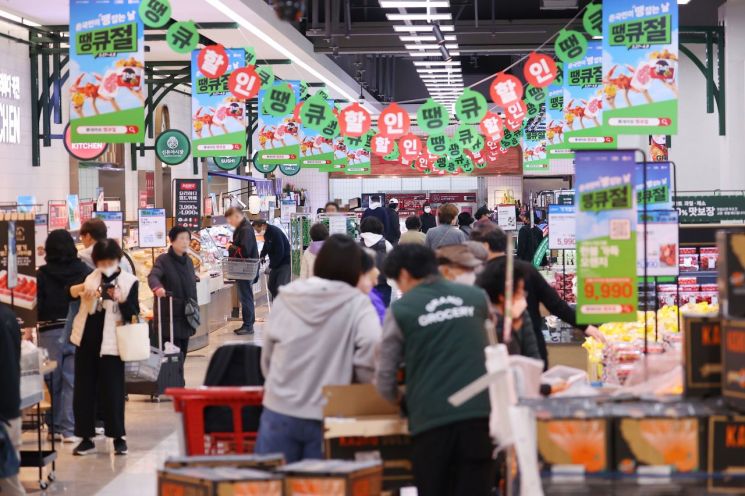 Citizens shopping at Lotte Mart Grand Grocery Lotte Mall Eunpyeong Branch in Eunpyeong-gu, Seoul. Photo by Yonhap News Agency
The Korean Chamber of Commerce and Industry announced on the 12th that, based on a survey of 500 retail companies regarding their current business conditions and outlook, the RBSI for the first quarter of this year was recorded at 79. This represents a drop of 8 points compared to the previous quarter (87).
The RBSI quantifies retail companies’ assessments and outlooks, reflecting their business sentiment. A figure above 100 indicates that more companies view the next quarter more positively than the previous one, while a figure below 100 means the opposite.
Regarding the survey results, the Korean Chamber of Commerce and Industry analyzed, “With consumer spending power weakened by high inflation, rising procurement costs due to the strong exchange rate, and increases in fixed costs such as labor costs are directly pressuring companies’ profit margins.” The chamber further added, “Increased marketing expenses due to intensified competition, combined with the seasonal off-peak period following the end of the year-end peak season, have dampened overall business sentiment in the industry.”
By sector, department stores (112) were the only category to exceed the benchmark. Online shopping (82), supermarkets (67), convenience stores (65), and hypermarkets (64) all fell below the benchmark.
Department stores are expected to maintain solid growth, driven by the popularity of K-food, K-beauty, and K-fashion, coupled with a surge in foreign tourists due to the strong exchange rate, as well as strong brand loyalty for luxury goods and robust winter clothing sales. Online shopping is projected to show relatively steady performance compared to other offline formats, as rational consumption trends have become more pronounced amid high inflation.
In contrast, hypermarkets recorded the lowest outlook due to reduced spending caused by high inflation and intensified competition with online platforms in the fresh food segment. Convenience stores posted a lower outlook due to the seasonal off-peak period resulting from decreased foot traffic in winter and anticipated increases in labor costs. Supermarkets also showed weak results, affected by intensified competition among nearby retail channels, including convenience stores, as well as rising fixed costs.
Lee Heewon, Director of the Distribution and Logistics Promotion Center at the Korean Chamber of Commerce and Industry, stated, “Large-scale discount events are essential to revive subdued consumer sentiment and act as a catalyst for invigorating local economies. As the retail sector is evolving beyond a simple sales channel into an advanced knowledge industry integrating artificial intelligence (AI) and data technology, bold investments in system modernization and technological innovation must also be prioritized.”
© The Asia Business Daily(www.asiae.co.kr). All rights reserved.
![Clutching a Stolen Dior Bag, Saying "I Hate Being Poor but Real"... The Grotesque Con of a "Human Knockoff" [Slate]](https://cwcontent.asiae.co.kr/asiaresize/183/2026021902243444107_1771435474.jpg)















