Plan to Refer Illegal Importers to Incheon District Prosecutors' Office This Month
The Animal and Plant Quarantine Agency has apprehended importers involved in the illegal importation of 1,150 tons of Chinese agricultural products.
The agency announced on January 12 that, from December 2023 to January 2025 (a period of 13 months), it had identified a total of 12 individuals-including three intermediaries and nine actual importers-who illegally imported a total of 1,150 tons of contraband items through Incheon Port. These items included Chinese dried jujubes, raw peanuts, and dried chili peppers that had not undergone quarantine under the Plant Protection Act, as well as Chinese fresh fruits and apple seedlings, which are prohibited from importation.
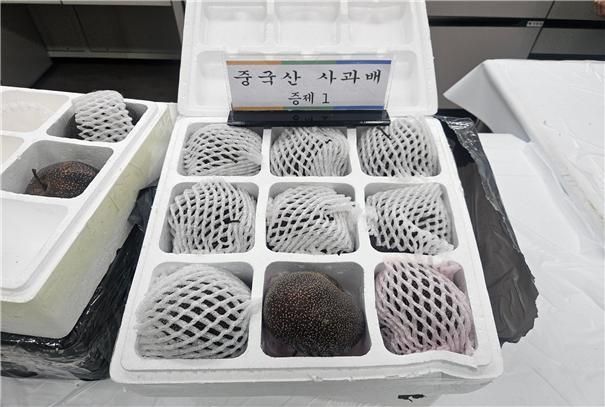 Photo related to the seizure of Chinese apples and pears (import prohibited items). Animal and Plant Quarantine Agency
The seized volume of 1,150 tons is the largest ever uncovered by the agency. Of the 12 individuals involved in the illegal importation, the agency plans to refer nine to the Incheon District Prosecutors' Office within this month.
In January of last year, a special judicial police officer (hereafter, special investigator) from the agency's Metropolitan Investigation Team conducted a search and seizure at a warehouse in Gimpo, discovering 33 tons of Chinese dried agricultural products on site. By analyzing the digital information from the suspect's mobile phone seized at that time, the agency further identified that more than 1,100 tons of Chinese seedlings and agricultural products (hereafter, contraband items) had been imported illegally over the course of a year-equivalent to approximately 10 containers per month. Based on this, the agency continued its investigation, tracing the importers who had ordered these contraband items domestically.
Additionally, through interrogations of the three intermediaries and other suspects, the special investigators found that the suspects had colluded with Chinese exporters to disguise the contraband items as pet supplies (a method known as "curtain trick") and falsely declared to customs that only pet supplies were being imported, when in fact the containers contained the illegal agricultural products.
Among the seized contraband items, the Chinese apple seedlings and fresh fruits are quarantine-regulated items that are strictly prohibited from importation, as they are host plants of fire blight-a disease that has recently caused significant damage to domestic apple and pear orchards. Dried agricultural products such as dried chili peppers and dried jujubes cannot be imported or distributed domestically without quarantine procedures, as a measure to prevent the introduction of invasive pests and diseases.
Importing agricultural products without quarantine, as in this case, can result in imprisonment for up to three years or a fine of up to 30 million won under the Plant Protection Act.
The 33 tons of dried agricultural products seized on site were disposed of for the first time through eco-friendly composting, rather than the conventional incineration method, achieving the dual benefits of environmental protection and reduced disposal costs. The resulting compost, totaling 300 tons and valued at 170 million won, was distributed free of charge to farmers in the vicinity of the compost production plant, helping to increase farm income.
To actively respond to organized crime cases like this, the agency established a Metropolitan Investigation Team with six dedicated investigators in April of last year. By December of the same year, the team had initiated criminal proceedings in 63 cases and referred 34 cases involving 47 individuals for prosecution.
Choi Jeong-rok, Commissioner of the Animal and Plant Quarantine Agency, stated, "The indiscriminate entry of prohibited items such as unquarantined dried agricultural products, seedlings, and fresh fruits can directly lead to the introduction of invasive pests and diseases and cause damage to agriculture and forestry. We will continue to strengthen our dedicated investigative organization and personnel to respond strictly to organized violations of the law."
© The Asia Business Daily(www.asiae.co.kr). All rights reserved.
![Clutching a Stolen Dior Bag, Saying "I Hate Being Poor but Real"... The Grotesque Con of a "Human Knockoff" [Slate]](https://cwcontent.asiae.co.kr/asiaresize/183/2026021902243444107_1771435474.jpg)











