No. 1 Growth Rate Among Cities in South Gyeongsang Province
Success of Youth, Marriage, and Childbirth Policies
The number of newborns in Jinju City, South Gyeongsang Province, has shown a marked increase for two consecutive years, ranking first in growth rate among city-level local governments in the province and drawing significant attention.
The city announced on January 12 that, as a result of actively implementing citizen-participatory population policies to overcome the crisis of population decline, the number of births rebounded sharply from its low point in 2023 and achieved year-on-year growth for two consecutive years.
According to the resident registration population statistics released by the Ministry of the Interior and Safety on January 5, the number of resident-registered newborns in Jinju City hit a low of 1,693 in 2023, then rose to 1,705 in 2024 and 1,864 in 2025, showing a clear upward trend.
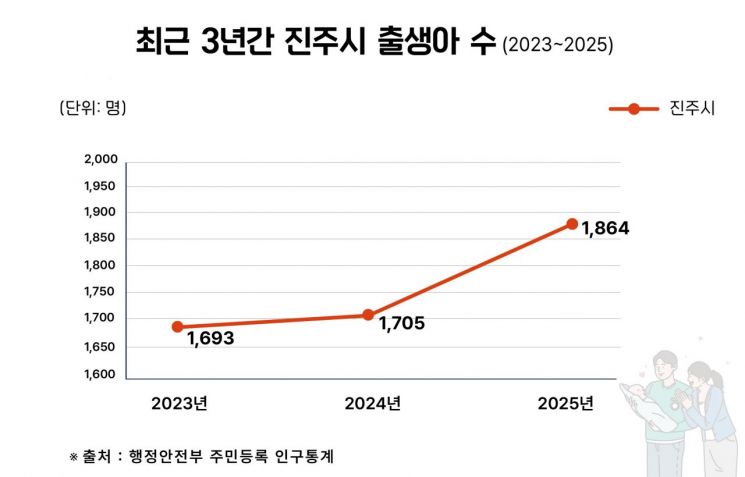
Notably, the number of births in 2025 increased by 128 (7.37%) compared to 2021 (1,736), recording the highest growth rate among city-level local governments in South Gyeongsang Province.
In comparison, the total number of newborns in South Gyeongsang Province during the same period decreased from 15,629 in 2021 to 14,265 in 2022 and 13,244 in 2023, before showing a modest recovery to 13,250 in 2024 and 13,911 in 2025. This highlights the remarkable pace and magnitude of recovery in Jinju City.
In terms of the youth population ratio, Jinju City also stands out. As of the end of 2025, the city’s total resident-registered population is 335,939, with 83,527 classified as youth, resulting in a youth population ratio of 24.86%. This is the highest among all cities and counties in South Gyeongsang Province.
During the same period, the total resident-registered population of South Gyeongsang Province is 3,207,383, with a youth population of 693,135, resulting in a youth ratio of only 21.61%. This confirms that Jinju City significantly exceeds the provincial average.
This achievement is attributed to the city’s consistent efforts to establish a foundation for quality jobs and support youth settlement through various youth policies, such as the "Youth Welfare Support Fund for Employment in Small and Medium Enterprises" and "Support for Youth Certification Exam Fees."
Jinju City has continuously promoted policies that enable young people to settle down and start families, including youth settlement support projects, expansion of youth job opportunities, housing support for youth and newlyweds, customized support throughout the entire cycle of marriage, pregnancy, childbirth, and parenting, and the creation of a child-friendly urban environment. In particular, these policies have minimized the decline in the youth population and created a virtuous cycle leading to an increase in the number of births, drawing even greater attention.
A city official stated, "Achieving a rebound in the number of births despite the structural challenge of population decline is the result of policy efforts that have enabled youth and newlyweds to plan their futures in Jinju. We will continue to focus our policy capabilities on creating a sustainable city where young people stay, and marriage and childbirth occur naturally."
Meanwhile, to ensure the stable continuation of the increase in births, Jinju City plans to introduce new projects this year, such as the "Youth Employment Support Project for Small and Medium Enterprises" and the "Support Project for Driving License Acquisition Costs for Young Adults." The city will also continue to expand policies to improve population structure, including strengthening youth settlement support, alleviating the burdens of marriage and childbirth, opening the Seongbuk-dong Child Welfare Center, expanding child allowances, enhancing care infrastructure, and building a family-friendly city.
© The Asia Business Daily(www.asiae.co.kr). All rights reserved.
![Clutching a Stolen Dior Bag, Saying "I Hate Being Poor but Real"... The Grotesque Con of a "Human Knockoff" [Slate]](https://cwcontent.asiae.co.kr/asiaresize/183/2026021902243444107_1771435474.jpg)















