HRANA: "538 Dead"
Iranian President: "Firm Crackdown... US and Israeli Conspiracy"
US Mulls Response... Israel Leaves Room for Military Action
As protests against Iran's economic crisis continued for the fifteenth consecutive day, the number of casualties has been rising rapidly. Some reports suggest that over 2,000 people may have died.
On January 11 (local time), Iran Human Rights (IHR), a Norway-based organization, estimated that at least 192 people had been killed as of that day. The organization had reported 51 deaths on the 9th, meaning the number has increased by about four times.
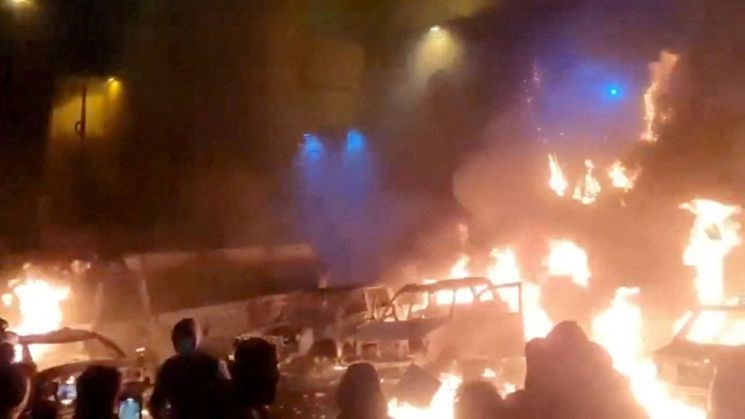 On the 9th (local time), as anti-government protests spread in Tehran, Iran, a photo showing protesters gathered in front of a burning vehicle was released on social media. Photo by Reuters Yonhap News
IHR pointed out that Iranian authorities have blocked internet and communications locally for more than 60 hours, and stated, "According to unverified reports, some sources suggest that over 2,000 people may have died."
IHR also reported that most deaths occurred on the 9th and 10th, and that there were accounts of hundreds of bodies of protest victims being seen at a morgue in Tehran, the capital of Iran.
According to the Associated Press, citing data from the US-based Human Rights Activists News Agency (HRANA), the death toll has reached 538, including 490 civilians and 48 military and police personnel, with more than 10,600 people arrested. This is about five times higher than the 116 deaths reported by the agency the previous day.
The Iranian authorities have not released an official death toll.
Previously, the US weekly magazine Time cited a doctor in Tehran, reporting that at least 217 deaths had been confirmed at six hospitals, with most victims killed by live ammunition.
Mahmood Amiry-Moghaddam, Director of IHR, said, "The massacre of protesters that has occurred over the past three days, especially since the nationwide internet blackout, may be far more extensive than we can imagine," and urged the international community to use every possible means to stop it. He also explained that the Iranian prosecutor's office has labeled the protests as 'Moharebeh (enemy of God),' a charge referring to denying Islam, calling it "a threat to execute protesters."
The protests, which began on December 28 in response to soaring prices, have been met with increasingly harsh crackdowns by Iranian authorities, who have blocked internet and communications since last week and deployed the Islamic Revolutionary Guard Corps (IRGC) ground forces, the vanguard of the theocratic regime, in some regions.
With communication channels to the outside world cut off, some Iranian citizens have used Starlink, the satellite internet network operated by Elon Musk's SpaceX. However, even this access has reportedly become unstable recently. Human rights groups have expressed concern that the internet shutdown is making it difficult to communicate with people inside Iran and that the death toll could rise further.
State-run Press TV reported that Iran's reformist President Masoud Pezeshkian declared in a national broadcast that "our security and defense agencies must decisively suppress the protesters."
President Pezeshkian stated, "The people's protests are legitimate, and we have a duty to meet and talk with them," but added, "It is our greater duty not to let a small group of rioters throw the entire society into chaos."
He also claimed, "Riots, attacks on public places, arson of mosques, and acts such as burning the 'Book of God (Quran)' are all part of plans and conspiracies by the United States and Israel," adding, "They have trained people inside and outside the country, brought in terrorists from abroad, and committed arson in mosques, markets, and public places. Such crimes cannot be committed by our own people."
Mohammad Bagher Ghalibaf, Speaker of the Iranian Parliament, referred to US President Donald Trump, who has hinted at intervention in the protests, saying he is "delusional" and warned, "Any attack on Iran will turn all US military bases, facilities, and ships in the region into legitimate targets."
The Wall Street Journal reported that President Trump is scheduled to receive a detailed briefing on January 13 regarding possible responses to the protests in Iran.
The Associated Press, citing sources, reported that President Trump and his aides are considering a range of responses against Iran, including cyberattacks and direct military action by the United States or Israel.
Israeli Prime Minister Benjamin Netanyahu expressed support for the protests during a cabinet meeting, saying, "Israel is closely monitoring the situation in Iran," and "We hope the Persian people will break free from the yoke of tyranny."
An Israeli military official stated, "The protests are an internal Iranian matter," but added, "If necessary, we are prepared to respond forcefully," leaving open the possibility of military action.
© The Asia Business Daily(www.asiae.co.kr). All rights reserved.
![Clutching a Stolen Dior Bag, Saying "I Hate Being Poor but Real"... The Grotesque Con of a "Human Knockoff" [Slate]](https://cwcontent.asiae.co.kr/asiaresize/183/2026021902243444107_1771435474.jpg)















