Consensus Reached on Need for Integration at Citizen Debate on January 11
Concerns Raised Over Methods for Gathering Resident Opinions
While there is a broad consensus regarding the administrative integration of Gwangju and Jeonnam, concerns have also been raised about the current approach, which is being rapidly advanced under political leadership. Critics point out issues of procedural legitimacy and the potential for future conflicts.
The tentatively named Gwangju-Jeonnam Integration Promotion Forum (preparatory committee) held a large-scale citizen debate on the administrative integration of Gwangju and Jeonnam at the convention hall of Chonnam National University on the morning of January 11. Lee Jeongrok, Professor Emeritus of Geography at Chonnam National University, who delivered the keynote presentation, stated, "It is difficult to consider the administrative integration discussions driven by the mayors of Gwangju and Jeonnam as truly democratic."
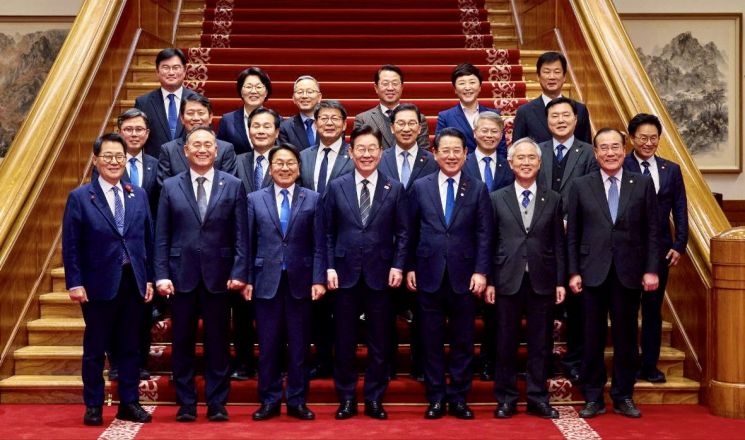 On the 9th, participants took a commemorative photo after discussions on the administrative integration of Gwangju and Jeonnam at the luncheon meeting presided over by President Lee Jae-myung held at the Blue House. Photo by Gwangju City
However, Professor Lee emphasized, "Nevertheless, I believe that the administrative integration of Gwangju and Jeonnam must be achieved during this opportunity, as it is both a survival strategy and a mandate for the region." He further stressed, "It is important to keep in mind that if the process is rushed like a race against time, unforeseen variables could cause the initiative to fail."
The debate was attended by 11 participants from academia, research institutes, civil society organizations, and the media. While there was agreement on the need for administrative integration, concerns were also raised about the manner in which it is being promoted. Participants pointed out that the current discussions have not been sufficiently explained to residents, and warned that bypassing procedural legitimacy in favor of speed could exacerbate conflicts. They also insisted that integration discussions should not remain mere political declarations, but must be preceded by citizen deliberation and the collection of public opinion.
Choi Youngtae, Professor Emeritus at Chonnam National University, said, "In principle, I am strongly in favor, but at least the minimum procedures are necessary." He argued, "If conflicts arise, issues of responsibility will follow, so a resident referendum is needed." The discussants also suggested that the special law should include a clear name for the integration, specific provisions for special cases, and a clear vision for regional development.
On this day, Lee Byunghoon, Chair of the Honam Development Special Committee, stated, "Integration is a matter of survival, and if not now, it will be difficult." He added, "What matters more than positions is the impact that integration will have on the region."
Min Hyungbae, a lawmaker from the Democratic Party of Korea, said, "If we overemphasize procedural legitimacy, integration may become difficult," and asserted, "Now is the time to accelerate the process."
Shin Jeonghoon, Chair of the National Assembly’s Public Administration and Security Committee, remarked, "The integration of Gwangju and Jeonnam is an issue we have been considering together for over 30 years." He added, "I will make sure that the National Assembly fulfills its role by making the most of this opportunity."
© The Asia Business Daily(www.asiae.co.kr). All rights reserved.
![Clutching a Stolen Dior Bag, Saying "I Hate Being Poor but Real"... The Grotesque Con of a "Human Knockoff" [Slate]](https://cwcontent.asiae.co.kr/asiaresize/183/2026021902243444107_1771435474.jpg)















