Only 99 New Monks Joined the Jogye Order Last Year
The "Hip Buddhism" trend has yet to translate into an increase in the number of people entering monastic life. This is a surprising development, given that Buddhism has recently become a new cultural code among younger generations.
On January 11, Yonhap News reported this information, citing data from the Jogye Order of Korean Buddhism, the largest Buddhist sect in Korea. Last year, a total of 99 people entered monastic life in the Jogye Order after completing novice training and receiving the samanera (75 men) or samaneri (24 women) precepts. This is an increase of 18 from 2024, but the number still did not surpass 100, remaining in double digits for the fifth consecutive year.
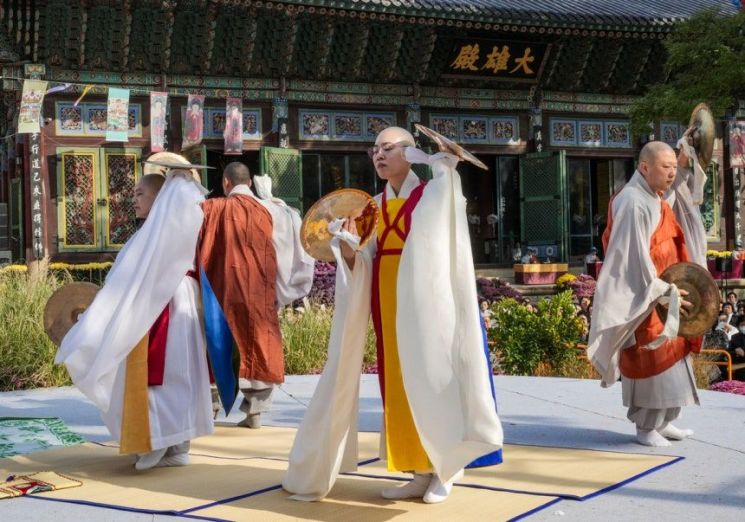 Last October, monks performed the Barachum dance at the Chrysanthemum Water and Land Ceremony for Chungyangjeol held at Jogyesa Temple in Seoul. Photo by Yonhap News
Samanera (male) and samaneri (female) refer to novice monks and nuns who have entered monastic life. After four years of training, they must receive full ordination to become fully ordained monks (bhikkhu) or nuns (bhikkhuni).
In 2005, the number of new monastics in the Jogye Order was 319, exceeding 300. However, by around 2010, this number had dropped to the 200s. After decreasing to 157 in 2016, the figure remained in the 100s from 2017 to 2020.
Since then, the number fell below 100 in 2021, reaching 99. It fluctuated below 100, with 61 in 2022, 84 in 2023, and 81 in 2024.
Other Buddhist sects are experiencing similar trends. For example, the Taego Order, which allows monastics to marry, is reported to have only about one-third the number of new monastics compared to 10 to 20 years ago.
The decline in Buddhist monastics is attributed to changes in the population structure, such as low birth rates and aging, as well as the popularization of scientific thinking and a general trend toward secularization.
In response, the Buddhist community is making efforts to increase the number of new monastics, as a decrease in monks and nuns could threaten the future of Buddhism. They are also expanding engagement with young people interested in Buddhism through events like Buddhist expos.
© The Asia Business Daily(www.asiae.co.kr). All rights reserved.
![Clutching a Stolen Dior Bag, Saying "I Hate Being Poor but Real"... The Grotesque Con of a "Human Knockoff" [Slate]](https://cwcontent.asiae.co.kr/asiaresize/183/2026021902243444107_1771435474.jpg)
















