580,668 Vehicles Produced Last Year, Surpassing 500,000 for Four Consecutive Years
Second-Highest Output on Record, Following 2023
The Gwangju automobile industry achieved strong results in both production and exports last year. The Gwangju City Government announced on January 11 that, despite the global economic slowdown and worsening trade conditions, export volumes reached an all-time high.
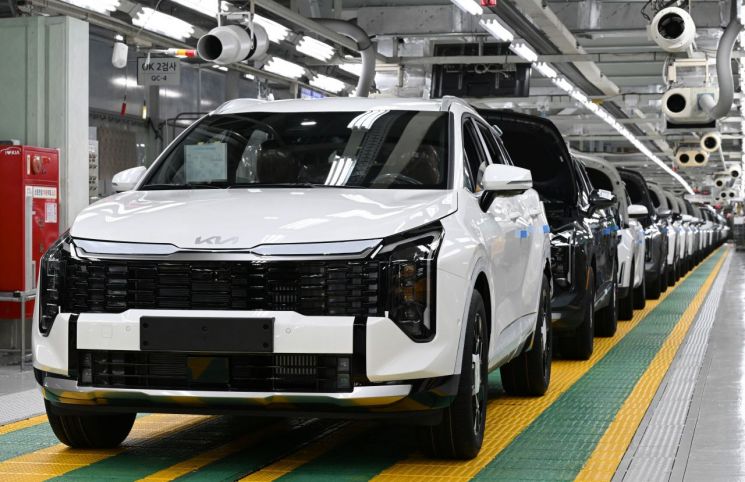 Vehicles produced at Kia Autoland Gwangju plant in Seo-gu, Gwangju are lined up on the production line. Photo by Gwangju City
According to the city, automobile production in the Gwangju region reached 580,668 units last year, marking the fourth consecutive year with production exceeding 500,000 units. This is the second-highest figure on record, following the all-time high of 586,100 units in 2023.
Annual production volumes were 522,479 units in 2022, 586,100 units in 2023, 566,811 units in 2024, and 580,668 units in 2025.
Export volumes also increased. Last year, automobile exports from the Gwangju region totaled 391,207 units. Despite challenges such as mutual tariffs in the U.S. automotive sector, the global economic slowdown, and weakened consumer sentiment, the region recorded its highest-ever export volume.
The city attributed these results to several factors: global demand for Kia's main models, the Sportage and Seltos; a production shift toward electric vehicles; and the stabilization of production processes at Gwangju Global Motors (GGM), a key component of the Gwangju-type job model.
The proportion of eco-friendly vehicle production in Gwangju also increased last year. Kia Autoland Gwangju expanded the share of hybrid and electric SUV models, while Gwangju Global Motors (GGM) increased production of electric vehicles such as the Casper Electric.
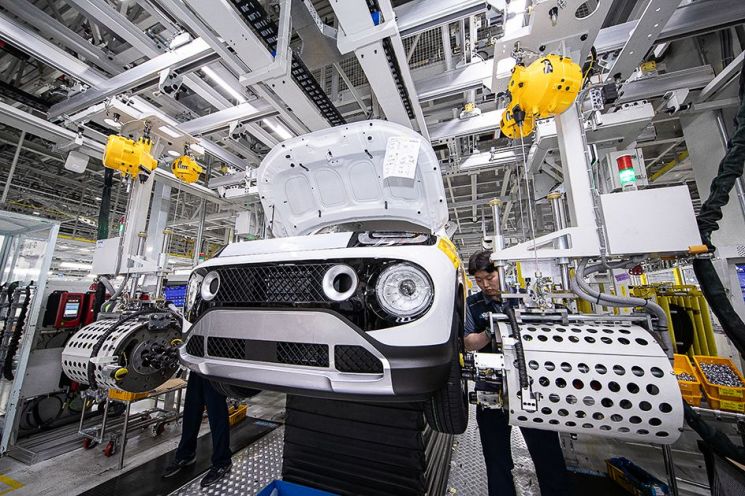 Casper vehicles are undergoing the assembly process at the Gwangju Global Motors (GGM) factory. Photo by Gwangju City
Building on these production and export achievements, Gwangju City plans to implement future mobility policies. To prepare for the transition to software-defined vehicles (SDVs), the city will support local parts suppliers in shifting their business focus and strengthen cooperation between automakers and parts manufacturers.
Son Dooyoung, Director of the Artificial Intelligence Industry Division at Gwangju City, stated, "The production of 580,000 vehicles last year is directly linked to the sustainability of local parts suppliers and employment. We aim to support the expansion of supply chains for core components of autonomous and next-generation vehicles, with the goal of reaching 600,000 vehicles in production."
© The Asia Business Daily(www.asiae.co.kr). All rights reserved.
![Clutching a Stolen Dior Bag, Saying "I Hate Being Poor but Real"... The Grotesque Con of a "Human Knockoff" [Slate]](https://cwcontent.asiae.co.kr/asiaresize/183/2026021902243444107_1771435474.jpg)
















