Similar Product Strategy Returns
Replication of Successful Formulas Repeats Once Again
Orion has launched a new pie product called 'Shall We,' featuring fresh cream, directly challenging Lotte Wellfood's flagship product 'Mon Cher.'
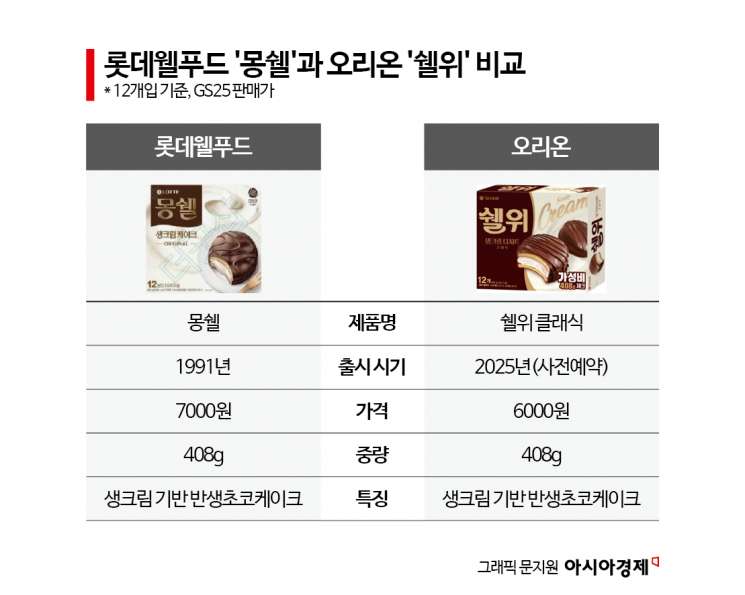
According to industry sources on January 13, Orion recently released its new chocolate pie-type product 'Shall We.' The key feature is the use of fresh cream instead of the traditional marshmallow found in chocolate pies. The product concept, packaging design, and even the name are reminiscent of Mon Cher, leading many to view it as a "me-too product" targeting consumers' experience with Mon Cher.
Shall We has the upper hand in terms of price competitiveness. A box of 12 Shall We pies is priced at 6,000 won, which is about 1,000 won cheaper than 12 Mon Cher pies (Mon Cher is sold at 3,500 won for 6 pieces at GS25). The emphasis on "value for money" on the front of the package is also interpreted as a typical catch-up strategy, offering a similar concept at a lower price.
This scene is not unfamiliar in the domestic confectionery industry. Whenever a particular product succeeds in the market, similar concept products are repeatedly launched-a trend that has persisted for a long time. From chocolate pies to pies, biscuits, and gum, the "replication of successful formulas" has become an industry practice.
This is rooted in the structural characteristics of the domestic confectionery market. The confectionery industry is a representative oligopoly market that requires large-scale production facilities, nationwide distribution networks, and stable cost management capabilities. The barriers to entry are high for new players to establish their own brands, and even existing companies face less risk by competing in areas where consumer awareness and demand have already been validated, rather than pioneering entirely new categories.
In fact, not only Orion and Lotte Wellfood but also major companies such as Haitai Confectionery and Crown Confectionery have competed by launching similar products centered around hit items. In this process, legal disputes over trademarks and packaging designs have been repeated. The chocolate pie packaging dispute in the 1980s, the "Fresh Berry" and "Hurabono" trademark lawsuit, and the 2005 design dispute between "Margaret" and "Maronie" are symbolic examples.
The similar product strategy has especially served as a way for latecomers to defend their performance. Entering a product category with already proven marketability lowers the probability of failure and can secure a relatively favorable position in negotiations with distribution channels. This is why the perception has spread among industry insiders that "it is better for profit management to have several variations of a successful format than to have one entirely new product."
The problem is that such competition has not led to overall market growth. As similar products increase, companies have focused on dividing the existing pie rather than creating new demand. Even as Mon Cher and its lookalikes proliferate, the premium pie market itself has not expanded rapidly; instead, the battle for market share among brands continues to repeat.
These structural limitations are also reflected in performance forecasts. According to market information provider FnGuide, Lotte Wellfood's annual sales consensus for 2025 is expected to reach 4.22 trillion won, up 4.3% from the previous year, but operating profit is projected to fall 9.9% to 141.5 billion won. Despite sales growth, profitability is actually declining. For the same period, Orion's sales are expected to rise 6.7% to 3.3111 trillion won, with operating profit increasing only 1.3% to 550.8 billion won. Analysts point to the burden of promotional and marketing costs, rising raw material prices, and sluggish consumption as factors restricting profitability recovery.
An industry official commented, "Competing with similar products can help fill sales gaps in the short term, but as price and promotional competition intensifies, it becomes harder to defend profit margins. If such competition continues in a market that is not growing, the potential for performance improvement will inevitably decrease."
© The Asia Business Daily(www.asiae.co.kr). All rights reserved.
![Clutching a Stolen Dior Bag, Saying "I Hate Being Poor but Real"... The Grotesque Con of a "Human Knockoff" [Slate]](https://cwcontent.asiae.co.kr/asiaresize/183/2026021902243444107_1771435474.jpg)















