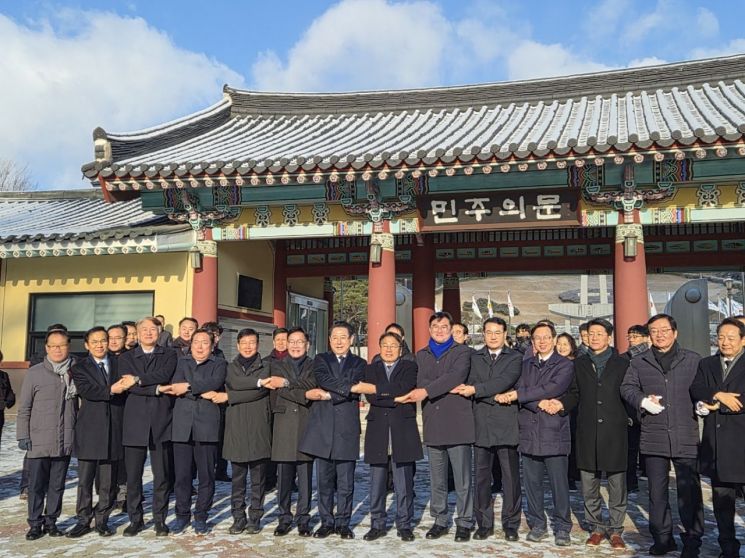
 On the morning of the 2nd, prominent figures from Gwangju and Jeonnam are holding hands and taking a commemorative photo in front of the Democracy Gate at the National May 18th Democratic Cemetery in Buk-gu, Gwangju. Photo by Song Bohyun
Civic groups in the Gwangju and Jeonnam regions have raised concerns about the "rush" to administrative integration, arguing that the deliberative process with citizens has been effectively excluded.
The Gwangju-Jeonnam YMCA Council issued a statement on the 9th, saying, "We agree on the need for discussions on cooperation and administrative integration at the metropolitan level amid population decline and the risk of regional extinction." However, the council argued, "The current approach is centered on political circles, with a speed-driven process that excludes citizen participation and deliberation."
The council emphasized, "Since administrative integration is a major issue that directly affects the lives and rights of 3.2 million residents of Gwangju and Jeonnam, sufficient information disclosure, public debate, and citizen deliberation must be prerequisites." The council also pointed out, "Integration pursued without direct democratic procedures, such as a residents' referendum, will struggle to secure legitimacy and sustainability."
The Gwangju Civic Organizations Council also released a statement, stressing, "Administrative integration must aim to resolve regional discrimination and substantially improve the lives of residents." The council called for responsible explanations and concrete measures from political leaders.
They warned, "Administrative integration without a fundamental strengthening of local autonomy, enhanced fiscal independence, and budget and policy support for regional development could instead intensify regional conflicts. A hasty integration driven solely by political interests will face resistance from residents."
They further added, "Rather than being fixated solely on the logic of economies of scale, a balanced development strategy must be presented, focusing on resolving educational and medical disparities, expanding social infrastructure, and creating quality jobs in regions that have been relatively neglected."
© The Asia Business Daily(www.asiae.co.kr). All rights reserved.
![Clutching a Stolen Dior Bag, Saying "I Hate Being Poor but Real"... The Grotesque Con of a "Human Knockoff" [Slate]](https://cwcontent.asiae.co.kr/asiaresize/183/2026021902243444107_1771435474.jpg)
















