Ministry of Food and Drug Safety to Designate Self-Treatment Medicines as 'Emergency Import Items' by 2030
Expansion of Domestic Production of Essential Medicines
Introduction of National Essential Medical Device System
Patients with rare and intractable diseases will now be able to receive rare medicines-previously difficult to purchase from overseas-directly from the government. The delivery period, which used to take one to two months, is expected to be reduced to just one day, significantly easing the financial burden on patients.
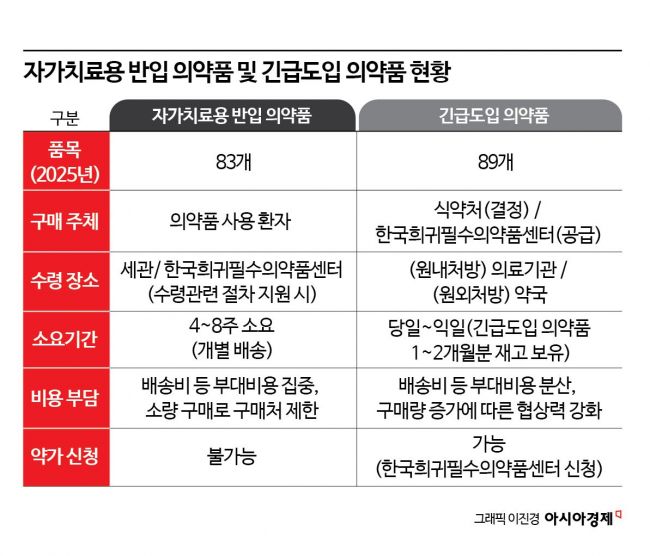
On January 8, the Ministry of Food and Drug Safety announced its major work plan for 2026, centered on "expanding patient access to treatment opportunities through stable supply of pharmaceuticals and medical devices."
First, a public supply system will be established for rare and essential medicines that have low domestic demand and are therefore not imported by pharmaceutical companies, to guarantee patients' right to treatment. Until now, patients had to purchase these medicines overseas for self-treatment, facing long delivery times of four to eight weeks and high shipping costs, among other inconveniences.
The Ministry of Food and Drug Safety will gradually convert these self-treatment rare and essential medicines into "emergency import" items to be supplied directly by the government. The plan is to convert at least 10 items each year, and by 2030, to convert more than 41 items-half of the current number of medicines imported for self-treatment.
If the government secures inventory in advance and supplies these medicines, patients will be able to receive their medication on the same day or the next day after receiving a prescription. The ministry also plans to expand insurance coverage for these medicines, aiming to significantly reduce the cost of medication, which patients currently bear entirely out-of-pocket.
Measures will also be implemented to increase the self-sufficiency rate of essential medicines that are highly dependent on imports. The government will promote a "national essential medicines contract manufacturing" project, in which domestic private pharmaceutical companies are commissioned to produce essential medicines and the government purchases the entire supply.
The number of contract-manufactured items, currently seven, will be increased to 17 by 2030. The "essential medicines public production and distribution network," established last year, will be expanded to include the medical and pharmaceutical sectors, strengthening the stable supply system for essential medicines that frequently face supply disruptions.
In the medical device sector, the government will establish procedures to urgently import products from overseas when domestic supply is expected to be discontinued due to the discontinuation of production by overseas manufacturers or lack of marketability. The government will directly import and supply rare and urgently needed medical devices required for the diagnosis and treatment of patients with rare and intractable diseases that are not distributed domestically. By conducting a preliminary review of the need for "designation of rare and emergency import," the government aims to shorten the process, which currently takes about nine weeks, and prevent any gaps in patient care.
Additionally, for cases where there are no domestic alternatives and patients must import self-treatment medical devices from overseas, the requirement to submit a medical certificate with each application will be improved. Patients will only need to submit the certificate once, and subsequent imports can be made with just an application, easing the administrative burden on patients.
Starting in November this year, the "National Essential Medicines Stable Supply Council" will be reorganized into a public-private governance body for supply discussions. The operation of the council, including agenda items and discussion methods, will be revised to more effectively respond to supply issues.
The Ministry of Food and Drug Safety also plans to introduce a legal definition for the "national essential medical device system" and establish inter-ministerial governance for systematic management. For seven key medical devices used in life-sustaining and emergency surgeries, the ministry will support the development of domestically produced products through collaboration with relevant ministries.
Oh Yu-kyung, Commissioner of the Ministry of Food and Drug Safety, stated, "We will continue to strengthen the supply system for rare and essential medicines and medical devices to ensure that patients have stable access to the pharmaceuticals and medical devices they need for diagnosis and treatment."
© The Asia Business Daily(www.asiae.co.kr). All rights reserved.
![Clutching a Stolen Dior Bag, Saying "I Hate Being Poor but Real"... The Grotesque Con of a "Human Knockoff" [Slate]](https://cwcontent.asiae.co.kr/asiaresize/183/2026021902243444107_1771435474.jpg)















