Taiwan Defense Ministry Think Tank Report
"Maduro's Capture Is a Serious Warning for Taiwan"
Rising Tensions... Unprecedented Threat from China
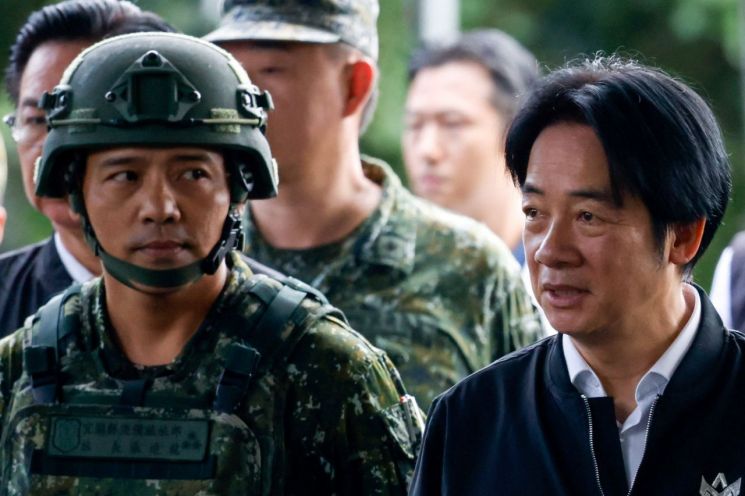 Taiwan President Tsai Ing-wen (right) inspects reservists during a military training exercise in Taiwan on December 2 last year. Photo by Reuters Yonhap News
At the beginning of the year, following the U.S. operation to capture Venezuelan President Nicolas Maduro, voices in Taiwan have called for a reestablishment of the country's security model. They argue that Taiwan should learn from the vulnerability of the traditional security model, which was the direct cause of the Maduro regime's collapse.
According to Taiwanese media outlets such as China Times on January 8, Cheng Minzhen, a policy analyst at the Institute for National Defense and Security Research (INDSR), a think tank under Taiwan's Ministry of National Defense, made this assessment in an international affairs report on the "U.S. operation to decapitate Venezuelan President Nicolas Maduro" released the previous day.
Analyst Cheng stated, "This year, the Maduro regime collapsed as a result of the U.S. 'Operation Absolute Resolve.' This was not simply due to external military pressure or accidental factors, but rather the combined result of the failure of multiple information systems, the collapse of internal defense lines, and institutional vulnerabilities."
He explained that Caracas, the capital of Venezuela, was paralyzed due to three major critical flaws: the fatal penetration of U.S. human intelligence (HUMINT), the lack of scientific and technological capabilities and vulnerabilities in all-domain intelligence, and weaknesses in communication and counterintelligence systems. As a result, the Venezuelan military was unable to mount an effective defense, reinforce troops, or carry out command and counterattacks.
Analyst Cheng emphasized that the capture of Maduro serves as a serious warning for Taiwan. The traditional security model, which focuses on conventional command and surface-level threats, is ill-equipped to respond to decapitation strikes and multifaceted surprise attacks.
He explained that future national security infrastructure must possess multi-layered resilience, decentralized decision-making, and integrated capabilities for all-domain information monitoring. He also argued that Taiwan should conduct regular live exercises to prepare for future decapitation operations or high-precision special operations.
Meanwhile, military tensions between Taiwan and China are escalating. Mas Yu-an, Deputy Minister of the Interior, stated during a government inquiry at the Legislative Yuan's Internal Affairs Committee the previous day, "Taiwan's national security is facing an unprecedented threat since 1949." He claimed that China is simultaneously engaging in military threats and cyber propaganda and attacks, and argued that China's actions are showing early signs similar to those seen during Russia's attack on Ukraine.
© The Asia Business Daily(www.asiae.co.kr). All rights reserved.
![Clutching a Stolen Dior Bag, Saying "I Hate Being Poor but Real"... The Grotesque Con of a "Human Knockoff" [Slate]](https://cwcontent.asiae.co.kr/asiaresize/183/2026021902243444107_1771435474.jpg)
















