At the New Year's Gathering, Diverging Views Between Medical Community and Government
Korean Medical Association: "Extraordinary Measures if No Policy Change"
Minister Jeong Eun-kyeong: "We Must Cross the River Together in the Same Boat"
The New Year's gathering of the medical community, attended by medical organizations, government officials, and politicians, turned into a forum for criticizing policies rather than one of unity and celebration. Some in the medical field and opposition parties voiced strong criticism of the recent physician workforce supply and demand projections, warning that they would take extraordinary measures if there were no policy changes. In contrast, the government acknowledged the medical community's concerns and encouraged collaboration to overcome current challenges.
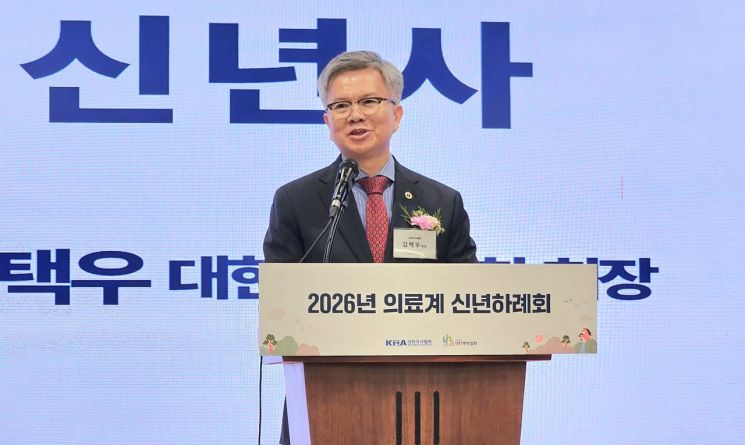 Kim Taekwoo, President of the Korean Medical Association, is delivering a New Year's address at the "2026 Medical Community New Year's Greeting Ceremony" held at the Korean Medical Association Hall in Yongsan-gu, Seoul, on the morning of the 8th. Korean Medical Association
The Korean Medical Association and the Korean Hospital Association held the "2026 Medical Community New Year's Greeting Ceremony" at the Korean Medical Association Hall in Yongsan-gu, Seoul, on January 8. While these gatherings are typically centered around well-wishes and New Year's greetings, this year's event was marked by sharp criticism of the recently announced physician workforce projections.
The medical community argued that workforce projections that ignore on-the-ground realities amount to bureaucratic decision-making and will ultimately lead to the collapse of the national health insurance finances. Kim Taekwoo, President of the Korean Medical Association, stated, "Because of the high degree of uncertainty in healthcare, other countries prepare for two years and announce results over six years, but in Korea, we are rushing to a conclusion in just five months." He added, "If the current projections are followed, health insurance expenditures will reach 240 trillion won by 2040 and 700 trillion won by 2060."
Kim Kyowoong, Chair of the Korean Medical Association's House of Delegates, also questioned the effectiveness of the policy. He said, "The government reduced the number of resident positions in Seoul to revitalize local areas, but in the first half of this year, the number of applicants for residency at Kyungpook National University Hospital dropped from 66 in 2023 to 45." He further explained, "Of the 21 fewer applicants, 18 were for internal medicine, surgery, obstetrics and gynecology, and pediatrics." He emphasized, "Especially in pediatrics, 57 first-year residents are needed nationwide, but only 13 applied this year. The key issue is not the number of positions but creating reasons for applicants to choose these specialties. If there is no policy change, we will take extraordinary measures."
Lee Sungkyu, President of the Korean Hospital Association, also stressed, "We need a mid- to long-term workforce supply and demand strategy that reflects regional and specialty-specific realities, not just vague nationwide projections." He also called for a fundamental redesign of the medical delivery system, which currently encourages endless competition, and demanded the resolution of legal risks and appropriate reimbursement as prerequisites for choosing essential medical fields.
Lee Jooyoung, a member of the Reform Party, cited the Geneva Declaration's reference to "freedom of conscience and honor," saying, "The more you try to grasp experts tightly, the more they will slip away like sand. It is the role of the government, policymakers, and the National Assembly to help medical professionals function well on their own." Seo Myungok, a member of the People Power Party, also stated, "I deeply empathize with the concerns of the medical community and will work to resolve the current issues."
In response to these criticisms, the government and some members of the ruling party emphasized the necessity of their policies and called for cooperation. Jeong Eun-kyung, Minister of Health and Welfare, said, "We are well aware of the wounds left by the conflict between the government and the medical community," but stressed, "Medical reform is urgent to address increased healthcare demand due to low birth rates and an aging population, as well as gaps in essential regional healthcare." She added, "We will promote the establishment of a special account for essential regional healthcare, introduce a regional physician system, and build a safety net for medical accidents. We will fully consult with the medical community based on sincerity and trust." Minister Jeong also mentioned the idiom "Dongjugongje," meaning "crossing the river together in the same boat," and emphasized, "We must work together to overcome difficulties."
Kim Yoon, a member of the Democratic Party of Korea, also commented on the Physician Workforce Supply and Demand Projection Committee, saying, "This body was created through social consensus to avoid repeating the failures of unilateral policy decisions by previous governments. I hope you will respect the results produced by the committee and develop feasible and agreeable proposals."
© The Asia Business Daily(www.asiae.co.kr). All rights reserved.
![Clutching a Stolen Dior Bag, Saying "I Hate Being Poor but Real"... The Grotesque Con of a "Human Knockoff" [Slate]](https://cwcontent.asiae.co.kr/asiaresize/183/2026021902243444107_1771435474.jpg)
















