Bank of Korea Releases "2025 Q3 Flow of Funds (Provisional)"
In the third quarter of last year, the amount of surplus funds held by Korean households increased to 58 trillion won. This was the result of household income growth outpacing the increase in expenditures, driven by the strong stock market, among other factors. Analysts also noted that the rise in transfer income for households, due to the government's distribution of consumption coupons, played a role. Government regulations in response to the sharp rise in housing prices reduced the scale of household financing, such as mortgage loans. As a result, the ratio of household financial assets to liabilities reached an all-time high of 2.47 times.
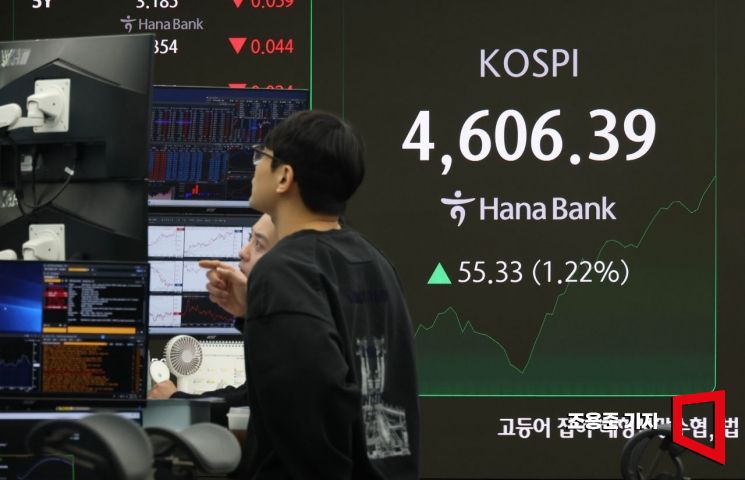 On the 8th, the status board in the dealing room at the Hana Bank headquarters in Jung-gu, Seoul, displayed the KOSPI and the won-dollar exchange rate.
Net Purchases of Investment Funds, Including ETFs, by Households Reach Record High Since Compilation of Statistics
According to the "2025 Q3 Flow of Funds (Provisional)" report released by the Bank of Korea on January 8, the net fund operation of households and nonprofit organizations in the third quarter of last year amounted to 58 trillion won. This is an increase of 6.7 trillion won from the previous quarter's 51.3 trillion won. Net fund operation is calculated by subtracting the amount of financial liabilities (fund procurement) from the amount of financial asset transactions (fund operation) for each economic entity.
Kim Yonghyun, head of the Flow of Funds Team at the Economic Statistics Department of the Bank of Korea, explained that the increase in household surplus funds was due to "an expansion in net fund operation compared to the previous quarter, as income growth outpaced expenditures." According to the National Data Office, household income in the third quarter of last year rose by 7.4% compared to the previous quarter, while household expenditures grew by only 3.2%. The household surplus increased by 20.9% from the previous quarter.
Excluding fund procurement, the fund operation of households and nonprofit organizations in the third quarter of last year stood at 78.8 trillion won, a slight increase from the previous quarter's 76.9 trillion won. The increase was mainly driven by deposits at financial institutions (42.1 trillion won). Notably, households recorded net stock sales of 11.9 trillion won, the highest since the compilation of statistics. During the same period, net purchases of investment funds, including domestically issued Exchange-Traded Funds (ETFs), reached a record high of 23.9 trillion won. Fund procurement during the same period was 20.7 trillion won, down from the previous quarter's 25.6 trillion won, as household borrowing from financial institutions, such as mortgage and credit loans, decreased.
Consequently, at the end of the third quarter of last year, the ratio of household debt to nominal GDP stood at 89.3%, down 0.4 percentage points from 89.7% at the end of the previous quarter. This is the lowest level since the end of the third quarter of 2019, when it was 88.3%, before the COVID-19 pandemic. Kim attributed the decline in the household debt ratio to "the government's June 27 policy measures and the implementation of the third stage of the stress-based Debt Service Ratio (DSR), which strengthened regulations on household lending and led to a decrease in credit loans outside of mortgage loans."
 A promotional flyer for jeonse loan guidance is posted at a commercial bank in downtown Seoul. Photo by Yonhap News Agency
Household Financial Asset-to-Liability Ratio Hits Record 2.47 Times: "Improvement in Soundness Expected to Continue"
The net fund procurement of non-financial corporations (general businesses) grew by 16 trillion won to 19.5 trillion won, compared to 3.5 trillion won in the previous quarter. The increase was attributed to greater demand for funds due to expanded investment, such as facility investment.
The government shifted to a net operation position. In the third quarter of last year, the net fund operation of the general government was 5.9 trillion won. With income surpassing expenditures, the government moved from a net fund procurement of 2.7 trillion won in the previous quarter to a net operation. The government debt ratio in the third quarter of last year was 47.7% of GDP, down 0.1 percentage points from the previous quarter.
The net fund procurement of the overseas sector was 46.3 trillion won, up from 41.5 trillion won in the previous quarter, as the current account surplus expanded. An increase in fund operation by the overseas sector indicates a rise in Korea's external debt, while an increase in fund procurement indicates a rise in Korea's external assets.
As of the end of the third quarter of last year, the financial assets of households and nonprofit organizations stood at 5,980.4 trillion won, up 183 trillion won from the previous quarter. Financial liabilities increased by 15.8 trillion won to 2,420.8 trillion won. Net financial assets, calculated by subtracting financial liabilities from financial assets, amounted to 3,559.6 trillion won, an increase of 167.1 trillion won from the previous quarter. Kim explained that "this was due to an increase in balances of equity securities and investment funds, driven by the rise in the KOSPI index and the strong stock market. As a result, the financial asset-to-liability ratio, which measures assets relative to financial liabilities, also reached a record high of 2.47 times. Kim stated, "With the stock market continuing its strong performance in the fourth quarter of last year, the upward trend in the financial asset-to-liability ratio, which serves as an indicator of improvement in household sector soundness, is expected to continue."
Meanwhile, the Bank of Korea has developed and newly released a detailed flow of funds table. This new statistic adds information on issuance and holdings by financial product to the existing flow of funds table. Kim explained, "Following the global financial crisis, it has become increasingly important to track the transmission channels of financial risk, which led us to develop the detailed flow of funds table to illustrate the interconnections between economic entities and financial institutions. We plan to publish annual statistics based on data from two years prior, alongside the provisional third quarter flow of funds announcement at the beginning of each January."
At the end of 2024, the scale of interconnections between economic sectors reached 16,706.9 trillion won, an increase of 928 trillion won from 15,778.9 trillion won at the end of the previous year. The interconnection ratios between economic sectors were highest between banks and households (13.9%), followed by banks and corporations (12.1%), insurance and pension funds and households (10.2%), and non-bank financial institutions and households (9.4%). The increase in the interconnection ratio between banks and corporations was due to a significant rise in corporate bank deposits as investment slowed amid growing domestic and international uncertainties. The decline in the interconnection ratio between non-bank financial institutions and households resulted from a decrease in non-bank household loans, as demand for mortgage loans weakened due to reduced housing transactions and the DSR loan regulations led to the repayment of other short-term loans.
At the end of 2024, the scale of interconnections between financial institutions reached 3,477.5 trillion won, up 285.6 trillion won from the end of the previous year.
© The Asia Business Daily(www.asiae.co.kr). All rights reserved.
![Clutching a Stolen Dior Bag, Saying "I Hate Being Poor but Real"... The Grotesque Con of a "Human Knockoff" [Slate]](https://cwcontent.asiae.co.kr/asiaresize/183/2026021902243444107_1771435474.jpg)

















