Full-scale Restoration of South Korea-China Relations Through Summit Talks
Sensitive Issues Discussed: "Hanhanling," West Sea Structures, and Anti-China/Anti-Korea Sentiments
Easing of "Hanhanling": "To Be Resolved Gradually and in an Orderly Manner"
Efforts to Address Anti-China/Anti-Korea Sentiments: "Baseless and Unnecessary Anti-China Agitation Must Be Eliminated"
Maritime Boundary Delimitation in the West Sea Remains Unresolved
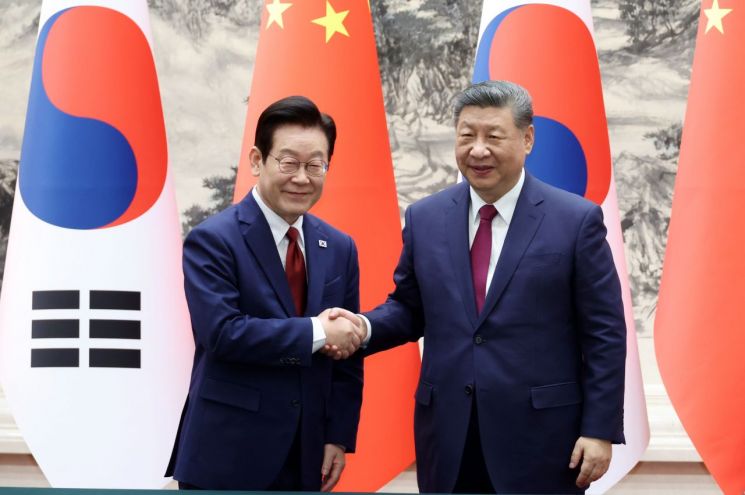
Amid ongoing concerns over a range of sensitive issues-including the so-called "Hanhanling" (the restriction on Korean cultural content), disputes over maritime structures in the West Sea, and persistent anti-China and anti-Korea sentiments-the relationship between South Korea and China has once again made progress, prompted by the second summit between the two nations' leaders. President Lee Jaemyung, reflecting on the outcomes of his state visit to China from January 4 to 7, remarked, "There has been more progress than expected." President Lee plans to share the achievements of this visit with his advisors at the Blue House and to seek more concrete, step-by-step, and gradual solutions.

The most notable aspect is that, compared to the first summit held during the Asia-Pacific Economic Cooperation (APEC) meeting in Gyeongju in November 2025, President Xi Jinping of China responded more proactively to sensitive issues. This is seen as laying the groundwork for a comprehensive restoration of bilateral relations, which had deteriorated due to China's retaliatory measures over the deployment of the Terminal High Altitude Area Defense (THAAD) system by US forces in Korea and former President Yoon Suk-yeol's anti-China remarks.
Indeed, on the final day of his visit, during a surprise luncheon with the accompanying press corps in Shanghai, President Lee commented on the "Hanhanling," saying, "Although the Chinese government has always claimed that there is no such restriction, this time, the language they used was different." He added, "It will be resolved gradually and in an orderly manner." President Lee also shared President Xi's metaphor that "three feet of ice does not form in a single day, so it will not all melt at once; fruit falls when it ripens," and explained, "(President Xi) instructed the relevant departments to engage in concrete discussions, so actual consultations are expected to take place."
Both leaders also agreed that continuous efforts are needed to address and resolve anti-China and anti-Korea sentiments. President Lee, noting that South Korea's trade balance with China (excluding Hong Kong) has turned to a deficit, stated, "South Korea has suffered greater harm from anti-China and anti-Korea sentiment," emphasizing, "We must eliminate baseless and unnecessary anti-China agitation." As part of these efforts, President Lee proposed that the two leaders meet at least once a year, to which President Xi responded, "That's a good idea." For the first time in nine years since 2017, South Korea and China held a business forum, and the two governments signed 14 memoranda of understanding (MOUs) between ministries and agencies, as well as a "Certificate of Donation for a Pair of Qing Dynasty Stone Lions." At the forum, President Lee highlighted President Xi's comment that "South Korea and China are inseparable," stressing, "Let us build a mutually beneficial and friendly relationship as close neighbors, especially in economic terms."
To build on the achievements of this visit, the South Korean government plans to institutionalize regular high-level working-level talks with China and to elevate the level of dialogue in the military sector. Minister of Trade, Industry and Energy Kim Jeonggwan and Chinese Minister of Commerce Wang Wentao agreed through the "Commercial Cooperation Dialogue MOU" to establish a ministerial-level regular consultative body, with both sides visiting each other at least once a year.
Meanwhile, President Lee also reported that, regarding the issue of maritime structures in the West Sea, the Chinese side expressed its intention to withdraw some facilities, including management facilities. The issue of maritime boundary delimitation in the West Sea has been a thorny problem between the two countries for 30 years. Since both countries joined the United Nations Convention on the Law of the Sea (UNCLOS) in 1996, they have held both formal and informal negotiations, but have yet to reach a conclusion, resulting in the establishment of a vague "Provisional Measures Zone (PMZ)" as a shared area. Yang Heecheol, Director of the Center for Ocean Law and Policy at the Korea Institute of Ocean Science and Technology, commented, "Even if China accepts the median line approach, the two countries may still have different interpretations of the median line, and their calculations are complex, making it a difficult issue to resolve."
Nevertheless, the agreement reached during this summit to upgrade the level of maritime boundary negotiations from director-general to vice-ministerial level is seen as progress. An official from the Ministry of Foreign Affairs stated, "We are negotiating based on the principles established by the United Nations Convention on the Law of the Sea and relevant international precedents."
© The Asia Business Daily(www.asiae.co.kr). All rights reserved.
![Clutching a Stolen Dior Bag, Saying "I Hate Being Poor but Real"... The Grotesque Con of a "Human Knockoff" [Slate]](https://cwcontent.asiae.co.kr/asiaresize/183/2026021902243444107_1771435474.jpg)

















