Potato Prices Surge 39% in One Year
Production Drop and Declining Quality Drive Increase
"Prices Expected to Stabilize from May When Open-Field Spring Potatoes Ship"
"There were only two pieces of potato in the Gamjatang."
Recently, an online user posted a review of a Gamjatang restaurant, saying, "I wanted some hot soup, so I went to a Gamjatang restaurant, but the amount of potato was less than a single potato, which was disappointing." The reviewer added, "I was expecting to enjoy cooked potatoes soaked in the broth, but there wasn't enough, so I was let down." They continued, "It would have been better to order Pork Backbone Stew instead."
As potato prices have soared by nearly 40% over the past year, the prices of food ingredients in general have continued to rise sharply since the start of the new year. As a result, even restaurants are reducing potato side dishes, and changes are being observed in dining-out menus. With both the cultivation area and production volume of potatoes having dropped significantly, it is expected that the strong price trend will continue until open-field spring potatoes are shipped in May.
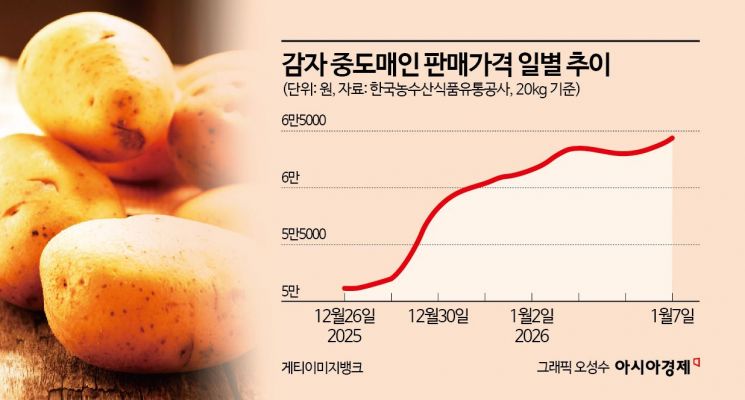
According to the Korea Agro-Fisheries & Food Trade Corporation’s (aT) Agricultural Products Price Information (KAMIS), as of January 7, the wholesale price of potatoes was 64,300 won per 20 kilograms, up 39.37% from the previous year's 46,135 won. Compared to the previous month (48,426 won), the price rose by 32.78%.
The main cause of the sharp price increase is a reduction in supply. As prices of other crops such as carrots and radishes rose, farmers opted to cultivate those instead of potatoes. Additionally, in some regions like Jeju, heavy rainfall immediately after planting led to poor growth and reduced production, which also contributed to the decrease in supply.
The cultivation area and production volume for autumn potatoes dropped significantly. According to the Korea Rural Economic Institute’s recent publication, "Potato, December 2025 Edition," the cultivation area for autumn potatoes last year was 948 hectares, a 56.3% decrease from the previous year. Due to the reduction in cultivation area, production volume was around 13,000 tons, down 53.0% from the previous year and 52.3% from the average year. As a result, the shipment volume also dropped by 9.0% compared to the previous year, significantly reducing the supply in the market. This has been analyzed as a factor driving up potato prices.
In addition, the quality of highland potatoes declined due to abnormal weather conditions. Last summer, the main potato-producing region of Gangwon experienced severe drought and high temperatures, causing highland potato production to fall to its lowest level in eight years, with quality also deteriorating. According to the National Data Office, last year’s highland potato production was 114,307 tons, a 9.5% decrease from the previous year’s 126,339 tons. This is the lowest level since 2018 (91,811 tons) in seven years. The combination of reduced production and lower quality has contributed to upward pressure on potato prices.
Potato prices are expected to remain high until open-field spring potatoes are shipped in earnest. Choi Junhyeok of the Korea Rural Economic Institute explained, "At this time of year, potato shipments are low, so prices usually rise. However, last year’s total potato production dropped significantly, causing the price increase to be larger than in other years."
He added, "From January to March, before open-field spring potatoes are shipped, prices are likely to remain higher than last year. Once open-field spring potatoes start shipping in May, the increased supply should improve conditions and stabilize prices." However, he also noted, "The actual increase in supply will depend on crop conditions, so we need to monitor the situation closely."
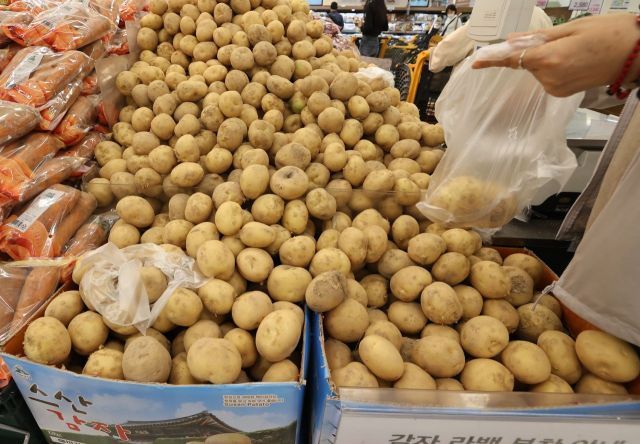 Potato display at a major supermarket in Seoul. Photo is unrelated to the specific content of the article. Photo by Yonhap News Agency
There are also warnings that abnormal climate events such as heatwaves and heavy rains could drive up food ingredient prices and significantly raise consumer prices for an extended period. Vegetable prices are already rising steeply due to cold snaps and abnormal weather. As of January 7, the retail price of green leaf lettuce was 1,405 won per 100 grams, up 25.45% from the previous year’s 1,120 won. Perilla leaves (3,447 won per 100 grams) increased 16.21% year-on-year, and young napa cabbage (4,428 won per kilogram) rose 39.68% from the previous year.
According to the Bank of Korea’s report, "The Impact of Extreme Weather Events on Inflation," published in September last year, a 1-degree Celsius temperature shock during extreme heat raises prices by 0.11 percentage points annually. The Bank of Korea added, "Given that extreme weather events are becoming routine, it is necessary to strengthen research on their impacts on the real and financial economy and monetary policy operations over the mid- to long-term, and to develop appropriate policy responses."
© The Asia Business Daily(www.asiae.co.kr). All rights reserved.
![Clutching a Stolen Dior Bag, Saying "I Hate Being Poor but Real"... The Grotesque Con of a "Human Knockoff" [Slate]](https://cwcontent.asiae.co.kr/asiaresize/183/2026021902243444107_1771435474.jpg)

















