Signs of Recovering Demand for Non-Chinese Products
Amid Restructuring of the Global Solar Supply Chain
Exports of Korean-made solar cells, which had been on a downward trend, have successfully rebounded. As the U.S. government moves to strengthen regulations on Chinese solar products and the restructuring of global supply chains accelerates, domestic solar companies are now seen as having an opportunity to expand into the North American market.
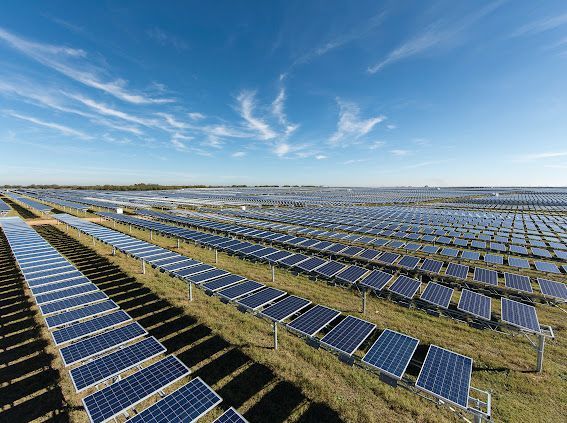 Aerial view of the Alamo1 solar project in Bear County, San Antonio, Texas, operated by OCI Energy, a subsidiary of OCI Holdings. The Asia Business Daily DB
According to the Korea International Trade Association on January 8, exports of photovoltaic cells (solar cells) reached $112.932 million (approximately 163.48 billion KRW) in November of last year. This figure is about three times higher than the $35.223 million recorded during the same period the previous year. After a sharp decline in the first half of last year, export performance began to recover in November, following $25.092 million in October.
The solar industry views this as a sign of recovering demand for non-Chinese products due to the restructuring of the global solar supply chain. An industry official explained, "Exports of wafers and polysilicon are returning to normal, creating a rebound across the sector," adding, "As supply chains excluding China are being established in earnest, materials and cells from non-Chinese companies are starting to flow back into the U.S. market."
Win-win synergy among domestic companies is also anticipated. Hanwha Qcells, which signed a 10-year, 1.4 trillion KRW polysilicon supply contract with OCI Holdings in 2022, is set to complete its Solar Hub plant in Cartersville, U.S., within this year. The industry expects that once the plant is fully operational, more than double the current supply volume will be needed, forecasting joint growth throughout the Korean solar value chain, from materials to finished products.
DB Financial Investment stated, "OCI Terrasus's polysilicon sales volume is expected to surge from 19,000 tons last year to 31,000 tons this year," adding, "Given its production capacity of 35,000 tons, the company will operate at nearly 90% of capacity, which should further improve cost efficiency."
The inflection point is expected to be the results of the U.S. Section 232 investigation under the Trade Expansion Act, scheduled to be announced around February. The U.S. Department of Commerce launched a Section 232 investigation in April last year, citing national security concerns, targeting semiconductors and semiconductor manufacturing equipment. This investigation also includes polysilicon wafers for solar power. According to the industry, the investigation is effectively aimed at China, targeting unfair trade practices and state-led overproduction. Once the results are announced, demand for non-Chinese solar materials in the U.S. is expected to increase even further.
© The Asia Business Daily(www.asiae.co.kr). All rights reserved.
![Clutching a Stolen Dior Bag, Saying "I Hate Being Poor but Real"... The Grotesque Con of a "Human Knockoff" [Slate]](https://cwcontent.asiae.co.kr/asiaresize/183/2026021902243444107_1771435474.jpg)
















