Ministry of Trade Holds Roundtable with Local Companies in Shanghai
SM, CJ CGV, Nongshim, Amorepacific and Other Firms Gather in China
Entertainment, Gaming, Food, and Beauty Companies Voice Their Challenges
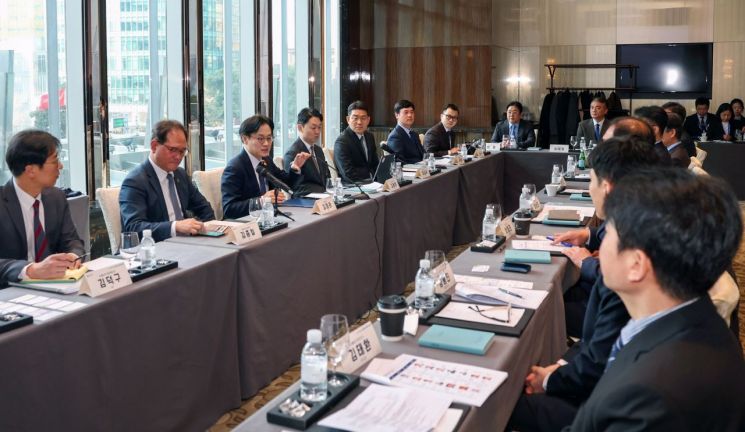
While trade between South Korea and China, which once exceeded 300 billion dollars, has remained stagnant for several years, the government has begun a renewed push to re-enter the Chinese market, focusing on consumer goods and content that have been blocked since the "Korean Wave Ban."
On January 7, Minister of Trade, Industry and Energy Kim Jeonggwan convened local entertainment, gaming, food, and beauty companies in Shanghai, coinciding with President Lee Jaemyung's visit, to closely examine regulatory and certification barriers as well as challenges in entering the service market.
The roundtable was attended by 14 leading South Korean companies in consumer goods and content sectors operating in China, including SM Entertainment, CJ CGV, Wemade, E-Land, Korea Ginseng Corporation, DIO, Nongshim, Sempio Foods, Daesang, Emart, Cosmax, Cosmecca Korea, Amorepacific, and LG Household & Health Care. Supporting organizations included KOTRA, Korea Trade Insurance Corporation, and KTR.
According to the Ministry of Trade, Industry and Energy, the scale of trade between South Korea and China surpassed 300 billion dollars in 2021, reaching 301.5 billion dollars and further expanding to 310.4 billion dollars in 2022. However, it decreased to 267.7 billion dollars in 2023, and remained at 272.9 billion dollars in 2024, indicating a recent stagnation. As of November 2025, the trade volume stood at 246.1 billion dollars, with no clear signs of a rebound yet.
The government has identified the limitations of the trade structure, which is centered on semiconductors and intermediate goods, as well as institutional barriers in the content and service sectors, as key reasons for the stagnation. In particular, companies on the ground commonly pointed out that the so-called "Korean Wave Ban," which intensified after the THAAD incident, still has not been fully resolved in the cultural and entertainment sectors.
Companies participating in the roundtable acknowledged that while the competitiveness of global brands and local Chinese companies has significantly strengthened in the Chinese market, there remains substantial preference and demand for K-content and South Korean consumer goods. However, they emphasized that in order to translate this into tangible export and investment results, it is necessary to expand exchanges between South Korean and Chinese companies, strengthen cooperation on regulations and certifications in the cultural, content, and service sectors, and establish institutional foundations to restore the service market, which has contracted since the Korean Wave Ban.
Minister Kim stated, "Relevant agencies and ministries will work together to build a support system and improve the institutional foundation for the service industry," adding, "We will utilize communication channels between central and local governments in both countries to address corporate challenges and ensure that companies' efforts lead to tangible results."
© The Asia Business Daily(www.asiae.co.kr). All rights reserved.

















